
Self-paced, first module free
Five Short Stories: Five Forms, Five Finished Stories
A self-paced course for writers who want range before they take on a book. Short lessons on five forms of the short story, and for each one you plan a story and then write it to the end: a flash story, a story with a twist that plays fair, a two-hander, a story told in letters, and a literary story with an ending that lands.
- 10 modules
- 42 short lessons
- Two to four months, one story at a time
Every lesson opens without an account. Log in if you have an account.
Every lesson is free to read. The first module’s step is free; the later steps are on the Writer plan.
The modules
A story in a moment
What a short story is, what flash fiction can do in a few hundred words, and how to tell whether an idea fits the form. You plan a flash story around one moment under pressure.
Writing the flash story
Arriving late and leaving early, the one detail that stands for many, and cutting until every word works. You write your flash story, complete, in under a thousand words.
Plan: Step 2: Write your flash story · Writer plan
A twist that plays fair
Plants a reader passes over, surprise set against suspense, irony that turns an outcome, and the order in which the truth comes out. You plan a twist from the end backwards: the truth, the false picture and the clues that fit both.
- Setup and foreshadowing
- Suspense versus surprise
- Information control
- Twist endings that play fair
- Verbal and situational irony
Plan: Step 3: Plan a twist · Writer plan
Writing the twist story
Starting near the change, scenes that cause each other, and narrators who see less than they say. You write your twist story and reread it as someone who knows the truth.
Plan: Step 4: Write your twist story · Writer plan
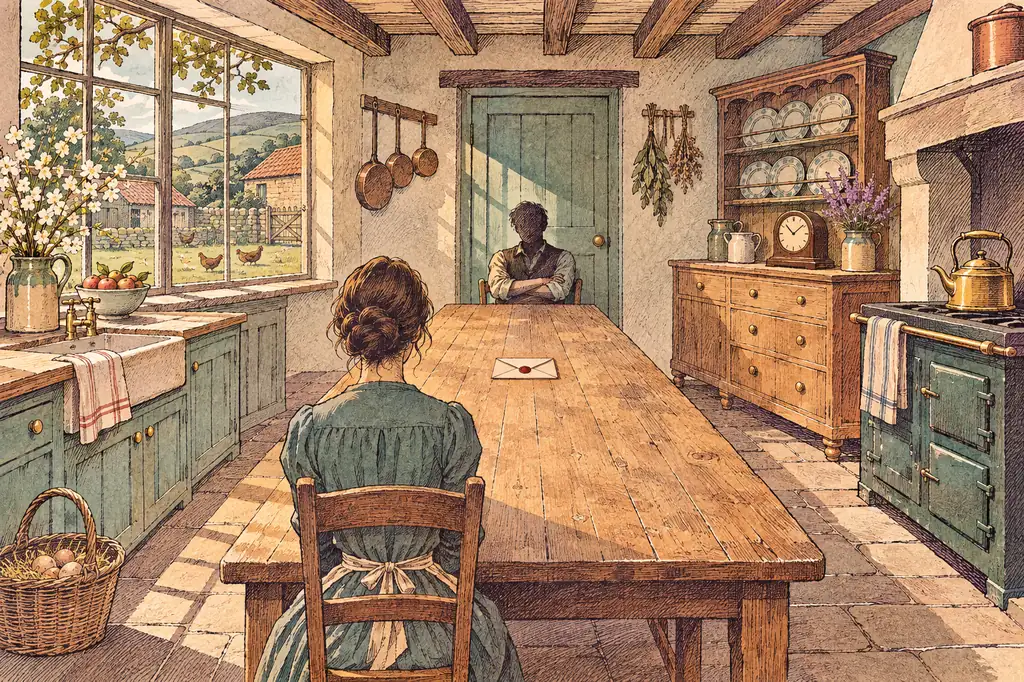
Two people, one room
Two wants that pull against each other, an opponent with a case of their own, and power that changes hands. You plan a two-hander: who, where, what lies between them and how the upper hand moves.
Plan: Step 5: Plan a two-hander · Writer plan
Writing the two-hander
What goes unsaid, questions left unanswered, two voices you can tell apart, and a room the reader can see. You write your two-hander, ending on the shift that cannot be taken back.
Plan: Step 6: Write your two-hander · Writer plan
A story in letters
Documents with a writer, a reader and a reason, time that passes between them, and what the reader knows that a character does not. You plan your story document by document and gap by gap.
Plan: Step 7: Plan a story in letters · Writer plan
Writing the story in letters
Word choice that tells you who is writing, lines that mean more than they say, and a first person that sounds like one particular person, or a “we” that speaks for many. You write your story in letters, notes or entries.
- Diction and register
- Saying one thing, meaning another
- Person: first, second, third
- Fourth person: the collective voice
Plan: Step 8: Write your story in letters · Writer plan
The literary story and its ending
A small event with an exact inner change, a theme held as a question, feeling that is earned, and an ending that shows the change and stops. You plan a literary story from its ending back.
Plan: Step 9: Plan a literary story · Writer plan
Writing the literary story
Thought in the character’s own words, trusting the reader, reading your work as a reader would, and sharing a story when it is ready. You write your literary story and choose which of the five to show someone first.
Plan: Step 10: Write your literary story · Writer plan


Questions
- Is it free?
- Every lesson is free to read, with or without an account. The first module, including its writing step, is free too. The writing steps in the later modules are on the Writer plan or above.
- How long does it take?
- Two to four months, one story at a time, at your own pace. There are 10 modules and 42 short lessons, and each module ends with one step of your own writing. There are no deadlines.
- Where do I write it?
- Here in the Practice Room: each step has its own page, and what you write is kept with your account.
- What do I finish with?
- Five finished short stories in five forms: a flash story, a twist ending that plays fair, a two-hander, a story told in letters and a literary story, with the plan you made for each.
- Is there a certificate?
- Yes: a certificate of completion. When you finish, you get a private portfolio of what you wrote and the skills you reached, and you can share it with a link and a PDF certificate. It records that you finished the course; it is not an accredited qualification. The main thing you finish with is still the draft.