Everything you organize in Scrivener, checked for you automatically.
Scrivener is a filing cabinet with a typewriter inside. BlurbBio is a manuscript editor with a brain: your characters, canon, and continuity are detected from the text itself and audited as you write, in any browser, with no compile step between you and a print-ready file.
Free to start. 7-day money-back guarantee on paid plans.
Scrivener has been the default serious-writer tool for two decades, and its binder is still a fine way to organize a big project. But everything in Scrivener is inert. The character sheets do not know what your chapters say. The research folder cannot warn you that chapter 19 contradicts chapter 4. Keeping your notes true to your manuscript is manual labor, and the Compile step remains famously hostile.
BlurbBio keeps the part of Scrivener that works, structured chapters and a distraction-free editor, and replaces the inert parts with active ones. The Story Bible builds itself from your prose. Conflict detection audits new chapters against established canon. Eleven analysis types examine plot logic, pacing, dialogue, and character consistency. And export produces print-ready PDF, DOCX, and EPUB without a compile screen in sight.
From Scrivener project to checked manuscript
Import your compile
Export your Scrivener project to DOCX and import it. Chapter detection runs automatically, your structure carries over, and you keep writing in a familiar chapter-based editor in any browser.
Your binder becomes a living bible
Instead of blank character sheets you fill in, the Story Bible scanner extracts characters, locations, items, and relationships from the manuscript itself and keeps them current as chapters change.
Analysis Scrivener cannot do
Conflict detection audits new scenes against established canon, and eleven analysis types cover plot holes, pacing, dialogue authenticity, and character consistency across the full manuscript.
BlurbBio vs Scrivener at a glance
Competitor details referenced from public websites and published pricing pages as of June 2026. Features and prices change. Always check the other product’s site for current information.
The revision list your binder cannot write
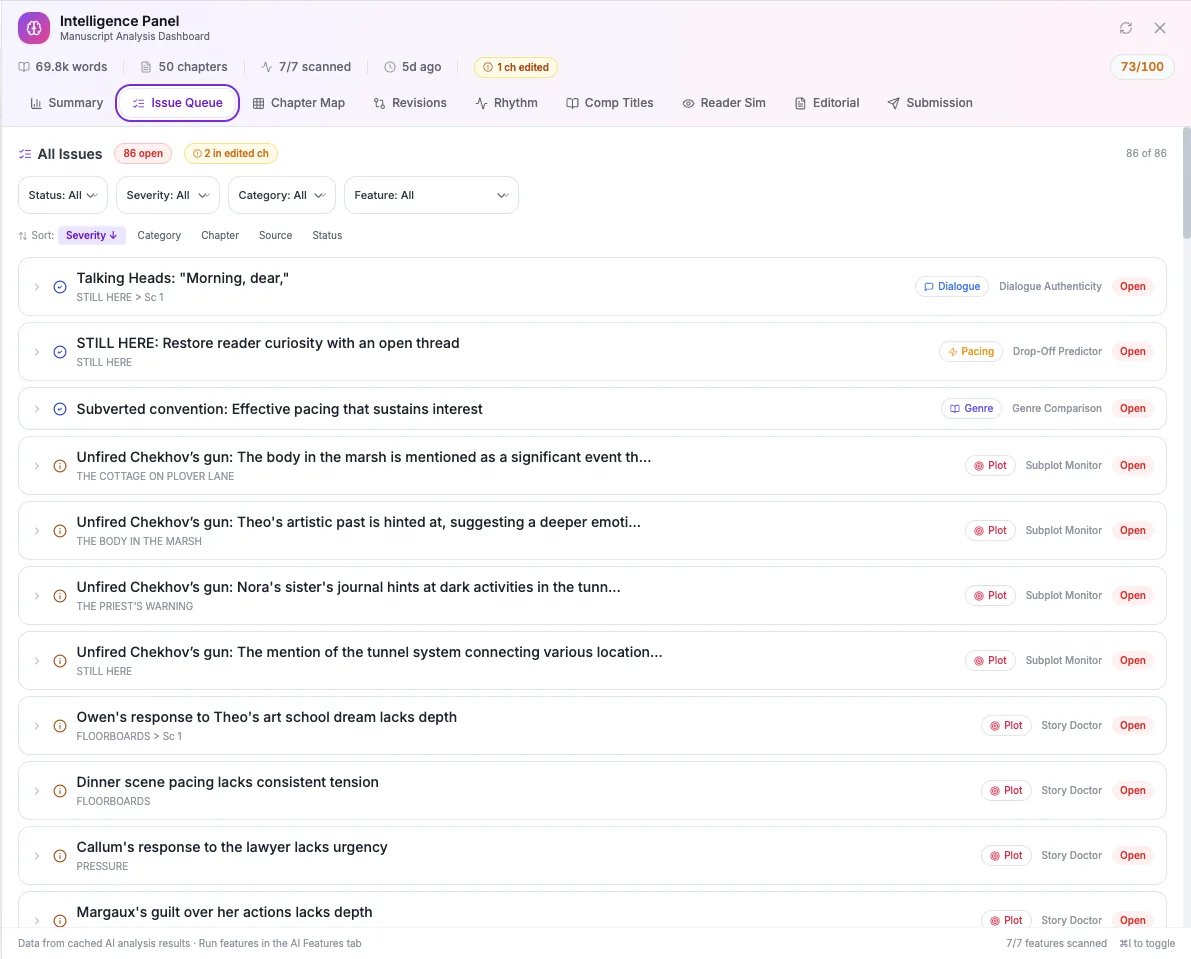
The real Issue Queue on a 69,800-word manuscript: 86 findings from five analysis features, filterable by severity, category, and chapter, each linked to the scene it came from.
Static notes vs a living Story Bible
The scale of the problem is what makes it unsolvable by hand. A 100,000-word novel establishes hundreds of checkable facts: physical descriptions, dates, distances, who was present in which scene, what each character knows and when they learned it. Holding those in working memory while drafting new material is beyond anyone, which is why continuity errors survive multiple read-throughs by careful authors. The fix is not more discipline. It is a system that reads the whole book every time.
Scrivener’s character templates are blank documents. They contain what you remember to type, and they silently rot as the manuscript evolves. BlurbBio’s Story Bible is extracted from the manuscript itself: every character, location, item, and relationship your chapters mention becomes a tracked entity, updated as you write. Then conflict detection uses that canon to audit the book continuously, catching the eye color that changed, the timeline that bent, the rule of magic you broke in act three.
What a revision session starts with
Timeline contradiction: the Ironhold crossing takes three days in Ch 9, one day in Ch 14
HighDropped thread: the harbor ledger is last mentioned in Ch 11 and never resolved
MediumCharacter knowledge: Elena acts on the letter in Ch 20 but only reads it in Ch 24
MediumPacing dip detected across Ch 16 to 17: three consecutive low-tension scenes
LowA Story Doctor pass on a full manuscript: prioritized findings with chapter references, instead of a blank read-through.
From final chapter to print-ready file without Compile
Ask any Scrivener forum what the hardest part of the app is and Compile wins. BlurbBio’s export system produces professionally typeset, print-ready PDF alongside DOCX and EPUB, with book design controls for trim size, typography, and front and back matter. What you preview is a real book file you can upload to a printer.
The error a binder cannot catch
Continuity conflict detected
High confidenceTimeline · the voyage to Ironhold
Chapter 9 · established canon
“The crossing to Ironhold took three full days, even with fair wind.”
Chapter 14 · contradiction
“They left at dawn and reached Ironhold by nightfall, the same day.”
A timeline contradiction spanning five chapters. Static character sheets and research folders have no way to surface this.
The revision workflow Scrivener authors are missing
Scrivener authors typically revise with a printout, a highlighter, and their memory. BlurbBio adds a systematic layer on top of that craft: run Story Doctor for plot holes and logic gaps, conflict detection for continuity against canon, dialogue analysis to confirm characters sound distinct, and pacing analysis to find where readers are likely to stall. Each finding comes with chapter and scene references, so a revision session starts with a prioritized list instead of a blank read-through.
This matters most at the moment Scrivener leaves you alone: the gap between finishing a draft and paying for editing. A developmental editor costs four figures, and a meaningful share of what they flag, timeline contradictions, dropped threads, inconsistent character behavior, is exactly what automated manuscript analysis catches first. Authors who clean those issues up before the editorial letter get more value from every dollar of professional editing that follows.
The Scrivener ethos, kept
Scrivener users chose a tool that organizes without interfering, and BlurbBio holds the same line in the AI era: the platform analyzes and checks, but it never generates prose. Your manuscript is private, is never used to train models, and every sentence in it is typed by you. You get modern manuscript intelligence without giving up the thing that made you a Scrivener person in the first place.
When Scrivener is the right choice
If you need fully offline writing on a plane with no internet, or you strongly prefer a one-time purchase to any subscription, Scrivener remains a solid buy. BlurbBio is a web platform: that is what makes the AI analysis possible, and it means you need a connection.
Frequently asked questions
More comparisons
See how BlurbBio stacks up across the rest of the category, or browse the full comparison hub.
Sudowrite Alternative
Sudowrite is built to generate prose. BlurbBio is built to strengthen the prose you write yourself: automatic Story Bible, continuity and conflict detection, plot hole analysis, and a Copilot that brainstorms without ever drafting a sentence of your book.
Read comparisonNovelcrafter Alternative
Novelcrafter gives you a Codex you maintain and an AI you configure. BlurbBio detects your characters, places, and relationships from the manuscript itself, then actively checks every new chapter against them. No API keys, no per-token bills, no manual upkeep.
Read comparisonPlottr Alternative
Plottr plans your novel, then hands you off to another app to write it. BlurbBio keeps the outline, the manuscript, the Story Bible, and the analysis together, so your plan and your prose can never drift apart unnoticed.
Read comparisonCampfire Alternative
Campfire gives you modules to document a world before and beside the draft. BlurbBio builds the world record from the draft itself, then checks every new chapter against it, so your worldbuilding and your book can never contradict each other silently.
Read comparisonStory Bible Software
Every serious author needs a story bible. Almost every story bible goes stale by chapter six. BlurbBio builds yours automatically from the manuscript and then does the job no document can: it checks every new scene against established canon and warns you before a contradiction gets published.
Read comparisonNovel Writing Software
A full manuscript editor, a Story Bible that builds itself, a plot outliner with 70+ genre templates, deep AI analysis, and print-ready book export. One platform from first chapter to finished file, with AI that strengthens your writing and never replaces it.
Read comparisonYour binder, upgraded with a brain.
Import your Scrivener manuscript and see your Story Bible build itself. Free to start.
Start Free