The story bible that builds and checks itself.
Novelcrafter gives you a Codex you maintain and an AI you configure. BlurbBio detects your characters, places, and relationships from the manuscript itself, then actively checks every new chapter against them. No API keys, no per-token bills, no manual upkeep.
Free to start. 7-day money-back guarantee on paid plans.
Novelcrafter earned its audience for good reasons: the Codex is a genuine story bible, and the bring-your-own-key model gives tinkerers full control over which model they use. But that flexibility is also the product’s tax. You manage API keys and per-token costs on top of the subscription, you maintain the Codex by hand as the story grows, and the Codex is a reference the AI reads rather than a system that checks your manuscript for you.
BlurbBio flips that model. The Story Bible populates itself from your chapters: characters, locations, items, relationships, and timeline events are detected as you write or import. Then it goes a step further than any codex can: real-time conflict detection compares new scenes against established canon and flags contradictions before your readers find them. Analysis, brainstorming, and print-ready export are included in one flat price with no keys to configure.
From blank codex to living Story Bible in three steps
Write or import, no setup
No API keys, no model selection, no prompt library. Sign up, draft in the editor or import your DOCX, and everything else is already configured and included in your plan.
Entities detected from prose
The Story Bible scanner reads your chapters and populates characters, locations, items, and relationships automatically, the work you would otherwise do by hand in a codex, done for you and kept current.
Canon checked continuously
Conflict detection audits every new scene against established facts and flags contradictions with chapter references. A codex stores your canon. BlurbBio actively enforces it.
BlurbBio vs Novelcrafter at a glance
Competitor details referenced from public websites and published pricing pages as of June 2026. Features and prices change. Always check the other product’s site for current information.
Purpose-built pipelines, not prompts you maintain
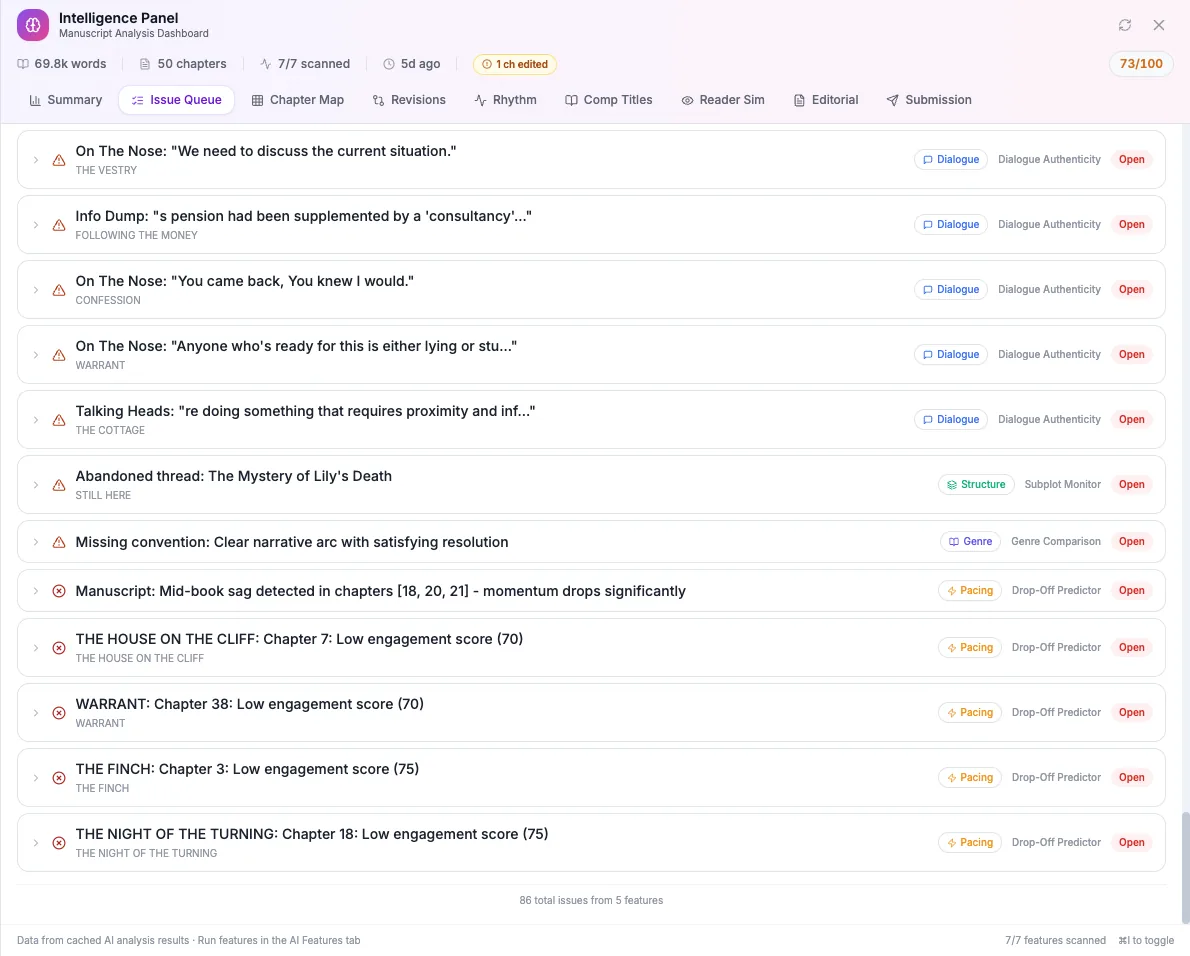
Real output from the analysis suite: unfired Chekhov’s guns, abandoned threads, on-the-nose dialogue, and mid-book sag, each tied to the chapter where it lives. No prompt engineering produced this.
A codex you read vs a bible that reads you
The difference is direction. In Novelcrafter, the Codex exists so the AI has context when you chat with it. You keep it accurate, and if an entry goes stale, nothing warns you. In BlurbBio, the Story Bible is an active system: it is built from what you actually wrote, it updates as chapters change, and conflict detection uses it to audit your manuscript continuously. When chapter 31 contradicts a rule you established in chapter 4, you get an alert with both locations. That is work no manually maintained codex performs.
The setup you skip
Bring-your-own-key stack
- 1. Choose and evaluate a model
- 2. Create and secure API keys
- 3. Fund a usage account with the provider
- 4. Write and refine your own prompts
- 5. Paste chapters, manage context limits
- 6. Reconcile the token bill each month
BlurbBio
- 1Sign up
- 2Import your manuscript
- 3Run analysis
No keys, no per-token bills, no prompt engineering. Flat plan, everything included.
The do-it-yourself stack is real work before the first useful result. BlurbBio ships configured.
Predictable pricing without token math
Bring-your-own-key sounds cheap until a heavy revision month runs your API bill past the subscription itself. BlurbBio bundles all AI analysis into flat plans: Writer at $10 per month and Author at $20 per month, each with a monthly credit allowance that covers normal novel-writing workloads. You never enter a payment method with an AI provider, never rotate a key, and never get a surprise usage invoice.
What active canon enforcement looks like
Continuity conflict detected
High confidenceRelationship state · Elena and Marcus
Chapter 12 · established canon
“After the harbor fire, Elena swore she and Marcus were finished, and she meant it.”
Chapter 15 · contradiction
“Elena waved Marcus over to their usual table, the argument apparently forgotten.”
A relationship-state conflict a codex cannot catch on its own: the manuscript disagrees with itself, and the system noticed.
The hidden cost of do-it-yourself AI
Bring-your-own-key setups put three jobs on your desk that BlurbBio removes entirely. First, prompt quality: the analysis you get from a raw model is only as good as the prompt you write, and continuity checking in particular needs structured context about your canon that a chat window does not build for you. BlurbBio ships purpose-built analysis pipelines, each engineered around your Story Bible data, so plot hole detection and consistency checks arrive tuned rather than improvised.
Second, context limits: pasting chapters into a chat hits model context ceilings fast on a novel-length work. BlurbBio processes manuscripts at full length with entity-aware extraction, which is how it can compare chapter 31 against chapter 4. Third, cost accounting: per-token billing turns every deep revision month into an unknown expense. A flat plan means analysis is something you run freely, not something you budget.
Your manuscript is not training data
With a bring-your-own-key setup, your data terms are whatever your model provider says they are, per provider, per policy update. In BlurbBio the terms are simple and singular: your manuscript belongs to you, is never used to train models, and is processed solely to produce your own analysis results. And because the AI never generates prose, every word in the book remains yours in the fullest sense.
When Novelcrafter is the right choice
If you want to choose your exact model, write your own prompts, and have the AI draft prose in a chat workshop, Novelcrafter is designed for that and BlurbBio deliberately is not. Authors who enjoy configuring their tools will find real power there. Authors who want the tooling to disappear so they can write are the people we built BlurbBio for.
Frequently asked questions
More comparisons
See how BlurbBio stacks up across the rest of the category, or browse the full comparison hub.
Sudowrite Alternative
Sudowrite is built to generate prose. BlurbBio is built to strengthen the prose you write yourself: automatic Story Bible, continuity and conflict detection, plot hole analysis, and a Copilot that brainstorms without ever drafting a sentence of your book.
Read comparisonPlottr Alternative
Plottr plans your novel, then hands you off to another app to write it. BlurbBio keeps the outline, the manuscript, the Story Bible, and the analysis together, so your plan and your prose can never drift apart unnoticed.
Read comparisonScrivener Alternative
Scrivener is a filing cabinet with a typewriter inside. BlurbBio is a manuscript editor with a brain: your characters, canon, and continuity are detected from the text itself and audited as you write, in any browser, with no compile step between you and a print-ready file.
Read comparisonCampfire Alternative
Campfire gives you modules to document a world before and beside the draft. BlurbBio builds the world record from the draft itself, then checks every new chapter against it, so your worldbuilding and your book can never contradict each other silently.
Read comparisonStory Bible Software
Every serious author needs a story bible. Almost every story bible goes stale by chapter six. BlurbBio builds yours automatically from the manuscript and then does the job no document can: it checks every new scene against established canon and warns you before a contradiction gets published.
Read comparisonNovel Writing Software
A full manuscript editor, a Story Bible that builds itself, a plot outliner with 70+ genre templates, deep AI analysis, and print-ready book export. One platform from first chapter to finished file, with AI that strengthens your writing and never replaces it.
Read comparisonStop maintaining your codex. Start writing.
Import your manuscript and watch the Story Bible build itself. Free to start, no API keys required.
Start Free