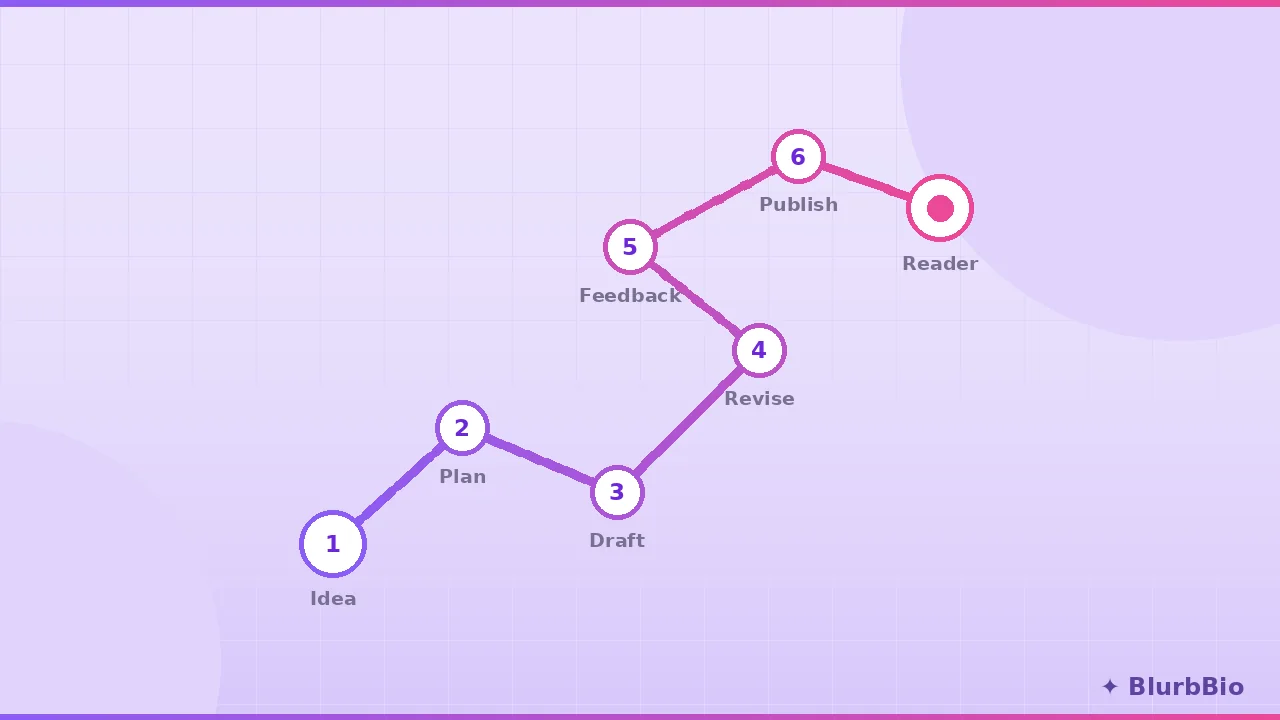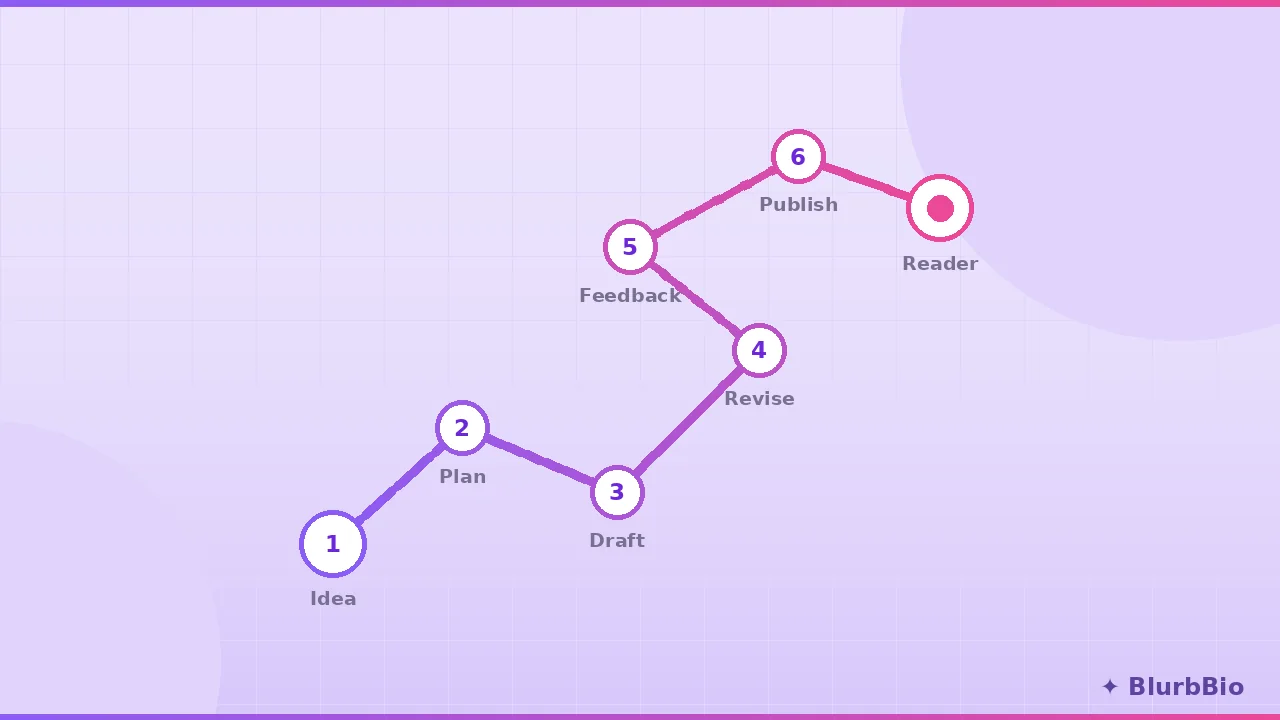
Somewhere around 800,000 people start a novel every November alone, and the finished-manuscript rate across all attempts is famously brutal, not because novels demand genius but because they demand a system sustained for a year. That is the honest premise of this guide: a novel is not one large act of inspiration, it is eight distinct stages with different skills, different failure modes, and different tools, and most abandoned drafts die at a stage transition, not mid-sentence.
This is the master map. Each stage below gives you the working method and the numbers that matter, then links the full chapter-length guide, because we have written one for nearly every step. Read this page to see the whole journey; read the chapters when you arrive at each leg.
And the destination is real: American readers bought 762.4 million print books in 2025, the second consecutive year of growth, with adult fiction up again, romance up 3.9% to nearly 44 million units, and science fiction up 22%. The market that will receive your finished novel is large, alive, and, as we will see at stage eight, more open to independent authors than at any point in publishing history.
Stage 1: The idea, and the only test it must pass
Ideas are not scarce; ideas that can carry 90,000 words are. The filter is a single conversion: can your idea become a dramatic question, a specific, answerable question about a specific person that a reader would pay to see resolved? "A story about grief in a fishing town" is a setting and a theme. "Can Nora prove what happened to her sister before the family that runs Harrowfield buries the truth for good?" is a novel, because it contains a protagonist, an opposition, stakes, and an ending waiting to happen.
The idea stage is also where genre gets chosen, consciously or not, and it deserves consciousness, because the shelves are not equally alive. The full-year 2025 numbers from Circana BookScan:
| Adult fiction category | 2025 US print units | Change vs 2024 |
|---|---|---|
| Romance | ~44.0 million | +3.9% |
| Graphic novels | 25.9 million | +9.2% |
| Suspense and thriller | 25.5 million | -2.2% |
| Fantasy | 24.1 million | -8.7% |
| Science fiction | 6.0+ million | +22.1% |
Read the table as terrain, not as instruction: fantasy's drop is largely the megahit comp cycle normalizing, science fiction's surge is real but from a smaller base, and romance remains the largest and steadiest engine in fiction. Write the book you can sustain for a year; just know the weather on its shelf before you start, and know its conventions cold, the way our romantasy guide maps that genre's dual-plot contract.
Run three quick checks before you commit a year. Scope: does the question naturally need a book, or is it a short story wearing a coat? Engine: does the question generate scenes on its own (mysteries, pursuits, and conflicts do; situations and vibes do not)? And appetite: is this a question you can stay curious about through month nine, because your fascination is the fuel supply for everything below.
Stage 2: Planning, without over-planning
The plotter-versus-pantser debate is publishing's oldest false binary; nearly every working author lives on the spectrum between them, and the correct position is personal: plan exactly enough to prevent your specific failure mode.
The hybrid method that survives contact with a real draft: fix the skeleton (your dramatic question, the direction of the ending, and five to nine load-bearing turns, roughly the beats every structure framework shares) and leave the connective tissue for discovery. Frameworks like the three-act structure, Save the Cat, and the Hero's Journey are best treated as diagnostic checklists rather than assembly instructions; our complete outlining guide walks through each framework, when it helps, and how to outline without strangling the draft. One planning warning that deserves its own sentence: an outline that keeps getting more detailed after week three has usually stopped being planning and started being avoidance.
Stage 3: Foundations: characters, world, canon
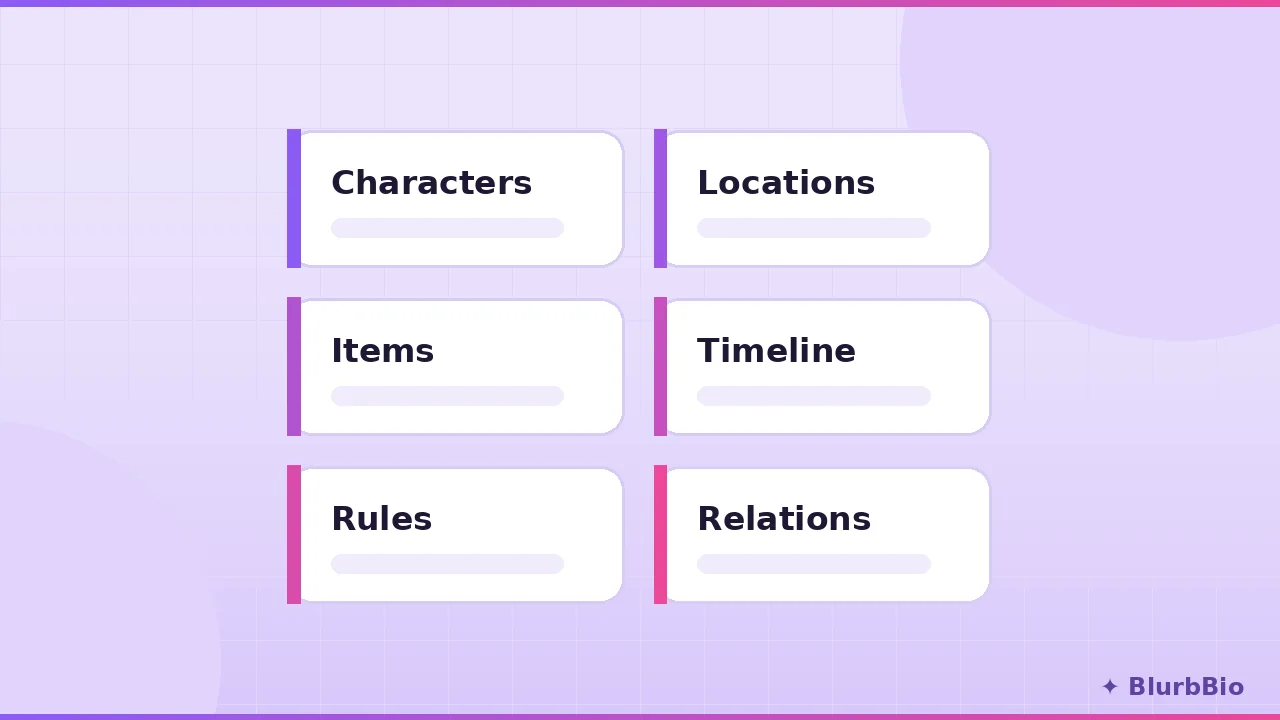
Three assets get built before and during early drafting, and all three exist to answer the same production problem: a novel accumulates hundreds of facts, and the author is the only continuity department it has.
Characters carry the book; readers forgive a wobbly plot and never forgive a cast they don't care about. The engine is want versus need under pressure, built in full in our character guide, with voice differentiation (cover the names; can you still tell who's speaking?) and names that pass the five tests as the supporting disciplines. World matters in every genre, not just fantasy: the rule from our worldbuilding guide is that settings are judged by the pressure they put on the story, not by their encyclopedic depth. And canon, the record of what is now true, lives in a story bible: every physical commitment, dated fact, capability, and who-knows-what ledger, logged at the moment of invention because reconstruction during revision costs hours per fact. Series authors, whose canon compounds across books, should read the series consistency guide before book two makes the problem permanent.
Stage 4: The draft: pace, targets, and the sag
Drafting is a logistics problem wearing an art costume. The variables that decide whether you finish:
| Decision | The working answer | Full guide |
|---|---|---|
| Total length target | 80,000 to 100,000 words for most adult debuts; genre ranges vary | Word counts by genre |
| Session pace | 500 to 1,000 words per session, held for months, beats sprints | this guide |
| Chapter rhythm | 1,500 to 5,000 words; length is the pacing throttle readers feel | Chapter length |
| Prose discipline | Dramatize decisions and turns; summarize transit | Show, don't tell |
| Genre contract | Know your shelf's promises before drafting into them | Genre guide example: romantasy |
Two rules do most of the work. First, draft forward: the writer who revises chapter one for three months has a beautiful chapter one and no novel, because drafting and revising are different mental modes and mode-switching kills momentum. Log problems in the story bible and keep moving. Second, defend the middle: the mid-book sag is the single most common place drafts die, and its anatomy (repetition without escalation while the author arranges furniture for the finale) plus its structural fix (a midpoint reversal that changes the goal or the rules) are covered in the pacing guide.
On sustainable pace: 750 words per day, five days a week, finishes a 90,000-word draft in under six months. The authors who finish are almost never the fastest; they are the ones whose schedule survived month four.
This stage is also where a system beats memory. Here is what a manuscript looks like as data, a real chapter map from a 50-chapter test novel we run our own analysis on daily, exactly the view that shows a sagging middle before a reader ever feels it:
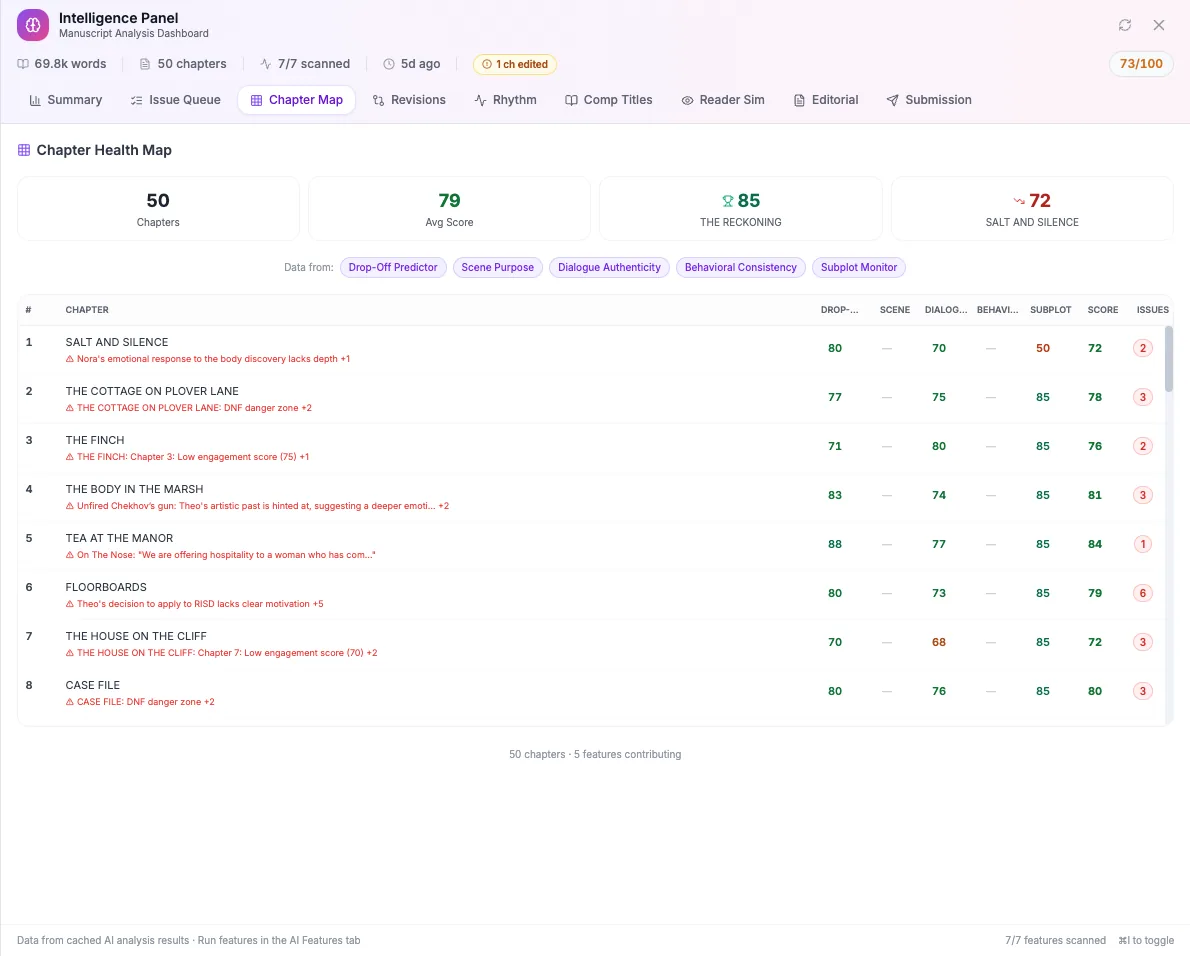
Every chapter scored and mapped: the shape of your middle act, visible before revision instead of after reviews.
Stage 5: Revision: structure first, always
The single most expensive revision mistake is starting at the sentences. Revision runs top-down, structure before scenes before lines, because polishing a chapter you will later cut is pure loss, and because pacing and plot problems are invisible at sentence altitude. The full system is our five-pass self-edit guide: story pass (does the structure hold?), scene pass (does every scene have a goal, an obstacle, and a change?), continuity pass (the manuscript versus the story bible, where the seven plot hole types hide), line pass, and proof pass, in that order, with a cooling-off gap between finishing the draft and reading it cold.
The continuity and pacing passes are the most automatable stages of the entire journey, mechanical cross-referencing that software performs without fatigue, and they are the reason manuscript analysis exists as a category; the self-edit guide shows a real automated pass on a full manuscript. What stays irreducibly yours: the judgment about what the findings mean and which ones the book's soul requires you to ignore.
Stage 6: Outside eyes: betas, then professionals
You cannot measure suspense you already know the answer to, which is why the feedback stage exists and why it has an order: beta readers on the self-revised second draft (three to five genre-fluent readers, asked reaction questions, never diagnosis questions), then professional editing where budget allows, with developmental editing as the structural tier. The synthesis rule that governs the whole stage: readers are almost always right about what is wrong and almost always wrong about how to fix it. Convergent symptoms are your revision plan; individual prescriptions are noise.
Stage 7: The fork: two publishing paths
The finished manuscript faces publishing's one genuinely binary choice, and it deserves an unromantic comparison:
| Dimension | Traditional (agent + publisher) | Independent (self-publishing) |
|---|---|---|
| Gatekeeping | Query agents, then submission to editors | None; you publish when ready |
| Timeline to shelves | Typically 2+ years after signing | Weeks, on your schedule |
| Money model | Advance plus ~10-15% print royalties | No advance; ~35-70% royalties, you fund production |
| Team | Editor, designer, marketing dept | You hire or DIY every role |
| Control | Publisher decides cover, title, timing | Total creative and pricing control |
| Print reach | Bookstore distribution built in | POD via KDP and IngramSpark; bookstores possible, harder |
| Proof it works in 2026 | The bestseller lists, still | An indie title sold 595,000+ print copies in 2025 |
The traditional path starts with a submission package: the query letter (one page, hook, pitch, metadata), the synopsis (whole plot, ending included), comp titles that position without megahit delusions, and a manuscript in standard format. The independent path fronts the business work: a blurb that sells, professional print formatting (your spine is arithmetic; our free calculator does it), and compliance details like KDP's AI disclosure rules. Neither path is the consolation prize; they are different businesses optimizing for different authors.
Stage 8: Launch, and the author you are now
Publication is a beginning disguised as an ending: the launch checklist (metadata, categories, the blurb's first line above the fold, review seeding, and for indies a marketing rhythm) matters, but the durable asset the whole journey built is you, an author with a finished book, a working system, and, statistically, a better second novel already forming. Series authors: the canon you kept in stage three is now the operating manual for book two, and the series guide is where this map loops back on itself.
Here is the realistic first-novel schedule, assembled from everything above, at the sustainable pace of 750 words a day, five days a week:
| Months | Stage | Milestone |
|---|---|---|
| 1 to 2 | Plan + foundations | Dramatic question, skeleton outline, story bible started |
| 3 to 8 | Draft | ~15,000 words/month; complete 90,000-word draft |
| 9 | Cool off | Manuscript in the drawer; you read your genre |
| 10 to 12 | Revise | Story, scene, and continuity passes |
| 13 to 15 | Feedback + polish | Beta round, synthesis, line and proof passes |
| 16+ | The path | Querying batches, or production and launch |
Twelve to twenty-four months, end to end, around a real life. Long enough to require a system. Short enough that the author who starts tonight, with the next scene and a 750-word target, is holding a finished manuscript before two winters pass.
One last piece of honesty, because a guide from people who read manuscripts for a living owes you the failure data too. Novels die at predictable points: at stage two, when outlining becomes a hiding place; at the stage-three-to-four transition, when foundations feel safer than a blank page one; in the chapter 15 to 25 sag, the single largest graveyard; at stage five, when an author reads the cold draft, mistakes normal first-draft roughness for a verdict, and quits instead of revising; and at stage seven, when a finished book waits forever for its author to feel ready. Every one of those deaths is a system failure, not a talent failure, and every one has its countermeasure named above. The writers who finish are not the ones who never stall; they are the ones who recognized which stall they were in.
That next scene is the entire secret. Everything else on this page exists to make it writable.
The chapters of this guide: Outlining · Characters · Worldbuilding · Story Bible · Word Counts · Chapter Length · Show Don't Tell · Pacing · Self-Editing · Plot Holes · Beta Readers · Query Letters · Synopsis · Comp Titles · Print Formatting