No document in publishing carries a worse ratio of length to dread than the query letter, and the dread has a real basis: agents receive thousands of queries a year, request pages from a small fraction, and make the request decision in about the time it takes to read one page, because that is all you get. What defuses the dread is knowing that the query is not a creative writing exercise. It is a business letter with a stable, known structure, and agents themselves publish exactly what they want in it. Your job is execution inside the container.
The container: one page, roughly 300 words, four components.
The hook: premise as proof
The opening one or two sentences establish protagonist, destabilizing event, and stakes, the same compression job as a blurb's first beat, performed under even harsher scrutiny, because here the hook is doing double duty: selling the premise and demonstrating that you can control language under constraint. "When investigative journalist Nora Ashworth returns to her hometown to cover a body found in the marsh, she reopens the twenty-year-old disappearance the town buried with it: her sister's." Specific nouns, a concrete situation, an implicit question.
The hook's classic failures are the throat-clearings: opening with rhetorical questions, with "I am seeking representation for..." (save it, or skip it, the letter's existence says it), or with theme instead of story ("My novel explores grief and memory..."). Agents request pages from situations, not themes.
The pitch: the first quarter, then stop
One to three short paragraphs, 150 to 200 words total, carrying the story from the hook through the central conflict and stakes, and stopping at the story question, the same withhold discipline as the blurb, because the query pitches the question while the synopsis sells the answer. Stay inside roughly the first quarter of the book: setup, the point of no return, what opposes the protagonist, and what failure costs, concretely. Two named characters is the comfortable ceiling, three the absolute one, and every plot thread beyond the spine gets cut without mercy, however beloved: the query pitches the book's spine, and subplots read as clutter at this altitude.
Voice matters here in a specific way: the pitch should sound like the book. A comic novel's query gets to be funny; a gothic's gets to be atmospheric, within business-letter bounds. This is the one place the container flexes.
Metadata and bio: the professionalism paragraph
One tight paragraph carries the facts: "THE WREN HOUSE is a 90,000-word thriller that will appeal to readers of [Comp One] and [Comp Two]." Title in caps by convention, genre and age category stated plainly (adult thriller, YA fantasy), word count rounded to the nearest thousand and sitting inside your genre's expected range, because a number far outside it is a rejection reason all by itself, and two comp titles, published within roughly the last five years, matched to your book's actual shelf position, and emphatically not the genre's megahits. Comps are their own craft with their own failure modes, covered in full in our comp titles guide.
The bio then takes two or three lines and only publishing-relevant facts: prior publications, pertinent prizes or programs, a profession that bears on the book's world. Debut with none of these? "This is my first novel" is complete and correct. The bio's failure mode is padding, and padding reads louder than absence.
Personalization, a single genuine line on why this agent (a title they represent that shares DNA with yours, an interview comment, a wishlist item), goes at the top when it is real and gets omitted when it would be generic, because agents can smell a mail-merged "I love your list" from the greeting.
What the assembled letter looks like
This structure is stable enough that it can be generated as a scaffold from the manuscript itself and then personalized per agent, which is exactly how we built it into our own product. Here is a real generated draft from a 50-chapter test manuscript, hook, pitch, comp line, and placeholder bio, exactly as it lands before the author's personalization pass:
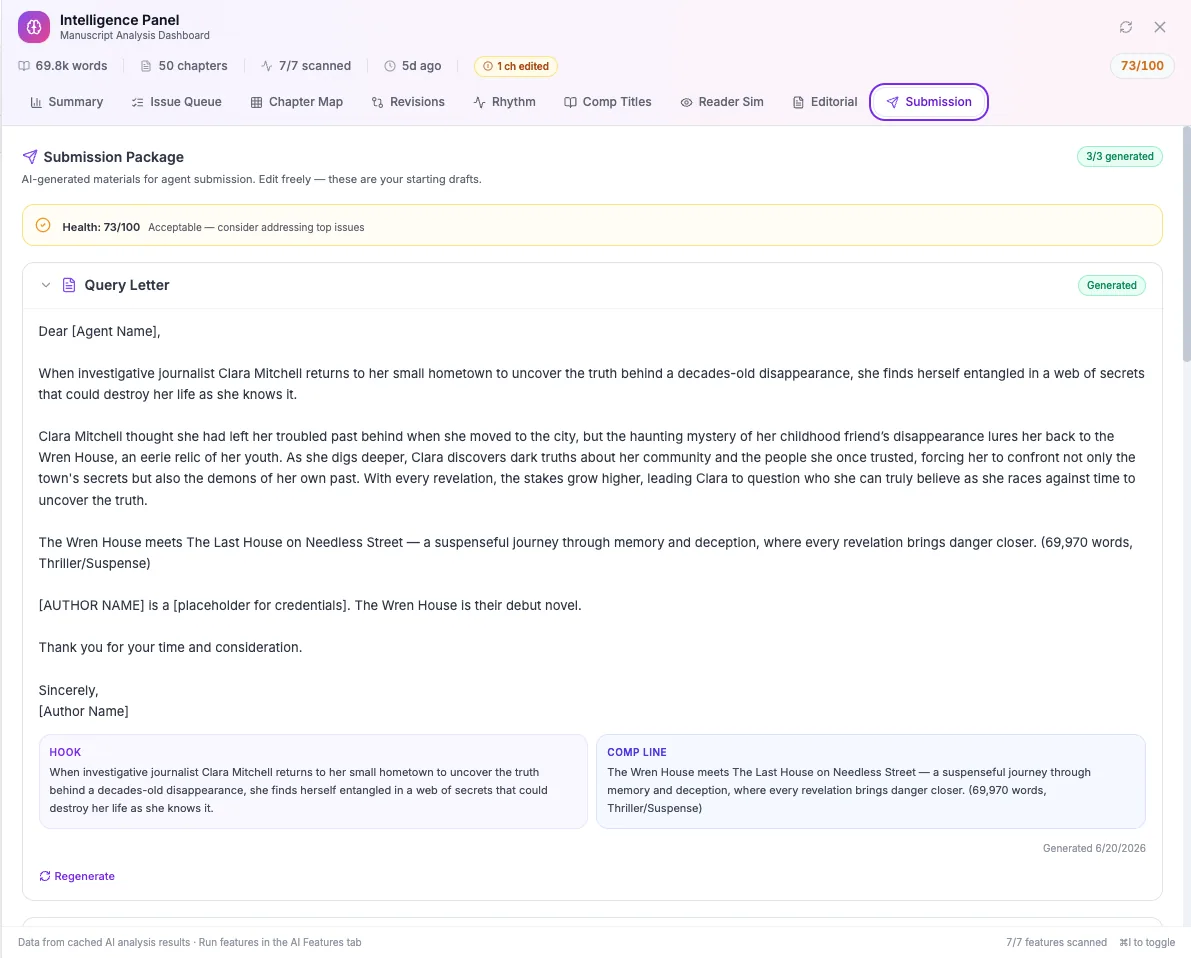
The hook and comp line are extracted as separate blocks because they are the two components agents weigh most, and the two you should personalize hardest.
Process: batches, tracking, and the revision trigger
Query in rounds of six to ten agents, tracked in a spreadsheet or a service like QueryTracker, and treat each round as an experiment: a round with page requests validates the letter, and a silent round means revise, the query or the opening pages, before spending the next batch of agents, because agents are a nonrenewable resource per book. Follow each agent's submission guidelines to the letter, pages pasted or attached exactly as specified, in standard manuscript format, since guideline compliance is itself the professionalism test. And expect the timeline to be measured in weeks to months per response, with silence as a common answer; the process rewards the author who treats it as a pipeline rather than a verdict.
Two protections for the process itself. Response norms run four to twelve weeks where agents respond at all, and many now state that silence past a deadline is a pass; a single polite nudge after the stated window is acceptable, and multiple follow-ups are not. And know the one bright line in the business: legitimate agents never charge authors, not reading fees, not editing fees, not marketing contributions. Money flows toward the author, commission comes out of sales, and any agent whose response involves an invoice, or a referral to a paid editing service they benefit from, has identified themselves as the thing to walk away from. The industry's watchdog resources and agent databases exist precisely to check reputations before a batch goes out, and ten minutes of diligence per agent is part of the job.
One page, three moves, executed cleanly. The book gets you the deal; the query's only job is getting the book read.
See also: How to Write a Synopsis · How to Find Comp Titles · Standard Manuscript Format · How to Write a Novel: The Complete Guide