No genre in modern publishing has moved numbers like this one. Romantasy sold $610 million in the US in 2024, a 34% jump in a single year, put five titles from just two authors in the year's overall top ten, and kept posting triple-digit growth into 2025, the fastest of any romance subgenre in Circana's tracking. One in four New York Times hardcover fiction bestsellers in 2024 was romantasy. Even skeptics conceding the boom to one or two megastars are wrong on the data: Circana noted the category grows double-digits with its biggest author excluded.
So the commercial case makes itself. The craft case is what this guide is for, because romantasy is harder to write than either parent genre, and the books that fail almost always fail the same structural test.
The dual-engine rule
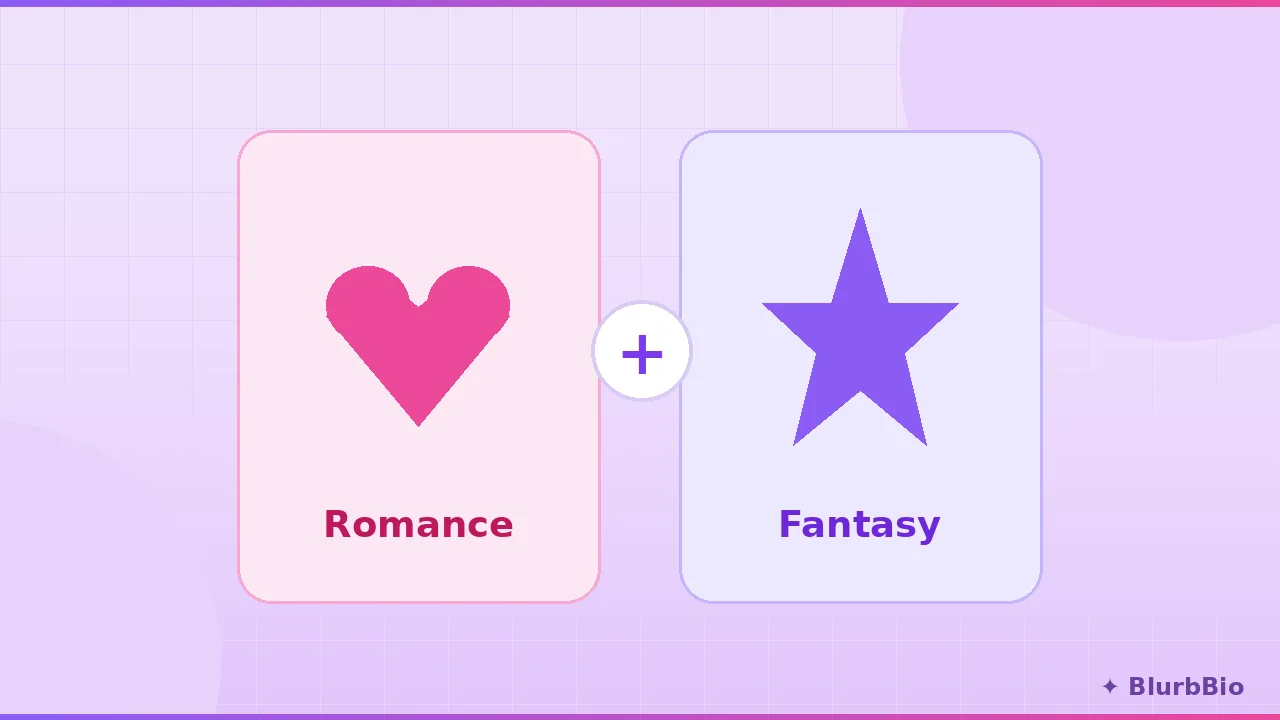
Everything that defines romantasy follows from one requirement: it runs two complete plots, not one plot and a subplot. The romance must satisfy romance readers, which means a central relationship with escalating intimacy, credible obstacles, and an emotionally satisfying resolution arc. The fantasy must satisfy fantasy readers, which means a world with rules, external stakes that would matter even if nobody fell in love, and a plot that resolves through those rules.
The test is subtraction. Remove the romance: does the fantasy plot still function as a story? Remove the fantasy: could the relationship arc survive translated to another setting? Books that fail the first test are romance in costume, and fantasy readers say so in reviews; books that fail the second are fantasy with kissing, and romance readers, the majority of the genre's buyers, feel cheated of the thing they came for.
The craft consequence is scene-level: the strongest romantasy scenes advance both engines at once. The heist requires the enemies to cooperate; the magic lesson is also the intimacy beat; the political betrayal is also the third-act breakup. Scenes that serve only one engine are not forbidden, but every one of them spends pace, which is why the genre's books run long and still read fast.
The trope economy
Romantasy discovery runs on tropes the way other genres run on premise, a direct consequence of how the genre is bought: NielsenIQ found nearly 15% of romantasy purchases now begin on short-form video, triple the 2021 share, and a thirty-second video sells tropes, not synopses. Enemies to lovers. Fated mates. One bed. Forced proximity. Hidden power. Morally grey love interest. Touch her and die. The academy.
Treat this as a contract system, not a checklist. Choose two or three load-bearing tropes, know exactly what promise each makes (enemies to lovers promises a credible reason for enmity and a gradual, earned thaw; fated mates promises the tension between destiny and choice), and then deliver the promise with a variation the reader has not seen. The genre's readers consume several books a week; they do not punish familiar tropes, they punish lazy execution of them. And signal your tropes honestly in the blurb, because trope-mismatch is the review-section death of otherwise good books.
Worldbuilding that serves the romance
Romantasy worldbuilding is judged by a different criterion than epic fantasy's: not depth for its own sake, but pressure on the relationship. The best-selling worlds in the genre are engineered so the setting itself forces the lovers together and apart: courts where alliances make love treasonous, bonds and trials that manufacture proximity, magic systems whose costs are intimate. When you design a magic rule, ask what it does to the couple; a power that only works through touch, a bond that shares pain, a court that forbids exactly this match, these are worldbuilding and romance engineering in one move.
This is also where the genre's continuity burden bites hardest. You are tracking a magic system's rules and costs, a political map, and a relationship whose state, who knows what, who has forgiven what, who touched whom and when, changes nearly every chapter, across what the market strongly prefers to be a series. Our worldbuilding guide covers rule discipline, and the series consistency guide covers the multi-book problem; romantasy authors need both more than anyone.
Heat, POV, and length: the deliberate decisions
Three choices define your position on the shelf, and all three punish drift more than they punish any particular answer. Heat level spans closed-door to explicit across successful books; pick a level, hold it consistently, and signal it accurately, because heat mismatch is the genre's most preventable one-star review. Point of view defaults to first-person present or past in the current wave, with dual-POV (heroine and love interest alternating) increasingly standard because it feeds the interiority romance readers want on both sides. Length centers on roughly 100,000 to 130,000 words, above romance norms and at fantasy's upper band, because two engines need fuel; debuts querying traditionally should respect the top of that range.
And the series question barely is one: the market rewards series overwhelmingly, with the standard architecture resolving a major romance milestone per volume while the fantasy stakes escalate across the arc, exactly the structure that keeps binge readers, the genre's superpower, buying book after book.
Where the opportunity actually is
The honest market note to end on: the boom has drawn a flood of supply, and mid-list romantasy now competes hard. The openings are where the megahits are not: indie authors in the genre grew revenue 70% year over year on wide platforms while traditional publisher growth in the same category ran single digits, subgenre niches (dark romantasy, cozy romantasy, sci-fi romance adjacency, sports-romance crossovers) are outgrowing the center, and craft quality is the differentiator precisely because the market is saturated with trope-compliant but structurally weak books. The dual-engine rule above is the moat. Write both plots like they each have to carry the book, because in the reviews, they each do.
See also: Worldbuilding Guide for Fiction Authors · How to Keep a Book Series Consistent · How Many Words Is a Novel? · How to Write a Novel: The Complete Guide