Authors who breeze through query letters still describe the synopsis as the worst document in publishing, and the reason is structural: everything you have learned about storytelling, withhold, tease, dramatize, is banned here. The synopsis is the anti-blurb. Where the blurb sells the question and the query pitches it, the synopsis sells the answer: the whole plot, in order, causally connected, ending included, in about 600 words of deliberately plain prose.
Understanding why agents want such a joyless document makes it writable. They are not reading for pleasure; they are inspecting architecture. Does the middle hold? Does cause drive effect, or do things merely happen? Does the protagonist's arc complete? Is the ending earned? A synopsis is a load-bearing diagram of your story, and it is judged like one.
The conventions, all of them fixed
The form's rules are conventions in the strict sense, standardized so agents can process hundreds of them, and deviation reads as unfamiliarity rather than creativity. Third person, present tense, whatever the novel does: "Nora returns to Harrowfield." Character names in ALL CAPS at first introduction only (NORA ASHWORTH, then Nora), with the named cast capped at three to five and everyone else reduced to role: the detective, the matriarch, her brother. One page, 500 to 700 words single-spaced, as the default deliverable, with longer versions produced only when requested. Neutral, clear prose that explains instead of dramatizing: no cliffhangers, no rhetorical questions, no scene-level detail. And the ending, stated plainly, because the coy synopsis ("what Nora finds will change everything...") fails the document's only job.
The five-paragraph architecture
A one-page synopsis maps cleanly onto five moves, which correspond to the load-bearing points an agent is checking:
The caption on the arrows is the whole craft of the form. A synopsis whose events connect as "and then" has documented an episode list; one whose events connect as "and so," each turn caused by the one before it, has demonstrated a plot. Weave the protagonist's internal arc through the same paragraphs in single clauses (Nora, who has spent twenty years running from Harrowfield, chooses to stay), because arc-plus-plot is precisely what the agent is auditing, and give the emotional logic of the ending a full sentence: not just what happens, but what it resolves.
The compression method: scene list, spine, prose
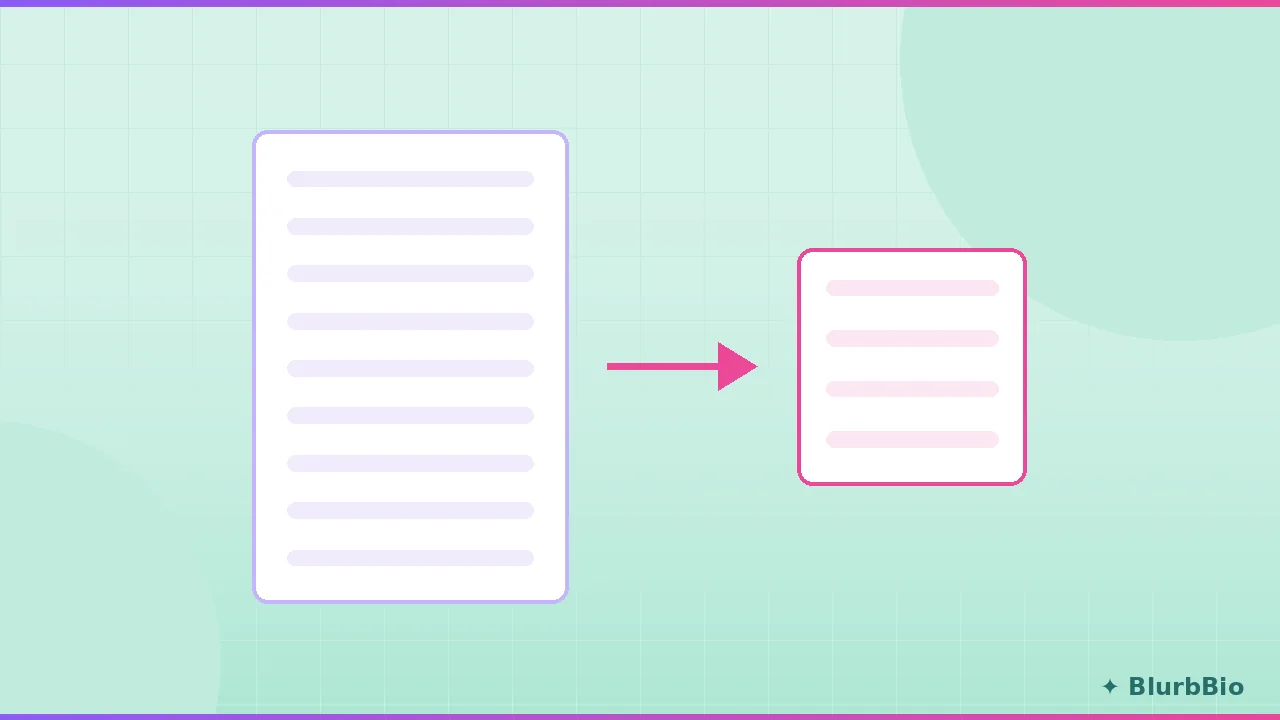
Compressing 90,000 words into 600 by staring at a blank page produces despair; compressing by pipeline produces a synopsis in an afternoon. Step one, list every scene or chapter in one line each, which for a fifty-chapter novel yields fifty lines. Step two, mark the spine: strike every line whose event does not causally connect to the ending, and watch subplots, however beloved, fall away; what survives is usually fifteen to twenty lines. Step three, write those lines as connected present-tense prose, forcing the "and so" connections and inserting the CAPS introductions, then compress sentence-level until it fits the page. Working from an outline or a story bible's chapter map makes step one nearly free, and this pipeline is mechanical enough that we automated it in our own product: BlurbBio's Submission Package extracts the spine and drafts both lengths from the manuscript itself, exactly the scene-list method run by software, leaving the author the judgment calls.
A worked example makes the compression visible. A scene-list line reads: "Ch 14: Nora breaks into the county archive at night, finds the land transfer records, is nearly caught by the night guard." In the synopsis, that entire chapter becomes half a sentence in the escalation paragraph: "Nora uncovers records proving the Sable family bought the marsh the week Lily vanished, and so turns from investigating a death to investigating a cover-up." Notice what survived: the discovery and its causal consequence. Notice what died: the break-in, the tension, the guard, everything that made the chapter worth reading, because the synopsis reports what the plot did, never how it felt to watch. Authors who grieve those cuts are grieving correctly and should make them anyway; the agent will meet the night guard in the manuscript.
Then apply the cut test to every surviving sentence: does removing it break the causal chain? If not, it goes, and theme statements, worldbuilding tours, and backstory go first. The one-page synopsis is an exercise in ruthlessness that, uncomfortably often, doubles as a diagnostic: authors who cannot make the spine connect on one page have frequently discovered a real structural problem, which is cheaper to learn now than in an agent's rejection.
Formats, and keeping the versions straight
Two structural situations need special handling. Multi-POV novels compress to the protagonist whose choice resolves the climax: tell the spine primarily through that character, fold the other viewpoints in as their events intersect it, and resist narrating each POV thread separately, which fragments one page into three unreadable columns. If the novel genuinely has co-leads, alternate by act, not by scene. Series books get synopsized as themselves: the synopsis covers this volume's complete arc, setup to resolution, with one closing sentence positioning the larger series ("Book one of a planned trilogy; the manuscript stands alone"), because an agent buying book one needs proof that book one lands, not a tour of the saga. In both cases the discipline is the same discipline as everywhere else in the document: one spine, causally told.
Maintain two documents: the one-page master (500 to 700 words, single-spaced, or the same text double-spaced across two pages) and a longer three-page version with room for the secondary arc, produced by expansion of the master rather than separate drafting so the two never contradict. Format both plainly, same standard manuscript conventions as everything else in the packet, header included, and always deliver exactly the length each agent's guidelines request, because in a process this standardized, precision is the personality trait being tested. The synopsis will never be fun. It can absolutely be finished by Friday.
See also: How to Write a Query Letter · How to Find Comp Titles · Standard Manuscript Format · How to Write a Novel: The Complete Guide