Single-book continuity is hard enough that we wrote a whole guide on it. Series consistency is that problem with three multipliers attached: the canon grows by a full novel per book, the drafting gaps stretch to years, and the modern reader consumes the whole series in a week, auditing book one against book four with both fresh in mind.
The authors who survive this do not have better memories. They have systems that make memory irrelevant. This guide is those systems: the series bible, the end-of-book snapshot, the pre-drafting check, and the protocol for the error that already shipped.
Why series break: the asymmetry
Every cross-book contradiction has the same root. The author wrote book one three years ago and carries a compressed, slightly fictional memory of it, the version they intended, not the version they published. The binge reader finished book one on Tuesday and starts book three on Thursday carrying the text itself. When the niece who was seven in book one turns up eleven two in-world years later, the author never notices and the reader always does.
And the canon compounds. Book one constrains book two; books one and two constrain book three. A trilogy author drafting the finale is writing against 300,000 words of binding commitments, every one of them checkable by a reader with a search function in their ebook app. No memory holds that. The system below does.
The series bible: a story bible with a time axis
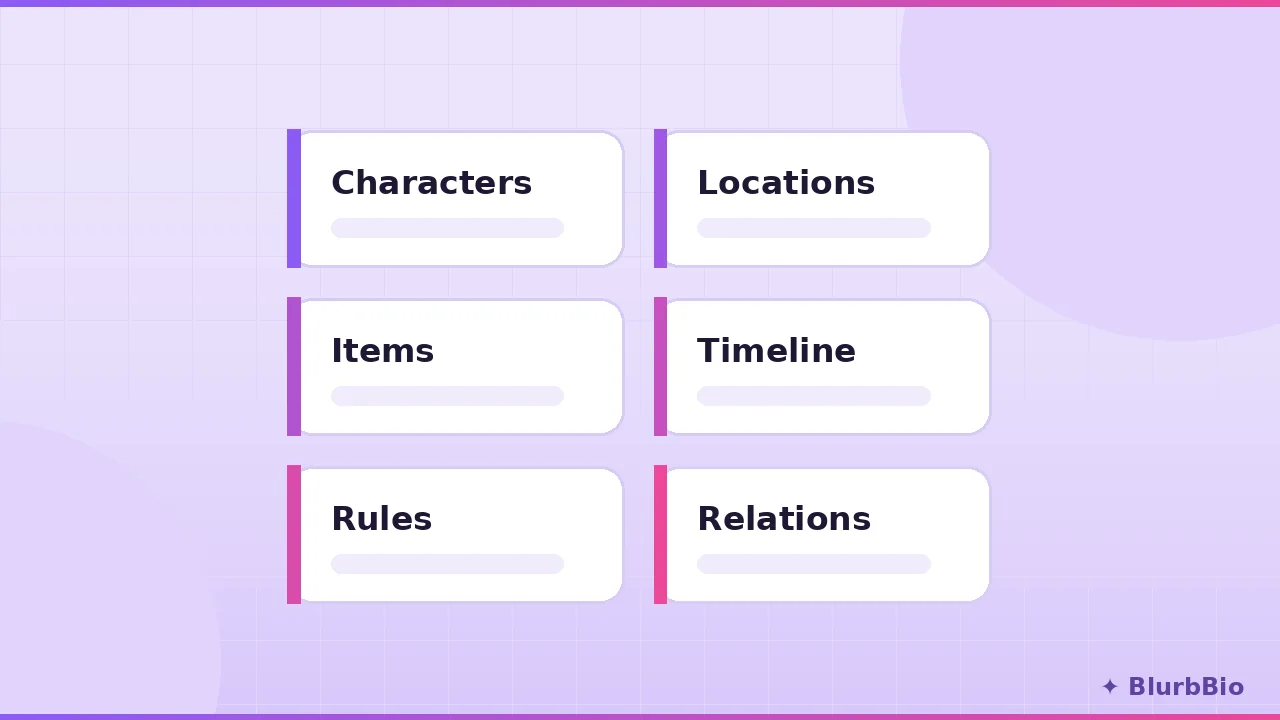
Start from the standard eight-section story bible template, then add the one structural change that makes it a series instrument: every fact that can change carries book references. Not "Maren distrusts her brother" but "Book 1: estranged, cause unknown to reader. Book 2 ch 14: cause revealed, partial reconciliation. End of Book 2: allied, distrust dormant."
The sections that need the time axis most are the fast-moving ones: relationships, character knowledge, injuries and physical changes, and world rule revelations, since a series typically discloses its world progressively and a later book must not casually reference what the reader, or a character, has not yet learned. Static facts, geography, backstory, appearance, can stay single-entry with their establishing book noted.
Series-specific sections worth adding: a reader knowledge ledger per book (what has been revealed to the audience by each book's end, the series version of dramatic irony management) and a promises register, the cross-book plot threads, tracked with the same open-advanced-resolved status as any plot thread, because a promise made in book one and forgotten by book four is the series-scale unfired gun.
The end-of-book snapshot
The highest-leverage single document in series writing takes one evening per book: when a manuscript is final, write the state of the world on its last page. Every major character's age, location, physical state, relationships, and knowledge. Every open thread. The world's revealed rules. The in-world date.
The snapshot works because it converts the hardest question in series drafting, "what was true at the end of the last book?", from an act of memory into an act of reading. Book two drafts against book one's snapshot; book five drafts against book four's. Authors who keep snapshots report that most would-be contradictions die in the outline, before a scene is ever written against a false premise.
The pre-drafting check, and the audit no one enjoys
Before drafting each new book, run a short mechanical review: the previous snapshot, the promises register, the timeline arithmetic (advance every recurring character's age by the elapsed time and write the numbers down), and the world rule ledger. An optional full reread on top helps voice, but it supplements the mechanical check rather than replacing it, because rereading refreshes the same memory that generates the errors.
Then there is the audit that matters most and gets skipped most: checking the new manuscript against the old ones. Memory-based drafting means errors enter silently mid-scene, a character referencing a conversation from the wrong book, a healed scar aching again, and catching them requires cross-referencing each chapter against the accumulated canon. Done by hand this is genuinely laborious, a search-and-verify pass per fact, which is precisely why it is the part of series maintenance that has moved to software: automated conflict detection that reads the manuscripts, holds the canon, and flags the chapter that disagrees with it does mechanically what no author does reliably at 300,000 words.
This is the workload we test daily while building BlurbBio, and the promises register in particular is where automation earns its keep. Here is a real detection run on a 50-chapter test manuscript, including an abandoned thread the subplot monitor caught, exactly the class of error that survives into book two when nobody is watching:
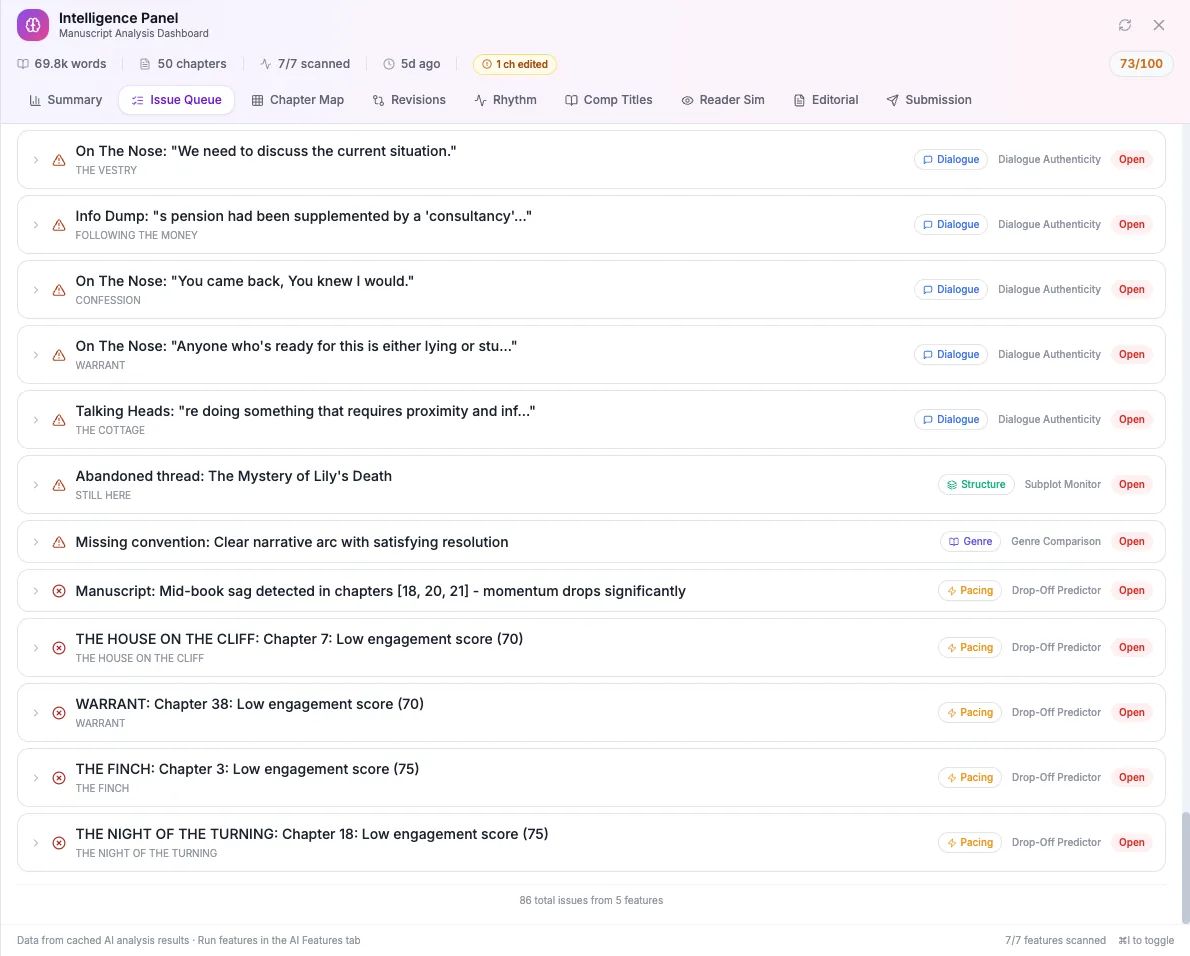
Unfired Chekhov's guns, an abandoned thread, and on-the-nose dialogue, each finding tied to the chapter where it lives. A series bible that reads the manuscripts can run this same audit across every book at once.
Retcon protocol: when the error already shipped
Eventually something gets through, and published errors demand a deliberate choice among three honest options. Canonize it: the mistake becomes truth and every later book honors it, usually the right call for small details. Silently correct it: platforms with updatable editions allow quiet fixes, defensible for typo-grade errors, riskier once readers have quoted the original. Retcon it visibly: acknowledge and explain in-story, which spends reader trust but can pay for itself when the explanation adds depth.
The only unacceptable option is the accidental one: half the later books honoring the error and half contradicting it, which turns one mistake into a pattern. Whatever the choice, log it in the series bible with a date, because the retcon you improvised in book three is itself canon by book six.
Consistency as a series asset
The commercial context has quietly shifted in the author's favor here. Completed series are marketed for binge reading, read-through rate is the metric that decides a series' profitability, and the reviews of later books are where consistency gets graded in public. A series that holds together across five books is not just craft hygiene; it is what converts a book one reader into a book five buyer. The systems above, the time-axis bible, the snapshot, the pre-drafting check, the audit, are a fixed cost of a few hours per book against that payoff, and they are the difference between a series that survives its own success and one that gets quietly caught by the readers who loved it enough to look closely.
See also: The Story Bible Template · How to Build a Story Bible · The 7 Types of Plot Holes · How to Write a Novel: The Complete Guide