Somewhere in every query letter sits the sentence that makes authors squirm: "THE WREN HOUSE will appeal to readers of ___ and ___." The squirm comes from a misunderstanding. Authors read that sentence as a quality claim, my book is as good as these, and freeze between arrogance and false modesty. Agents read it as coordinates: which shelf, which readers, which proof that those readers exist and spend money. Comps are the publishing industry's addressing system, and learning to use them is learning to say where your book lives.
What a comp actually asserts
When you comp two titles, you are asserting exactly three things: readers who bought these books are the readers for mine; those readers are buying now (hence the recency window); and I know my shelf well enough to name my neighbors. Notice what is absent: any claim about sales figures or literary merit. "For readers of X" means the audience overlaps, not that the numbers will.
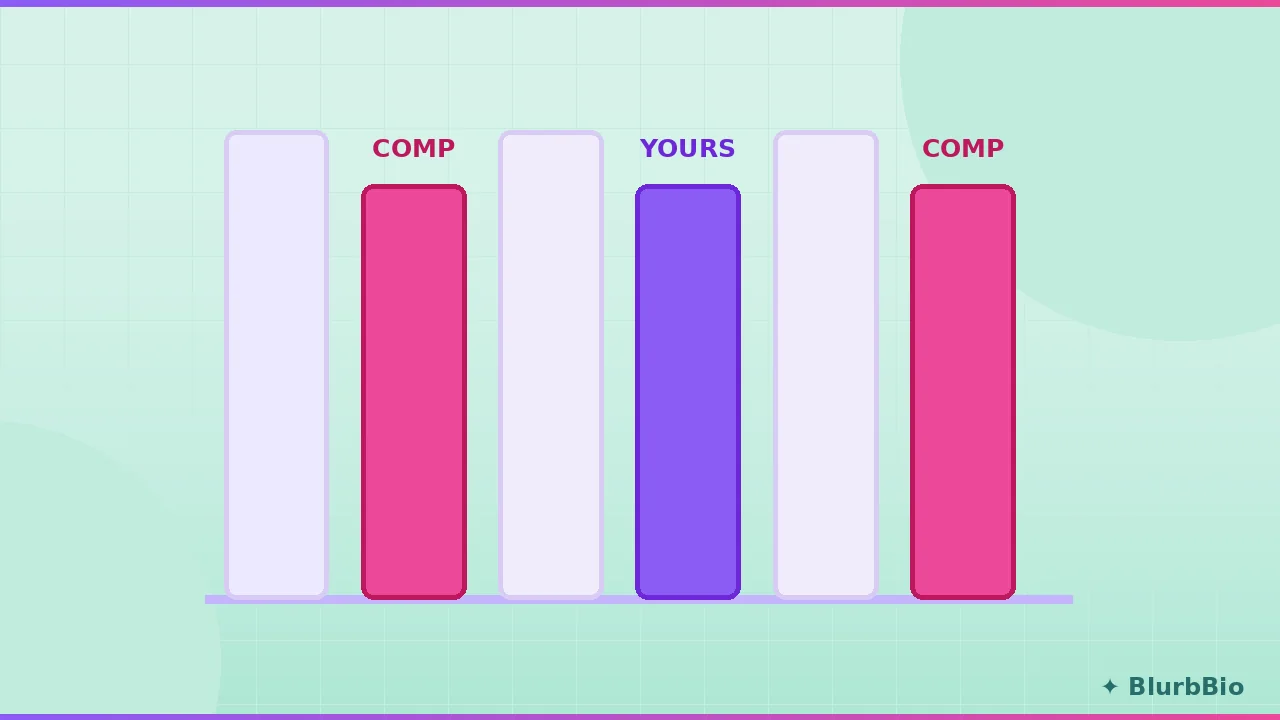
This is why the pairing logic matters more than either individual comp. Two comps triangulate: one typically carries the plot engine or subgenre (the small-town cold case), the other the voice, tone, or audience (the literary interiority, the romance heat level), and your book lives at the intersection. The strongest comp lines make the axes explicit: "the buried-secrets small town of [X] with the dual-timeline structure of [Y]." A single comp gives one coordinate; a good pair gives a location.
The rules: recency, altitude, and format
Recency: five years. Comps prove a current market, so at least one should be recent, ideally within two or three years, and both within roughly five. An older title can serve as a tonal grace note ("with the gothic patience of Rebecca"), but a query comped entirely to older books tells the agent the author's reading stopped a while ago, and the market they are pitching into may have too.
Altitude: the mid-list credibility zone. This is the rule authors resist and agents insist on: do not comp the megahits. Fourth Wing, ACOTAR, Gone Girl, and their peers fail as comps for three compounding reasons: they implicitly claim outlier sales no rational agent will underwrite; every agent's inbox already overflows with manuscripts comped to them, so the comp signals trend-chasing rather than positioning; and, least obviously, they carry no targeting information, because phenomenon books are read by everyone, which means "readers of Fourth Wing" describes no one in particular. The credibility zone is the successful mid-list: recent books that visibly performed, earned reviews and a readership, without becoming cultural weather. Comping there says the quiet, professional thing: this book has a real, reachable audience. And when a megahit genuinely is structurally relevant, comp through it, not to it: "for readers who finished [megahit] wanting more court politics and a slower burn" positions against the phenomenon's audience without claiming its numbers.
Format: books first. At least one comp should be a book, because book comps prove book-buying behavior; a film or series can serve as the second element when it communicates tone faster than any title would, and the X-meets-Y construction across media is now standard. Two comps is the convention, three the ceiling, and each should earn its slot by contributing a distinct axis.
Finding them: a research method, not a memory test
"I can't think of any comps" is almost never a memory problem; it is a reading-gap report, and the fix is systematic. Work the also-boughts and category bestseller lists outward from the published books nearest yours. Read recent releases in your subgenre, the last three years, not the canon. Search agent wishlists on MSWL and recent deal announcements in Publishers Weekly for the comp language your category's agents are themselves using right now, which is both a source of comps and a dictionary of how your market describes itself. Mine Goodreads lists and genre communities, where readers self-organize by exactly the axes comps run on: trope, tone, heat, vibe. And read the acknowledgments pages of your near-comps, which name the agents who sold them, converting comp research directly into your query list.
There is also a structural angle most authors never check: whether your manuscript's measurable shape actually matches the shelf you are comping into. This is mechanical enough that we built it into BlurbBio; here is the Comp Titles analysis running on a 50-chapter test manuscript, suggesting comps and then benchmarking the book's chapter length, dialogue ratio, and POV against its genre's norms:
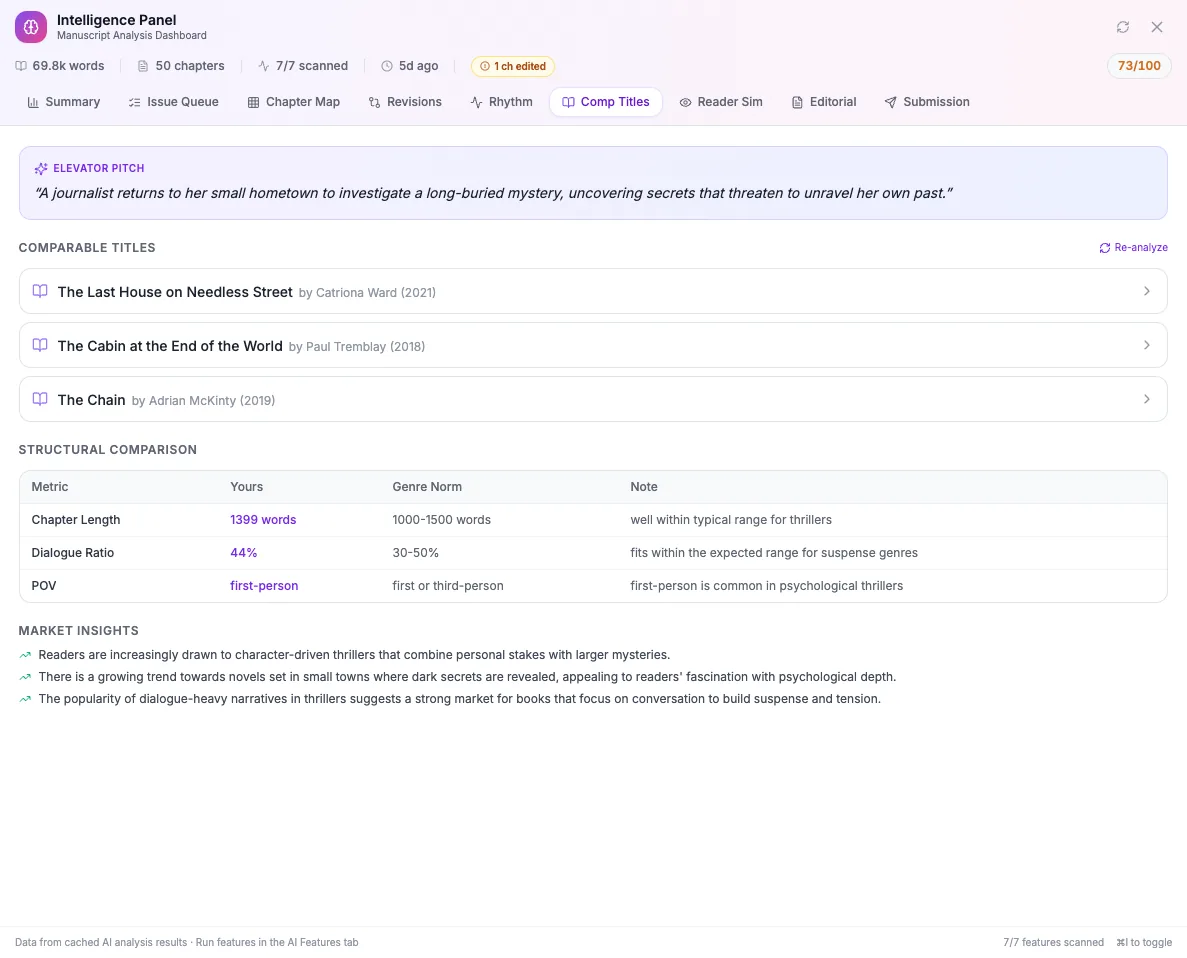
Suggested comps with an elevator pitch, plus the structural evidence: chapter length, dialogue ratio, and POV each checked against the genre's expected range.
Using comps beyond the query
The failure modes on the other side of the megahit deserve naming too. The too-obscure comp, a book so small the agent cannot picture its market, fails the same information test from below; a comp works only if the recipient recognizes it, which in practice means it visibly sold. The category-mismatch comp, citing adult titles for a YA manuscript or literary comps for commercial work, misaddresses the book worse than no comp at all, because it proves the author cannot read shelf position. And the stale-trend comp, a title from a wave that already crested, positions the book behind the market. When genuinely stuck between the megahit and the obscure, the escape is the axis split: a well-known series for the premise axis, a recent mid-lister for the audience axis, which keeps recognition and information in the same pair.
Comps found once keep paying. They calibrate the blurb's genre signals and the cover brief (your comps' covers are your cover's design language), they seed the also-bought targeting in ads, and inside the query letter they carry the metadata paragraph. They even discipline revision: reading your two comps closely against your manuscript shows you your shelf's conventions from inside, chapter lengths, heat level, pacing contract, before an agent measures you against them anyway. The squirm-inducing sentence, it turns out, is just the address line. Fill it in accurately and everything downstream ships better.
See also: How to Write a Query Letter · How to Write a Book Blurb · How to Write a Synopsis · How to Write a Novel: The Complete Guide