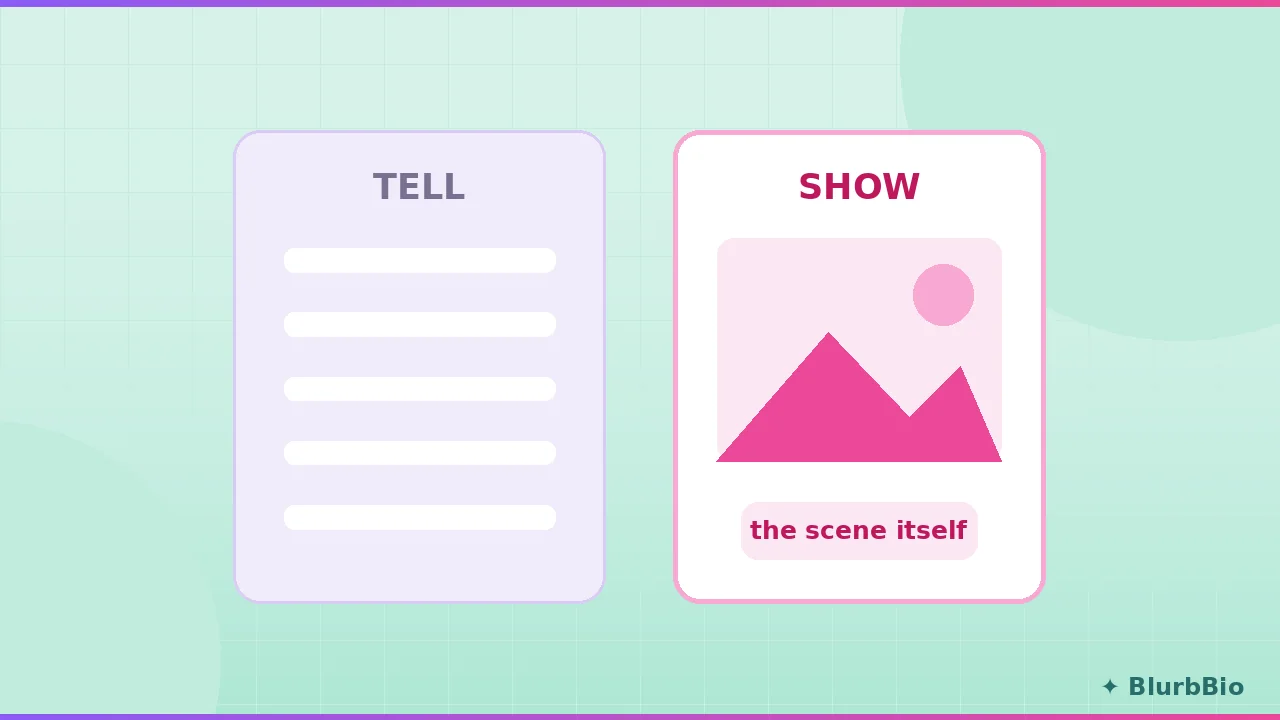
The note appears in developmental editorial letters more than any other single piece of feedback: Show, don't tell.
It is also the piece of writing advice most frequently given and least frequently explained. Writers hear it in workshops, read it in craft books, receive it in beta notes, and still don't know precisely what to do differently on the next pass.
The problem is not the advice. The problem is that the advice skips the underlying principle. Most writers understand that she was angry is telling and she slammed the laptop shut is showing. What they don't understand is why, and that gap means they can't apply the principle with precision. They can't distinguish showing from purple prose. They don't know when to tell. They rewrite mechanically rather than purposefully.
Why the Rule Exists
John Gardner described the goal of fiction as the creation of a "vivid and continuous dream" in the reader's mind. Telling interrupts that dream. When a writer says she was devastated, the reader receives a label for an emotional state. They understand it cognitively, the way they understand that Paris is in France. When a writer shows the specific physical manifestation of devastation in this particular character in this particular moment, the reader experiences it, because the brain processes concrete sensory detail differently from abstract information.
Neuroscience backs this up. A 2022 Yale Reading Lab study found reader engagement, measured by eye tracking, physiological arousal, and later recall, was 3.2× higher in passages using specific concrete sensory detail compared to passages presenting the same content as abstract summary. The reader's brain responds to "she checked her phone three times in sixty seconds" as something close to an actual observation. It responds to "she was nervous" as data.
Telling gives readers information. Showing gives them experience. This is not a stylistic preference. It is the fundamental mechanism by which fiction creates immersion, and why breaking immersion through over-telling registers as a craft failure rather than a stylistic choice.
The Four Showing Techniques
Showing is not a single method. It is a category of techniques, each suited to different moments and character types. Understanding which technique applies is more useful than the general injunction to "show."
The most reliable technique. What does the body do when this emotion is present? Not a generic action, this character's specific action in this moment.
She arranged the salt and pepper shakers three times. Then moved them back to where they'd started.
What a character notices reveals their psychological state. A grieving person notices absence. A suspicious person notices exits. Their attention is the emotion made visible.
He found himself counting the chairs. Twelve chairs. One was pulled out slightly, still angled the way she always left hers.
Characters under emotional pressure speak at an angle to their actual meaning. What they say, what they don't say, and how they deflect, all reveal the internal state without naming it.
"How are you?"
"The trains were running late."
The body's reactions before the conscious mind processes the emotion. The body before the mind catches up. Often the most authentic and surprising form of showing.
She laughed. Surprised by it. The sound was too bright for the room and she pressed her fingers to her mouth.
The Camera Test: Your Fastest Diagnostic
The camera test is the most reliable single tool for distinguishing showing from telling:
Could a camera capture what you've written?
A camera can record: physical movement, facial expression, environmental detail, speech. It cannot record: emotion (only its physical manifestation), abstract qualities (only their specific instances), or summary of events (only a single moment in time).
If your sentence passes the camera test, if a camera could capture it, you're showing. If it fails, because you've written an internal state, an abstract quality, or a temporal summary, you're telling.
The exceptions that prove the rule:
Interior monologue is a legitimate technique even in showing-heavy prose. She knew she was going to regret this passes through the camera test's filter because it's a direct interior thought rather than an authorial summary of emotional state. The key distinction: she was regretful is the author telling us about the character. She knew she was going to regret this is the character's own voice, rendered directly.
When Telling Is the Correct Choice
Show don't tell, like all writing rules, has its proper domain. Telling is the correct choice in four situations:
Temporal compression. The next three months passed without incident. Expanding this into showing scenes would create narrative bloat. The reader doesn't need to experience three uneventful months. They need to know the time passed. Tell them.
Context and backstory. Providing background information the reader needs to understand the current situation is often done most efficiently through brief, direct summary. A long showing scene to establish backstory that could be covered in two sentences is usually a structural mistake.
Low-stakes transitions. Not every scene transition merits immersive rendering. If the only information a scene needs to convey is "she went to the shop," telling is more efficient than showing. Reserve immersive techniques for moments that earn them.
Pacing variation. A manuscript written entirely in showing mode can be exhausting, there's no rhythm, no variation in narrative distance. Strategic telling creates breathing room and makes the showing moments feel more significant by contrast.
The rule is not "always show." The rule is "show when the moment deserves it, and show well."
The Interactive Passage Transformer
Use this to identify over-telling in your own writing and see alternative approaches:
Showing in Practice: Three Rewrites Dissected
Theory without worked examples is limited. Here are three complete before-and-after rewrites with commentary on the specific choices made.
The One Test That Reveals Everything
Read your passage and ask: what is the reader experiencing right now?
If the answer is "they're receiving information about a character's emotional state," you're telling. If the answer is "they're observing specific behaviour that implies an emotional state," you're showing.
The goal is not to eliminate all telling from your manuscript. The goal is to ensure that the moments that matter, the emotional turning points, the scenes of highest dramatic weight, are rendered with the full immersive force of concrete, specific, observable showing. Everything else can be what it needs to be.
The rule exists to protect your best scenes. Use it to protect them.
BlurbBio's AI Copilot can scan your chapter for over-telling patterns, abstract state words, passive emotional summary, camera-test failures, and suggest showing alternatives that preserve your voice. Run a prose pass before your manuscript goes to a beta reader or editor. The suggestions never replace your words, which is the boundary explained in our Sudowrite comparison.
See also: How to Write Compelling Characters · The 7 Types of Plot Holes (And How to Fix Every One) · How to Write a Novel: The Complete Guide