Somewhere past the midpoint of every first draft, the author checks the word count and asks the internet whether the number is normal. The answer exists and is more precise than most of the advice suggests, because word count ranges are not stylistic folklore. They encode real economics: paper costs, spine widths, shelf prices, and decades of data on what readers of each genre finish.
This is the reference version of that answer: the thresholds, the full genre table, the reasons behind the numbers, and the honest guide to when they can be broken.
The thresholds: what counts as a novel
The fiction length categories, using the SFWA definitions that most of publishing echoes:
| Form | Word count |
|---|---|
| Flash fiction | Under 1,000 |
| Short story | 1,000 to 7,500 |
| Novelette | 7,500 to 17,500 |
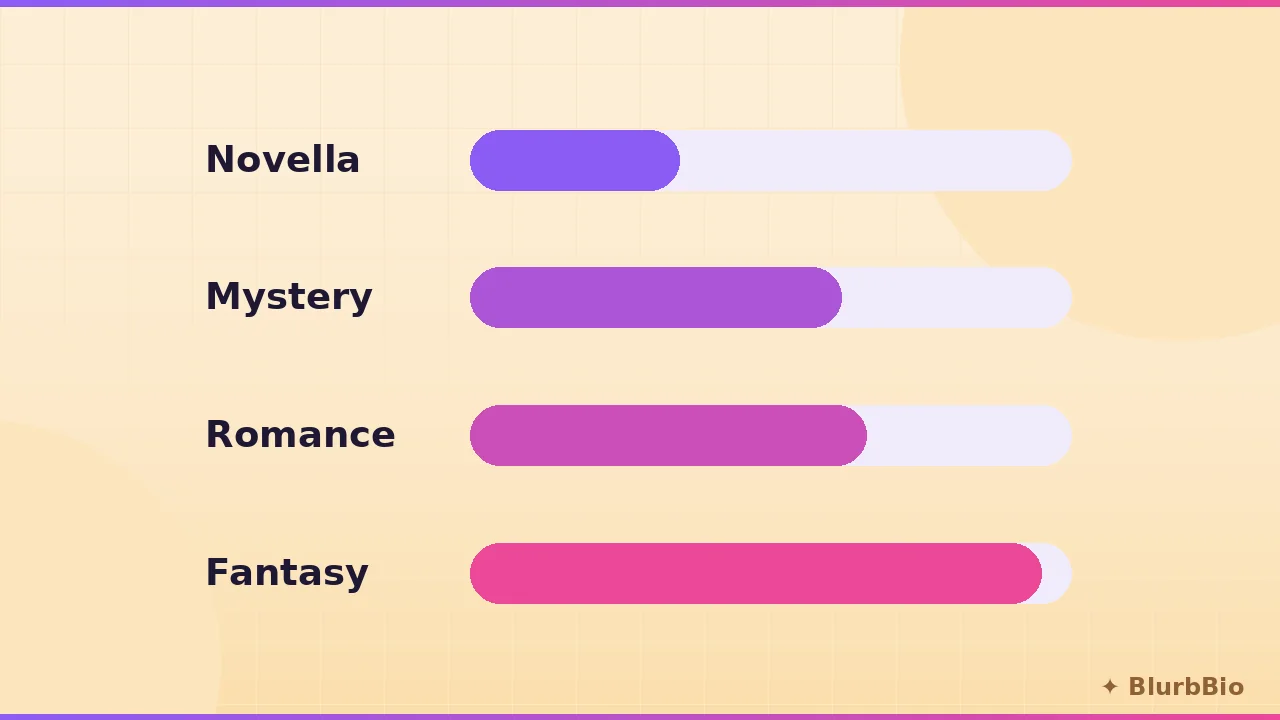
| Novella | 17,500 to 40,000 |
| Novel | 40,000 to 50,000 and up |
The novel line is usually quoted as 50,000, the NaNoWriMo target, though awards bodies place it as low as 40,000. In commercial practice the distinction barely matters: almost nothing between 40,000 and 60,000 words sells as an adult novel outside category romance and literary fiction, so the practical novel floor for most genres sits higher than the technical one.
The genre table
Ranges below reflect adult fiction as agents and publishers commonly cite them for querying authors in the mid-2020s. Individual houses and imprints vary; these are the fairways, not the rules of physics.
| Genre | Typical range | Debut guidance |
|---|---|---|
| Literary fiction | 70,000 to 100,000 | Flexible on both ends; quality carries |
| Thriller and suspense | 70,000 to 90,000 | Lean is a feature; pace sells |
| Mystery and crime | 70,000 to 90,000 | Cozy mysteries often 65,000 to 80,000 |
| Romance | 50,000 to 90,000 | Category lines 50,000 to 60,000; single title 80,000+ |
| Fantasy | 90,000 to 120,000 | Debut ceiling about 120,000; epic earns more later |
| Science fiction | 90,000 to 120,000 | Same ceiling logic as fantasy |
| Horror | 70,000 to 100,000 | Leaner skews are common |
| Historical fiction | 90,000 to 110,000 | Period detail buys the extra length |
| Women's fiction | 80,000 to 100,000 | Center of the adult market |
| Young adult | 50,000 to 80,000 | YA fantasy to about 90,000 |
| Middle grade | 25,000 to 50,000 | Upper MG fantasy to about 65,000 |
| Memoir | 60,000 to 80,000 | Reads like fiction ranges, enforced similarly |
Two patterns worth noticing in the table. Speculative genres get roughly 20,000 extra words, which is a worldbuilding allowance, not a pacing one; a 115,000-word fantasy is expected to spend the surplus on the world. And the genres built on propulsion, thriller, mystery, romance, cluster tightest, because their readers report abandonment fastest when pace sags.
Why the numbers exist
Three forces set the ranges, and none of them is taste.
Print economics. Paper, printing, and shipping scale with page count, while genre paperbacks sell inside narrow price bands. Every 10,000 words is roughly 40 more pages; past a point, the margin on a debut priced at market simply disappears. This is also why established bestsellers swell: their guaranteed sales absorb the cost.
Risk signaling. To an agent reading a query, 175,000 words from a debut does not read as ambition; it reads as a book that has not been edited yet, statistically a fair inference. The number gets a manuscript declined before the pages are opened, which is the cheapest rejection in publishing and the easiest to avoid.
Reader completion. Genres train stamina expectations. Romance readers finish books in a sitting or two and buy accordingly; epic fantasy readers signed up for the long haul. A book priced against its genre but sized against another violates a contract the cover made.
Self-publishing removes the gatekeeper but keeps the physics: print-on-demand costs still scale with pages, and readers carry the same instincts to Kindle, where the visible length estimate does the signaling instead of the spine.
The 50,000-word threshold itself has a practical genealogy worth knowing. National Novel Writing Month adopted it in 1999 as an ambitious-but-achievable monthly target, roughly the length of The Great Gatsby, and two decades of NaNoWriMo made it the culturally accepted floor even though the commercial floor for most adult genres sits 20,000 words higher. Meanwhile the page conversion that underlies all the print math is steadier than authors expect: a trade paperback carries roughly 250 to 300 words per page depending on trim and typesetting, which is why an 80,000-word novel lands near 320 pages almost regardless of who formats it, and why agents can estimate production cost from a query letter's word count alone. Series economics push the other way in self-publishing: in Kindle Unlimited, where payment tracks pages read, many full-time indie authors deliberately write 60,000 to 75,000-word books on faster release schedules rather than single 120,000-word volumes, trading length for velocity because read-through across a series out-earns thickness within one book.
Working with the number while you draft
The useful discipline is not hitting a target but noticing drift early. A thriller outline projecting 130,000 words is announcing a structural problem in act form, cheaper to fix now than in revision; a fantasy draft arriving at 70,000 is usually underdeveloped in the world or the middle, not admirably lean. Word count per chapter matters too: chapter lengths that swing wildly against genre norms are a pacing signal readers feel even when they cannot name it, which is why genre benchmarking of structure is worth running before revision rather than after. Project the total from your outline, check it against the table, and treat a big gap as information about the story, not a quota to force.
And when the draft lands outside the fairway anyway: over means cutting scenes, not sentences, since prose-level trimming rarely recovers more than five percent, and the five-pass self-edit does the surgery in the right order; under means the missing words are usually a subplot or a middle turn, which outlining frameworks diagnose quickly. The ranges are conventions, and conventions bend for a book that earns it. They just bend a great deal more readily for the author whose previous book proved they could.
See also: How to Outline a Novel · How to Self-Edit Your Novel · Best Writing Software for Novelists in 2026 · How to Write a Novel: The Complete Guide