Our complete story bible guide explains the why and the method at length. This article is the other half of the request we get most often: the template itself, section by section, field by field, ready to copy into any document and use tonight.
The design principle behind every field below is speed at the moment of invention. A story bible fails in exactly one way, staleness, and staleness comes from fields that take too long to fill while drafting. Everything here is fillable in under a minute.
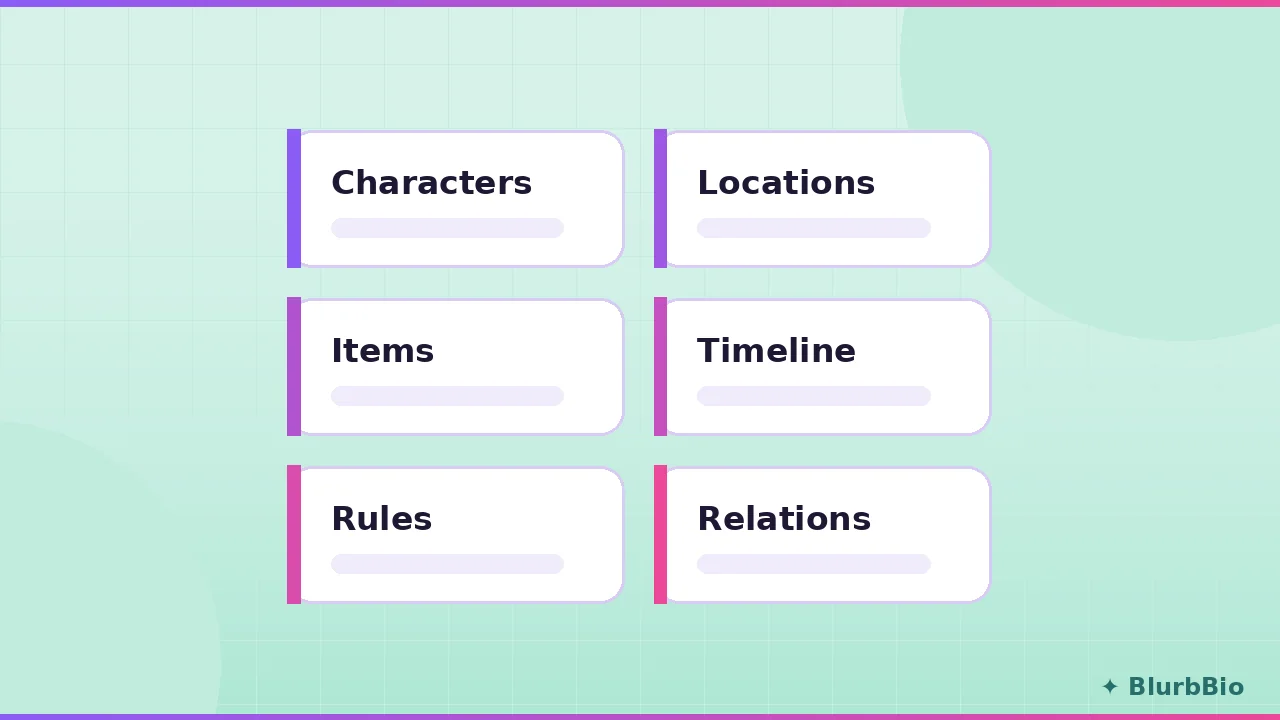
The eight sections at a glance
| Section | What it protects against |
|---|---|
| 1. Characters | Changing eyes, ages, skills, and knowledge |
| 2. Locations | Geography that rearranges itself between scenes |
| 3. Timeline | Impossible sequences and drifting dates |
| 4. World rules | Magic, technology, and law bending for the plot |
| 5. Relationships | Feelings and histories that reset without cause |
| 6. Items and objects | Objects that teleport, duplicate, or vanish |
| 7. Plot threads | Promises to the reader left unpaid |
| 8. Style and voice | Spelling, capitalization, and voice drift |
Section 1: Characters
One entry per named character, using these fields:
Name and variants (nicknames, titles, how each other character addresses them). First appearance (chapter). Physical commitments: only what the manuscript states on the page, with the chapter where each detail was established. Dated facts: age, birthday, anniversaries, anything arithmetic can contradict. Capabilities and limits: skills, languages, injuries, fears, and the scenes that established them. Knowledge ledger: what this character knows, and the chapter where they learned it. Voice markers: three to five recurring speech habits.
Here is what a complete entry looks like in practice, filled the way it would be mid-draft:
Every line above took seconds to log at the moment of invention and would take an hour to reconstruct in revision. The knowledge ledger is the field authors skip and regret. Characters acting on information they have not learned yet is among the most common serious continuity errors in unpublished manuscripts, and it is invisible without a record of who learned what, when.
Section 2: Locations
Per location: name and variants, fixed geography (what is north of what, travel times to other locations by each method used in the book), interior commitments (which floor, how many rooms, what is visible from the window), and established chapter per fact. Travel times deserve their own line because they generate silent math: if the ride took two days in chapter 6, chapter 30 cannot do it in an afternoon without an explanation.
Section 3: Timeline
A single running table: scene or chapter, in-world date or day number, duration, and elapsed time since the previous entry. Absolute dates are optional; relative arithmetic is not. Most timeline holes are not wrong dates but impossible durations, pregnancies of fourteen months, winters that last a week, a Tuesday that follows a Thursday. Five columns, one row per scene, filled at the end of each session.
Section 4: World rules
For speculative fiction this is the load-bearing section; for contemporary fiction it holds the smaller set of invented institutions and constraints. Per rule: the rule as stated, its cost or limit, known exceptions, and the establishing chapter. The cost field matters most: readers forgive a strange rule and punish a free one, and rules whose costs are never logged are the rules that quietly stop being paid in act three.
Section 5: Relationships
One entry per pair that matters: current state, history the manuscript has committed to, what each party knows about the other (secrets included), and state changes with chapters. Relationships are the fastest-changing facts in a novel, which is why they belong in their own section rather than inside character entries where the current state gets buried under biography.
Section 6: Items and objects
Only objects the plot touches: description as committed on the page, current holder, current location, chain of custody with chapters. The chain of custody is the whole trick. The letter, the weapon, the heirloom ring: when an object matters, readers track it better than authors do.
Section 7: Plot threads
Per thread: the promise made to the reader, the chapter that made it, current status (open, advanced, resolved, deliberately abandoned), and the resolution chapter once paid. Review this section at every act break. Unfired Chekhov's guns, the mysterious warning nobody follows up, the sister's journal that never reappears, are less continuity errors than broken promises, and readers name them in reviews. Our plot holes guide covers the seven varieties in depth.
Section 8: Style and voice
The lightweight appendix: invented-word spellings and capitalization, hyphenation decisions, units and date formats, per-character dialect decisions. Ten minutes of logging here saves your copyeditor hours and saves you the reader email pointing out that the magic system changed capitalization in part two.
The maintenance routine that keeps it alive
The template survives on one habit: at the end of every writing session, spend five minutes logging what the session established, new facts into their sections, changed states updated, new threads opened. The 2022 Alliance of Independent Authors survey found authors with a working system averaged 3.1 hours of continuity revision per manuscript against 14.3 hours without one; the difference is not the template, which anyone can copy, but the five minutes, which most authors stop paying around chapter ten, precisely when the book grows past what memory can hold.
That decay pattern is why the automatic version of this template exists as a product category: software that reads the manuscript, fills these same eight sections itself, and flags new chapters that contradict the record. The trade-offs between manual and automatic are covered honestly in the story bible software guide. Whichever you choose, the sections above are the sections; the only variable is who maintains them.
See also: How to Build a Story Bible · Worldbuilding Guide for Fiction Authors · How to Keep a Book Series Consistent · How to Write a Novel: The Complete Guide