Tolkien spent decades building Middle-earth before writing The Lord of the Rings. His invented languages, mythological histories, and genealogical tables fill volumes that were never intended for publication. The Silmarillion, published posthumously, covers thousands of years of world history that appear in the main trilogy only as texture, resonance, and depth.
That depth is what readers feel when they enter his world. They don't need to read The Silmarillion to sense that Middle-earth has been old for a very long time. The feeling comes from consistency, from the fact that every detail has a cause, every custom has a history, every conflict has roots.
This guide covers every layer of a fictional world, the order to build them in, and the discipline that keeps it consistent.
The Worldbuilding Iceberg
The mistake most beginning writers make with worldbuilding is the same mistake they make with exposition: they put everything on the page.
The worldbuilding iceberg works like this: what readers see in your text is the visible tip. History, economics, theology, deep mythology, these form the submerged mass that the visible world rests on. Readers don't read the submerged mass. They feel it. The world feels solid because it has weight beneath the surface, even when that weight is invisible.
Tolkien knew the complete creation mythology of Middle-earth before he wrote a word of The Fellowship of the Ring. That mythology never appears in the main trilogy. It appears as residue, in the weight of ancient names, in the ruins characters pass without comment, in the way Galadriel speaks about ages that no living person remembers.
The practical implication for writers: you need to build more world than you show, and show only what creates tension. A piece of world information earns its place on the page when it changes what's at stake in a scene. If it doesn't change the stakes, it belongs in your story bible, not your manuscript.
Geography: The Layer That Touches Everything
Geography is the most underrated worldbuilding layer. Authors spend months on magic systems and an afternoon on maps, then discover, three hundred pages in, that a journey that took a week in chapter 6 somehow takes a day in chapter 22.
Geography constrains everything else:
- Climate determines what food is available, which determines social structure, which determines political priorities
- Natural barriers, mountain ranges, oceans, rivers, explain why kingdoms exist where they do
- Travel time creates the rhythm of plot. A message that takes eight days to arrive changes what's possible in ways that a two-hour message does not
- Resource distribution explains almost every war in history, real or fictional
The one thing every author must do before drafting: create a travel time table. For every pair of frequently-visited locations in your story, write down how long the journey takes by every available means. Pin it next to your manuscript. Check it every time a character travels.
Distance inconsistency in published fantasy is not rare. It is extremely common. Readers in genre communities maintain lists of contradictory travel times in bestselling series. They notice. A travel time table costs thirty minutes to create and prevents the most embarrassing continuity errors in the genre.
Magic and Technology Systems: Rules Before Wonder
Brandon Sanderson's First Law of Magic: An author's ability to solve conflict with magic is proportional to how well the reader understands the magic.
This law has three implications that practicing authors need to understand:
1. Undefined magic can create wonders but cannot resolve plot. If your reader doesn't understand the rules, you cannot use magic to solve a problem, the solution will feel arbitrary. Deus ex machina happens when magic has wonder but no rules.
2. Defined magic creates expectations readers will hold you to. Once you establish that magic has a cost, every use of magic without a cost will register as an error. The rules you set in chapter 2 are promises you make to the reader for the rest of the book.
3. The best magic systems are constrained, not limitless. Constraints create story. A magic user who can do anything faces no dramatic tension when threatened by a magical problem. A magic user who can do specific things, and not others, faces real stakes.
The three-sentence magic system test: if you cannot define your system in three sentences covering capability, cost, and limitation, you don't have a system yet. You have wonder. Wonder is valuable, but wonder alone cannot resolve plot.
History and Society: Building Backwards from the Present
The most common mistake in worldbuilding history is building forward, starting with creation mythology and working toward the present. This produces encyclopaedic history that doesn't connect to your story because you built it before knowing what your story needed.
Build backwards instead:
- Where is your world now? What is the current political situation, the dominant religion, the economic conditions?
- What event created this? For every current condition, identify the most recent major historical cause.
- What created that event? Go one layer deeper. The war that created the current borders, what caused the war?
Two to three historical layers is enough for most novels. Tolkien went much deeper, but Tolkien had decades and was building mythology as much as narrative. For a single novel, knowing why the world is currently broken, and the two events that broke it, produces enough history to make the world feel old.
Society and culture emerge from geography, history, and survival. The social structures in your world should be explicable by what the people in it needed to do to survive. A maritime culture worships different gods than a nomadic steppe culture. A society that survived by collective farming has different values than one that survived by conquest.
N.K. Jemisin's approach to the Stillness in the Broken Earth trilogy demonstrates this precisely: the society's obsessive stability, its dehumanisation of orogenes, its comm-based structure, all emerge directly from the world's geological reality. The social structures aren't invented arbitrarily; they're evolved responses to an environment that kills unpredictably and often.
The Worldbuilding Consistency System
Building a world and keeping it consistent across a 100,000-word manuscript are two different problems. Many authors solve the first problem and assume the second follows automatically. It does not.
The worldbuilding consistency problem is a documentation problem. The rules you invented on page 40, the cost of magic, the travel time between cities, the religious prohibition that shapes your character's choices, are the constraints you'll violate on page 340 if they aren't written down.
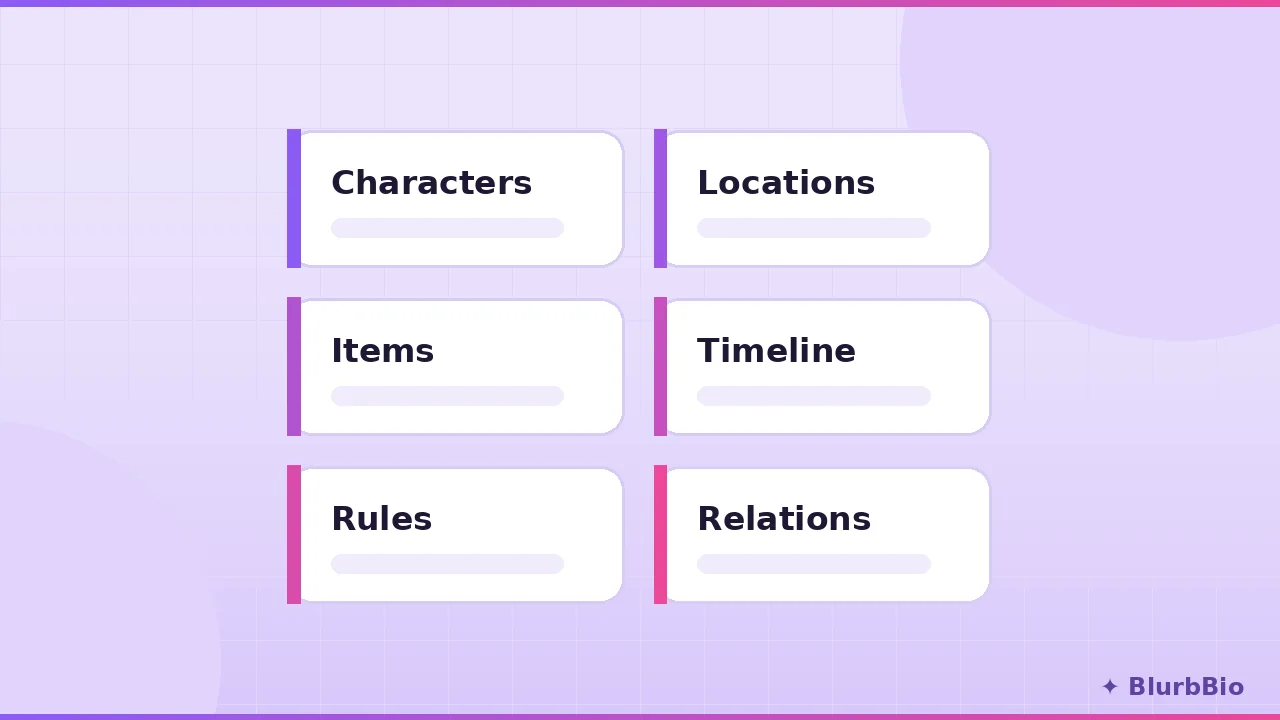
The five-category world bible:
Every worldbuilding note should fall into one of five categories, each maintained as its own section:
- Geography, Locations with sensory detail, climate, resources, and travel times between all frequently-visited pairs
- Systems, Magic, technology, or any rule-governed capability. Rules, costs, limits. Explicitly stated, in writing, not just "held in mind"
- History, Significant events that shaped the current world, listed chronologically, with cause and effect chains
- Factions, Every organization with goals, methods, key members, and current status
- Lore, Everything else: deep mythology, religious doctrine, cultural customs, naming conventions, historical figures
The test for every entry: can you check a new scene against it in under thirty seconds? If finding an entry requires reading through paragraphs of prose notes, the documentation format is wrong. Use headers, bullet points, and specific declarative statements.
Genre-Specific Worldbuilding Priorities
Different genres demand different worldbuilding depths. A contemporary thriller set in a real city needs minimal geography invention but extensive research into real institutions, procedures, and subcultures. A secondary-world epic fantasy needs deep geography, history, and systems but can invent freely. Science fiction near-future requires consistent extrapolation from real science. Historical fiction requires research rigour equivalent to academic history.
The One Rule That Covers Everything
Every worldbuilding element, geography, magic, history, society, lore, follows a single underlying rule:
The world must be internally consistent with itself, even when it is inconsistent with reality.
Readers will accept dragons, faster-than-light travel, economies that run on magic gems, and societies with values completely alien to contemporary Western culture. They will not forgive a world that contradicts itself. The magic that cost the user consciousness in chapter 4 must still cost them something in chapter 34. The city that was three days' ride away in chapter 8 cannot become half a day's ride in chapter 27.
Consistency is the contract. Everything else, the wonder, the history, the culture, the depth, is what makes readers want to enter the world. Consistency is what makes them trust it enough to stay.
See also: How to Build a Story Bible · The 7 Types of Plot Holes (And How to Fix Every One) · Story Bible Software · Campfire Alternative · How to Write a Novel: The Complete Guide