Readers almost never tell you why they quit your book. They just stop, silently, usually somewhere in the middle third, and the only trace is a review that says "couldn't get into it" or a Kindle progress bar frozen at 43%. When readers do name the cause, they call it pacing, which is the most diagnosed and least understood complaint in fiction, because pacing is not speed. Pacing is the rate at which things change, and readers quit not where books are slow but where books stop changing.
That definition converts pacing from a vibe into something you can audit. Here is the audit, level by level, and the fixes.
The scene-fuel test: goal, obstacle, change
Pacing problems are built one scene at a time, so the diagnostic starts there. Every scene runs on three fuels: a goal (what the POV character wants inside this scene, concretely, now), an obstacle (what resists them, a person, a fact, themselves), and a change (something is different at the scene's end: the plot state, a relationship, or what the reader knows). Run the test across your manuscript, one line per scene, marking which fuels are present.
The results sort scenes into three bins. Scenes with all three are pulling their weight. Scenes missing one can usually be repaired by adding it, most often the goal, because drifting scenes where characters chat and process are usually goal-less scenes. Scenes with none, and every manuscript has them, are inert: they exist to move characters into position, repeat an established emotion, or deliver information a livelier scene could carry. These cut cleanly or fuse into neighbors, and the fusion move (give this scene's one useful job to the scene next door) recovers pace with zero story loss. A saggy stretch, when you audit it, is almost always three or four consecutive scenes failing the change question, which is why the stretch feels slow even when its prose is quick.
Anatomy of the mid-book sag
Drop-off concentrates in the middle third of novels for a structural reason: the opening's questions have been priced in, the ending's gravity has not yet engaged, and too many second acts consist of the protagonist pursuing the same goal the same way while the author arranges furniture for the finale. Repetition without escalation is the sag's signature: the third interview, the fourth clue, the second argument that makes the first argument's point again.
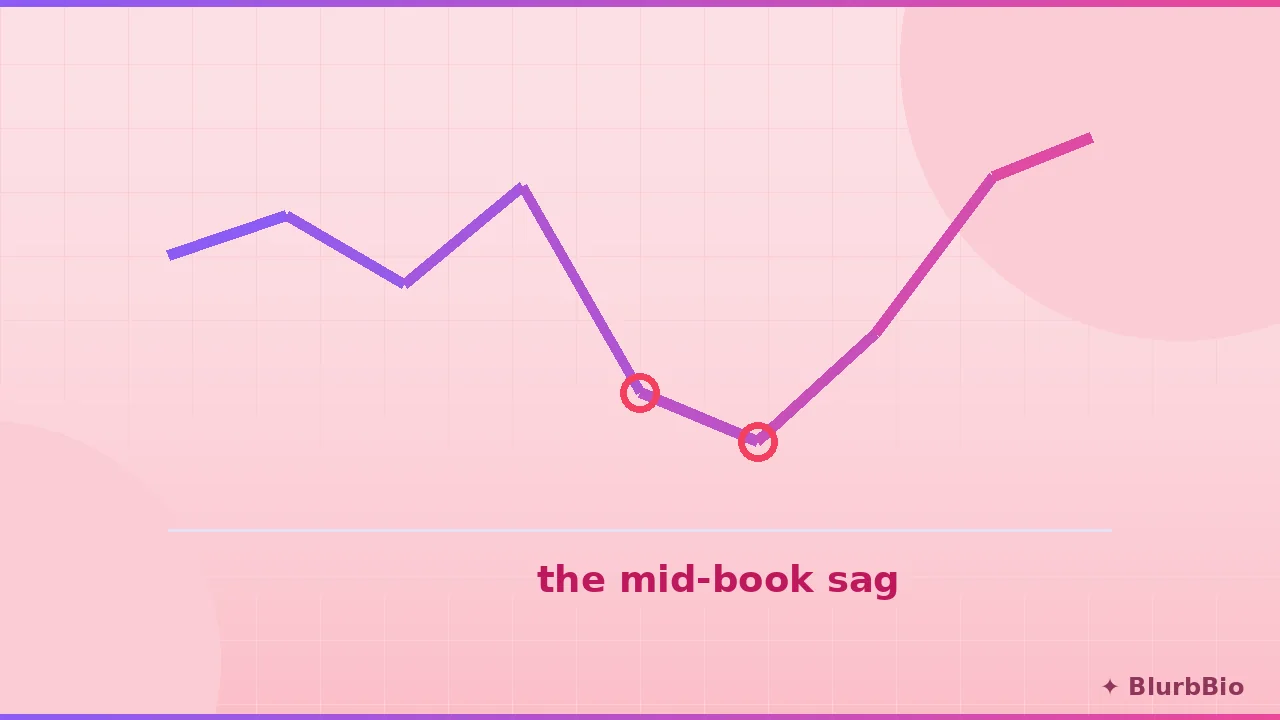
The load-bearing fix is the midpoint turn: a reversal near the story's center that changes the goal, the rules, or the protagonist's understanding, so the second half is a different pursuit rather than more of the first. Around it, complications must escalate rather than accumulate, each obstacle costing more than the last, and subplots must braid into the spine rather than pause it, because a subplot that halts the main question rather than complicating it reads as an intermission. Diagnostically, this stretch is exactly where analysis pays: here is BlurbBio's Drop-Off Predictor running on a 50-chapter test manuscript, flagging the DNF danger zones by chapter, including a detected mid-book sag across chapters 18 to 21:

Chapter-level DNF danger zones ranked by severity: the machine finds the sag; the fixes above are how you repair it.
The two clocks: layered tension
Momentum between turns comes from open questions, and the reliable pattern is running two clocks at once: a scene question that opens and closes within a chapter or two (will she get into the archive tonight?) and a story question that stays open for acts (what happened to Lily?). The scene clock delivers constant small payoffs; the story clock makes each payoff matter. Sag, examined closely, is often a single-clock stretch: the story question idling while scenes resolve only local business, or, in the exhausting-book failure mode, scene incidents firing constantly with no story question to charge them.
This is also where chapter mechanics join the system: chapter length is the throttle readers feel most directly, and breaks placed on open questions convert stopping points into continuation points, machinery covered in full in the chapter length guide. Shortening chapters through a slow stretch, and toward the climax, is a legitimate mechanical assist, but note the order of operations: throttle work amplifies a working engine and cannot replace one.
The fix sequence, and the too-fast trap
Pacing revision runs top-down like all effective revision: structural first (install the midpoint turn, cut and fuse the inert scenes, braid the subplots), then scene-level (enter every scene later and leave it earlier; the openings of scenes carry most of a manuscript's removable fat), then chapter mechanics (lengths and break placement), and only last, prose rhythm, sentence variety and scene-versus-summary balance, which polishes pace but never creates it. Authors who start at the prose level experience the classic frustration of cutting 8,000 words and feeling no faster, because readers do not quit over adjectives; they quit over chapters where nothing changed.
One pacing killer deserves separate indictment because it disguises itself as depth: backstory placement. Flashbacks and history dumps stop both clocks at once, the scene question and the story question, which is why a flashback chapter in the sag zone is compound interest on the problem. The discipline is need-to-know delivery: backstory enters in the scene where the present-tense story requires it to make sense, in the smallest unit that does the job, and ideally under pressure, revealed in conflict rather than reflection. The test for any flashback is whether the present-day scene that follows it plays differently because the reader now knows; if not, the flashback was a rest stop, and rest stops in the middle third are where readers get out of the car.
And guard the opposite flank: books can pace themselves to death. Relentless incident without consequence reads as noise, since tension requires each change to land before the next arrives, and the fix is the sequel beat, a short breath of reaction and processing after major turns that converts event into meaning. Pacing, finally, is that conversion rate: not how fast things happen, but how fast they matter. Audit for change, repair the middle, keep two clocks running, and the silent quitters, most of them, keep turning pages instead.
See also: How Long Should a Chapter Be? · How to Self-Edit Your Novel · How to Find Beta Readers · How to Write a Novel: The Complete Guide