Here is the uncomfortable arithmetic of book browsing: the cover earns a tap, the blurb earns the sample, and the whole transaction between a browser and your book's product page lasts seconds. In those seconds, the blurb is the only writing of yours the buyer will ever see, which produces the great irony of the form: 150 words of copy determine whether 90,000 words of story get their chance, and most authors spend three years on the latter and an evening on the former.
Blurbs are learnable copywriting with a stable formula. This is the formula, the length math, and the mistakes that quietly kill conversion.
What a blurb is, and the one thing it is not
A blurb is advertising. Its only success metric is whether the browser starts the sample, which means its operating principle is the opposite of a summary's: a summary resolves curiosity, a blurb manufactures it. Every converting blurb opens a specific question, what is in the marsh, who is sending the letters, why must she marry the enemy prince, and then ends, leaving the question priced at one click.
Hold that principle and the form's rules all become obvious: no twists revealed, no third-act material, no answer to the question you opened. The blurb operates inside roughly the first quarter of your story, the protagonist, the destabilizing event, the stakes, and treats everything after the point of no return as protected inventory.
The three-beat formula
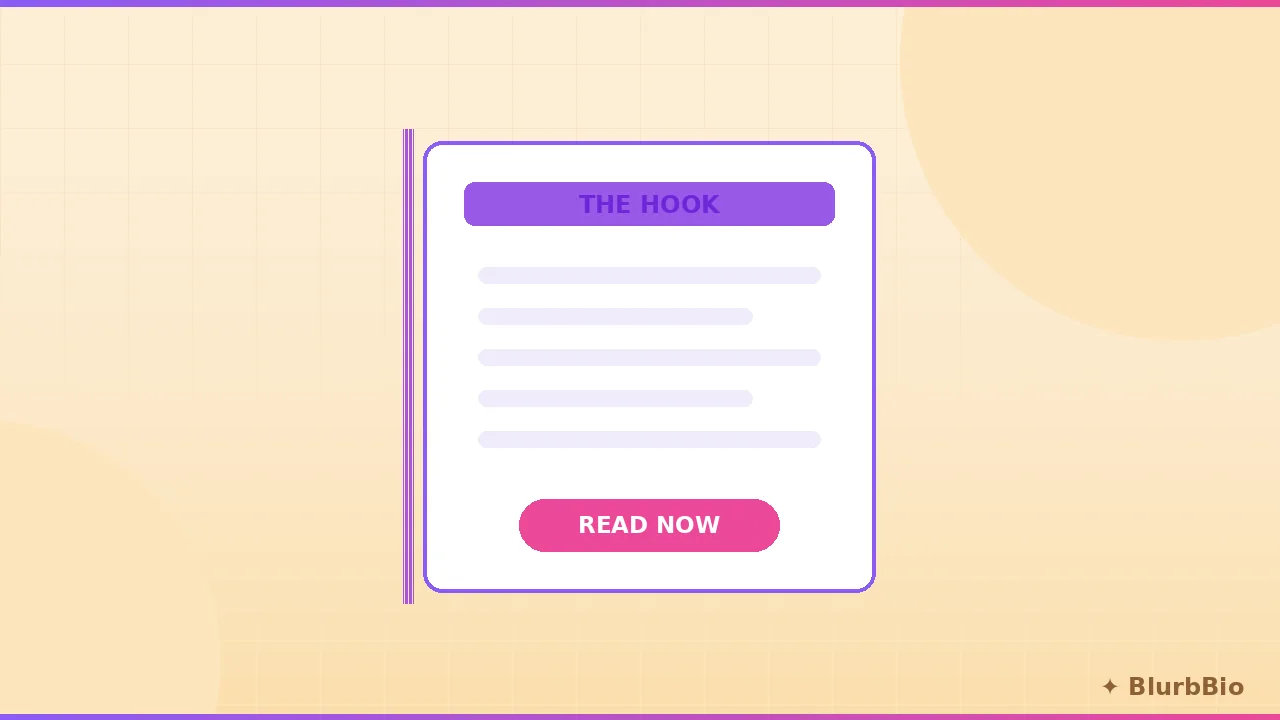
Beat one, the hook. Protagonist plus destabilizing event, in one or two lines, opening the question. Name the character, establish one identifying pressure, and detonate the situation: "Investigative journalist Nora Ashworth swore she'd never return to Harrowfield. Then a body surfaces in the salt marsh where her sister vanished twenty years ago." Concrete nouns, active verbs, no backstory, no weather.
Beat two, the escalation. What pursuing this costs and what opposes it, with stakes stated concretely. Vague stakes ("nothing will ever be the same") are the beat's most common failure; the fix is specificity of loss: what does she lose if she fails, and who is making sure she does. Two to four lines, at most one new named character, ideally the opposition or the love interest.
Beat three, the withhold. The gesture at a turn you refuse to show, classically a but-line: "But the body in the marsh is only the first secret Harrowfield has kept." Then stop, on the question, never the answer. If your genre uses taglines, one italic line above or below the blurb ("Some towns bury their dead. Harrowfield buries its truth.") does the emotional signaling.
Length, formatting, and the fold
The working target is about 150 words, with 200 as a practical ceiling, in three short paragraphs, because retail pages truncate: on Amazon, only the opening line or two shows before "Read more," which makes your first sentence a blurb within the blurb. Format for scanning, short paragraphs with white space between them, an optional bolded tagline or hook line up top where the platform allows it, and write in third person present tense regardless of the book's own POV, the near-universal convention because it reads as the book presenting itself.
Genre signaling runs through every choice here: word choice, sentence rhythm, and trope vocabulary tell a romance reader or a horror reader "this is for you" faster than any category tag. In trope-driven genres, especially romance and romantasy, naming the tropes plainly (enemies to lovers, one bed, morally grey) is not lazy, it is the discovery language readers shop in. The blurb's promises, genre, tone, heat, pace, are promises the manuscript must keep, because mismatch converts into returns and reviews instead of sales.
The kill-list of common mistakes
The failures repeat so consistently they can be listed: opening with the world instead of the person ("In the kingdom of Veyra, magic has rules..."), naming more than three characters, summarizing act two, rhetorical-question openers ("What would you do if..."), vague superlative stakes, praise-adjectives about your own book ("a thrilling, unforgettable tale"), and comparing yourself to megahits, which is the comp-title mistake wearing marketing clothes. Every one of these is a summary instinct or an ego instinct displacing the sales instinct.
Series and platform add two wrinkles worth planning for. A series blurb sells the individual book's question while signaling the series promise, reading order, and completeness ("Book two of the Harrowfield trilogy; can be read standalone" when true), because series readers shop for commitment terms as much as premise. And unlike almost anything else you write, blurbs generate live data after launch: a page that gets traffic but not sales is a blurb problem or a mismatch problem, and swapping the description costs nothing, which is why professional indies rewrite blurbs the way marketers rewrite ads, testing openings against click-through in ad campaigns and revising the page when a book's conversion lags its category.
Then test the thing, because blurbs are the most testable writing you will ever do: read it aloud, put it beside five bestselling blurbs from your exact subgenre and check that it sounds native, ask someone who hasn't read the book what question the blurb leaves them with, and if they can't name one, you have written a summary. Revise until the question is unmissable and unanswered. That question is the product; the book is just how the reader pays for the answer.
See also: How to Write a Query Letter · How to Find Comp Titles · How to Write Romantasy · How to Write a Novel: The Complete Guide