Every author using any AI tool eventually meets the same checkbox in the KDP publishing flow, and most meet it unprepared. The question looks simple. The confusion around it is not: writing communities are full of authors who believe any AI use requires disclosure, authors who believe heavy editing erases the requirement, and authors who quietly skip the question because they cannot tell which bucket they are in.
The policy itself is clearer than the discourse around it. This guide quotes what Amazon actually requires, maps the common tools and workflows to the correct answer, and covers what enforcement looks like in 2026, so you can answer the checkbox in ten seconds and move on with your launch.
The two definitions that decide everything
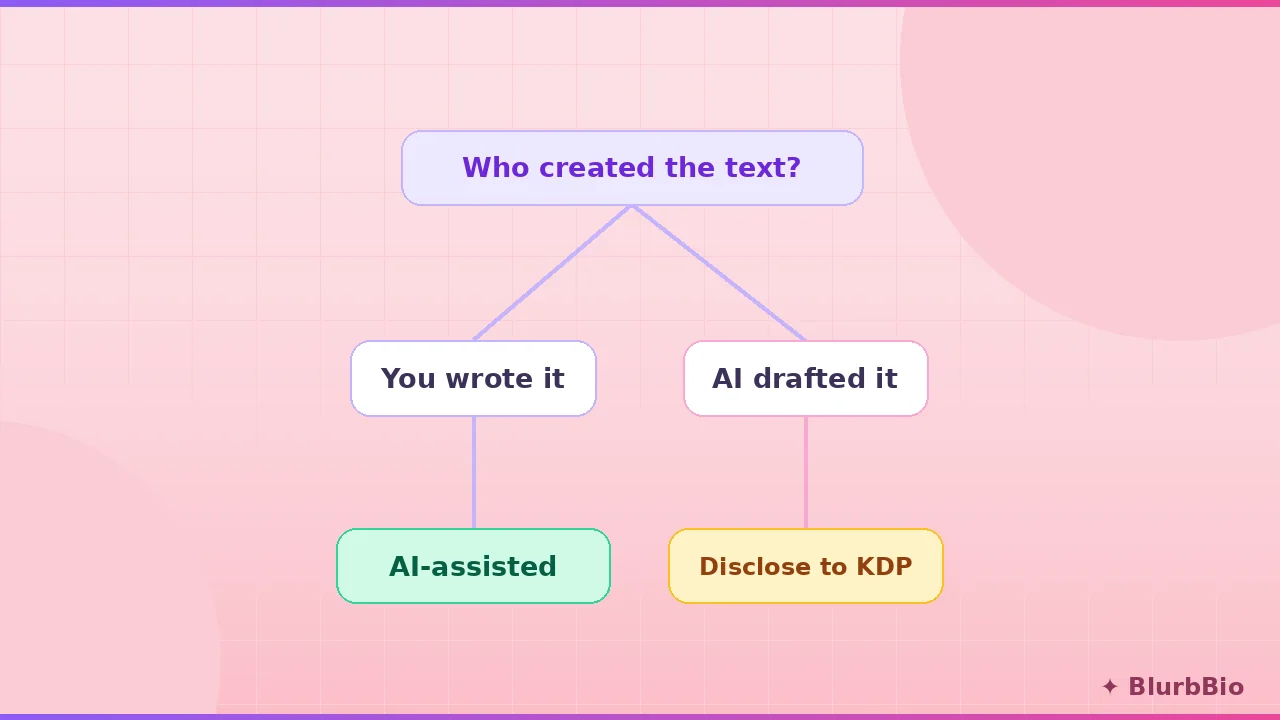
Amazon's content guidelines draw exactly one distinction, and every disclosure decision reduces to it.
AI-generated content is text, images, or translations created by an AI-based tool. The policy is explicit that this classification holds even if you edited the output afterward. If an AI drafted the scene, the scene is AI-generated, whether you published it raw or rewrote half the sentences.
AI-assisted content is content you created yourself, where AI helped you refine, edit, error-check, or improve it, or helped you brainstorm and outline before you wrote. Amazon states directly that AI-assisted content does not require disclosure.
The test is not effort, quality, or percentage of words changed. It is authorship of the initial content. That single fact resolves most of the edge cases authors argue about.
Every common workflow, classified
Here is where the tools authors actually use fall under those definitions. The classification is about what the tool did in your specific workflow, not the tool's brand, but these are the typical uses.
| Workflow | Classification | Disclose? |
|---|---|---|
| Grammar and style checking (Grammarly, ProWritingAid) on text you wrote | AI-assisted | No |
| Brainstorming plots, characters, or what-ifs in a chat, then writing the prose yourself | AI-assisted | No |
| AI-built outline that you then write from, in your own words | AI-assisted | No |
| Manuscript analysis: plot hole detection, continuity checking, pacing, dialogue reports | AI-assisted | No |
| AI drafting scenes, chapters, or descriptions that you revise (Sudowrite, ChatGPT drafting, Novelcrafter prose generation) | AI-generated | Yes |
| AI rewriting your paragraphs so substantially the output is new prose | Gray zone, treat as AI-generated | Yes, when in doubt |
| AI-generated cover art or interior images (Midjourney, DALL-E, and similar) | AI-generated | Yes, images category |
| Machine translation of your book, even with human review | AI-generated | Yes, translations category |
Two rows deserve emphasis. The rewriting row is the genuine gray zone: light smoothing of your own sentence is assistance, but feeding a paragraph in and accepting a fundamentally new paragraph back edges into generation, and the safe reading of the policy is to disclose when the output no longer resembles authorship. And the translation row surprises people every year: Amazon names translations explicitly, so a machine-translated edition is disclosable even when a human editor reviewed every line.
Where the checkbox lives and what it asks
The disclosure sits in the Book Content tab of the KDP setup flow, the same page where you upload your manuscript and cover, for both new titles and republished updates. Amazon asks separately about text, images, and translations, so a human-written novel with an AI-generated cover discloses images only.
Three facts about the mechanics that defuse most of the anxiety. The disclosure is private: it goes to Amazon and appears nowhere on your product page, with no badge or label visible to readers as of 2026. Amazon has stated it does not affect ranking, visibility, or royalties. And you can update it retroactively: existing titles can have their disclosure corrected from the Bookshelf at any time, which Amazon treats far more favorably than discovered non-disclosure.
What enforcement actually looks like in 2026
The disclosure requirement dates to September 2023, introduced after months of discussions between Amazon and the Authors Guild, but enforcement has tightened substantially through 2025 and 2026. Amazon combines automated signals, including writing-pattern analysis and submission velocity, with human review, and the reported escalation path runs from a notification email, to title suppression during review, to permanent removal, to account flags, and in repeated cases account suspension with royalties at risk.
The pattern in the reported cases is consistent: enforcement lands on undisclosed generation and on high-volume, low-quality publishing operations. There is no documented pattern of penalties against authors who wrote their own books and used assistive tools, because there is nothing to disclose in that workflow. If you are a working novelist using AI for editing, checking, and brainstorming, the policy was effectively designed to leave you alone, a balance the Authors Guild specifically praised when the rule was introduced.
The workflow that stays cleanly assisted
If your goal is to use serious AI tooling and never think about the checkbox again, the boundary to protect is a single one: no AI drafts prose that enters the manuscript. Everything on the other side of that line is available to you.
That means you can brainstorm against an AI freely, as long as the sentences that land on the page are typed by you. You can run deep manuscript analysis: continuity checking against your established canon, plot hole detection, pacing and drop-off analysis, dialogue authenticity reports. You can use AI-built outlines, AI research summaries, and AI editorial letters. None of it creates book content, so none of it is disclosable, and just as importantly, none of it touches your voice.
It is also worth keeping light records. Several platforms now recommend documenting your process, and a folder of dated drafts demonstrating that the prose originated with you is cheap insurance if a classification question ever arises.
One honest caveat to close on: this article describes Amazon's policy as published in mid-2026, and platform policies change. Before every publish, the two minutes it takes to skim the current KDP content guidelines is worth spending, and nothing here is legal advice.
See also: Best Writing Software for Novelists in 2026 · What Is Developmental Editing? · Sudowrite Alternative · How to Write a Novel: The Complete Guide