Readers forget plots. They can adore a book and, a year later, misremember who stole what and why the city fell. What they do not forget is the moment a character they loved finally stopped lying to themselves, or refused to and paid for it. That moment is the arc, and it is the part of your novel doing the emotional heavy lifting while the plot gets the credit.
An arc is not a vibe of growth. It is machinery, with parts that can be named, assembled, and tested. Here is the full system.
The engine: lie, want, need
Nearly every functional change arc runs on the same three-part engine.
The lie is a false belief the character holds about themselves or the world, installed by backstory: love is weakness. I am only worth what I achieve. If people knew the real me, they would leave. The lie is not stupidity; it was a rational adaptation to something that happened, which is why it is so hard to give up.
The want is the concrete external goal the character pursues on the page: win the case, take the throne, get the girl, survive the winter. The want is what makes the plot go.
The need is what would actually resolve the character's internal problem, and it is almost always in tension with the want, because the character's strategy for pursuing the want is built on the lie. The character who believes love is weakness wants the throne and needs to let someone in; her lie guarantees she pursues the first in a way that destroys the second.
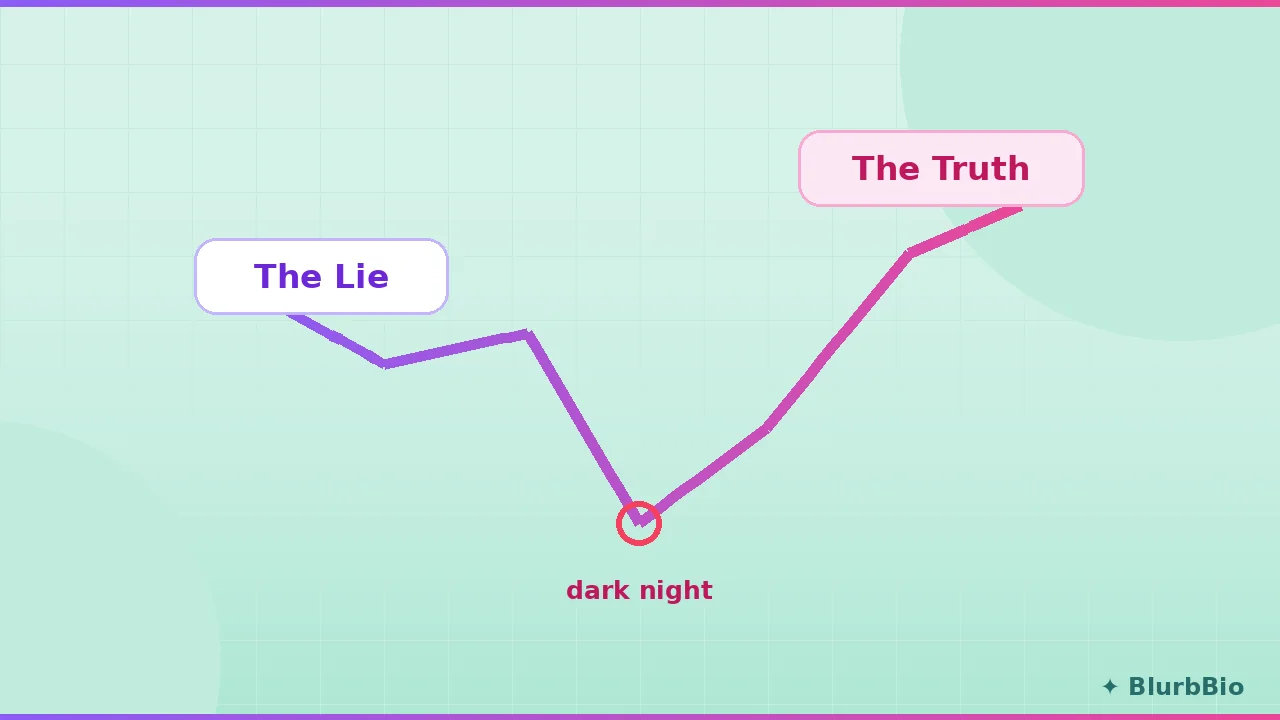
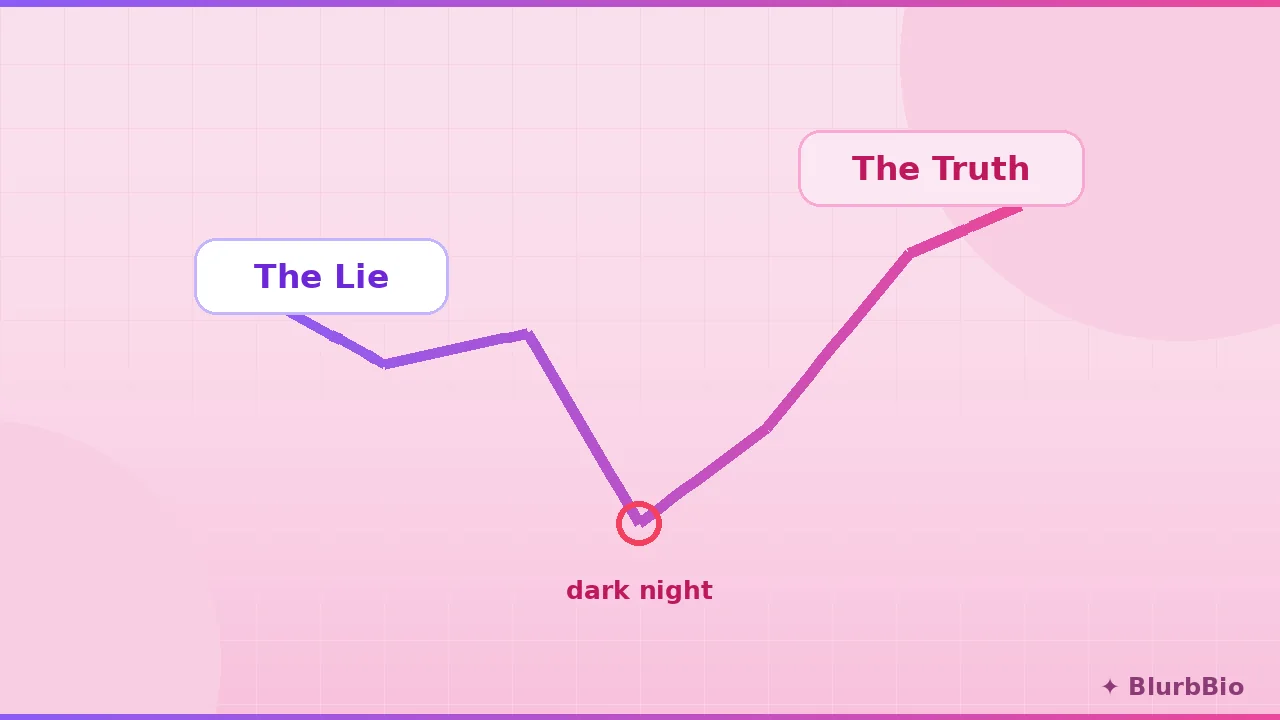
The arc is the story of the gap between want and need closing, one costly scene at a time. Plot beats are experiments run against the lie: early on, the lie seems to work; then it starts charging interest; at the low point it costs something irreplaceable; and at the climax the character either abandons it and acts from truth, or doubles down.
The three arc types
Positive change arc. The default of commercial fiction: the character overcomes the lie and ends closer to truth. The satisfaction comes from earned cost; a positive arc where the truth is adopted cheaply reads as sentimental. The proof-of-change beat, a late scene where an early situation recurs and the character chooses differently, is what makes the change legible. If your beta readers say the ending felt unearned, the missing part is almost always either the early lie-in-action scene or this mirrored proof scene.
Negative change arc. The character descends: embracing the lie fully (corruption), trading truth for the want (fall), or discovering a devastating truth and being broken by it (disillusionment). Negative arcs are having a commercial moment; the 2026 reader appetite for morally grey leads, villain perspectives, and dark subgenres runs directly through them. The craft demand is sympathy management: the reader must understand every step of the descent as the character's best available choice, or the arc reads as authorial cruelty. If you are writing in the darker end of the market, our dark romance guide covers how negative and ambiguous arcs carry those books.
Flat arc. The character already holds the truth, and the story tests it: the world pressures them to abandon it, they refuse, and the world changes instead. Flat arcs are not archless; the pressure curve is identical, but it bends the setting and supporting cast rather than the lead. Detective series, action franchises, and mentor-figure protagonists live here. The failure mode is passivity: a flat-arc lead must pay escalating costs for holding their truth, or they are just a person things happen near.
| Arc type | Character ends | Reader payoff | Classic risk |
|---|---|---|---|
| Positive change | Closer to truth | Earned hope | Unearned, too-cheap change |
| Negative change | Deeper in the lie | Tragic clarity | Losing reader sympathy mid-descent |
| Flat | Same truth, tested | Steadfastness vindicated | Passive lead, world arcs without cost |
Mapping the arc to structure
Arc and plot are not parallel tracks; they are one track viewed internally and externally, and they must touch at five specific points. If you outline, place these deliberately; if you discover-draft, verify them in revision. Our outlining guide covers the structural frameworks these beats live inside.
Setup: the lie in action. Before anything explodes, the reader watches the lie work as a strategy, with a visible cost the character does not count. First test: the want acquired. The inciting chain gives the character a concrete want, and their lie-shaped pursuit of it commits them. Midpoint mirror. Something forces the first honest glimpse of the need; the character usually sees it and swerves. This is the beat most manuscripts are missing, and its absence is why so many middles sag, the plot escalates but the internal story stalls. Low point: the lie's bill. The strategy fails catastrophically at the worst moment, costing something the character cannot recover. Climax: proof. The mirrored choice, made differently. Or, in a negative arc, made the same way with full knowledge, which is its own terrible proof.
A one-line arc summary is the highest-leverage sentence in your planning notes: "[Name] believes [lie], wants [want], needs [need], and at the climax chooses [need or lie] at the cost of [price]." If you cannot fill it in, the arc is not designed yet. Store it in your story bible where every drafting session can see it.
Arcs at series length
Series multiply the arc problem. Two architectures dominate. Stacked arcs give each book a complete stage of growth while a meta-lie dissolves across the whole series; romantasy and epic fantasy run this way, which is part of why those genres reward series so heavily. Flat lead, rotating arcs keeps the protagonist's truth stable while each installment arcs a client, a victim, a rival; most detective fiction runs this way.
Both architectures die the same death: the reset, where growth achieved on the last page of book two has silently evaporated by chapter three of book three, because the author drafted the sequel eight months later from memory. Readers binge series in days and catch this instantly. Character state at end-of-book, what was learned, what was forgiven, what was promised, is exactly the kind of canon that belongs in a maintained series bible; our series consistency guide treats this at length.
The consistency traps
Three traps flatten otherwise sound arcs in the drafting trenches.
Behavior that outruns the arc. In chapter nine the character acts from wisdom she is not due to earn until chapter twenty-four, because the author, who already knows the ending, leaked it. Every choice must be legal for the character's current position on the curve.
The vanishing wound. The backstory that installed the lie gets established in chapter two and never pressures anything again. The wound should be load-bearing: the specific shape of the lie, and the specific situations that trigger it, come from the specific thing that happened.
Voice that does not move. Change should register in how a character speaks and what they notice, not just in what they decide. A character who has genuinely stopped believing "I am only worth what I win" argues differently, apologizes differently, jokes differently. If your climax chapter dialogue could be pasted into chapter one without friction, the arc is asserted, not dramatized; the levers in our dialogue guide are how you dramatize it.
Plot makes readers turn pages. Arc is why they close the book changed, press it on a friend, and preorder the next one. Build the engine, wire it to your structure at the five contact points, and guard its consistency like the asset it is.
Test yourself: read the arc
Three quick diagnostics. Answer all three to get your read.
BlurbBio's Story Bible tracks character arcs and progressions chapter by chapter across a manuscript, including imported drafts written elsewhere.
See also: How to Write Compelling Characters · How to Write Dialogue · How to Outline a Novel · How to Keep a Book Series Consistent