Writers agonize over how character names sound. Almost nobody thinks about what they mean, even though for most of human history the meaning was the point. So we did something slightly obsessive: we counted.
Our name generator carries 4,803 curated names: 2,469 modern names across 23 cultures, 1,016 more across 8 historical era pools from Heian Japan to Imperial Russia, 1,101 archetype names, and 217 deities across 7 mythologies. For every real-culture name where the etymology is documented, we hand-curated a short meaning from standard onomastic references, 2,586 etymologies in total. Then we ran frequency analysis on what those meanings actually say.
What humanity names its children
Strip away the languages and the clusters are startlingly consistent. The dominant meaning families in the corpus:
Descent and family. The single most common semantic element, appearing in some 60 glosses directly and underpinning most surname systems: son of, child of, descendant of. Patronymic machinery (Johnson, Ivanovich, ben Ya'akov, Fitzwalter, O'Brien, MacDonald) is humanity's default surname technology, independently invented almost everywhere.
Rulership and power. Fifty-three names in the corpus carry meanings built on ruler, king, or command. Henry (ruler of the home), Frederick (peaceful ruler), Dominic, Vladimir, Malik-adjacent forms: parents across every culture in the dataset have named children as small predictions of authority.
Brightness and light. Forty-seven names gloss on bright and thirty-six more on light: Clara, Roxana, Phoebe, Lucian, Zohar. If rulership is the ambition cluster, light is the blessing cluster.
Peace. Forty-four names: Frederick again (the -fred is the peace), Solomon and Salma from the Semitic root, Irene from Greek, Shanti-adjacent forms in the Sanskrit tradition.
Nobility and greatness. Forty names on noble (Adele, Alice, Albert, Patrick from patrician) and thirty-five on great.
The picture is coherent: across 23 cultures, parents have been telling their children the same four things through names. You will lead. You will shine. You will bring peace. You are noble.
The origin fingerprint
The second thing the corpus shows is how few source languages feed modern Western naming. Greek is the most-cited origin language in our glosses (83 mentions), then Latin (49), Germanic (48), and French (40), the last mostly as a filter that reshaped Latin and Germanic stock. A modern English-speaking cast of characters is, etymologically, a Greek and Latin chorus with Germanic percussion.
This matters for fiction more than it seems. When you name a fantasy culture's characters, readers subconsciously benchmark against these real origin textures. Names built on Greek-style phonology read classical and philosophical; Germanic compound structure (two meaning-roots welded together, Wolf-gang, Ger-trude) reads sturdy and old; Romance-filtered forms read refined. You can steer reader perception of an invented culture just by choosing which real etymological texture to echo.
Meanings by culture: same instincts, different weights
Every culture in the dataset draws on the same clusters, but the weighting is a cultural signature. The Japanese pool leans on nature and virtue compounds where the written form carries the meaning. The Arabic pool is dense with theological structure, the Abd al- servant-of compounds that must never be split. Turkish names are frequently transparent dictionary words (Deniz, sea; Yagmur, rain), a legacy of one of the youngest surname systems on Earth, mandated by law only in 1934. The Hebrew pool spans the oldest continuously used names in the corpus alongside deliberately new Israeli nature names. Old Roman names barely encode wishes at all: they encode clan, which tells you what that society thought a name was for.
For a writer, this is the practical payoff of the whole study: when you pick a character's culture, you are also picking what their name is likely to be doing. A Roman-style name is a political statement by the family. A Turkish name may be a small poem. A patronymic tells the reader the father matters.
Using meaning as a craft layer
Three honest ways to put this to work, and one warning.
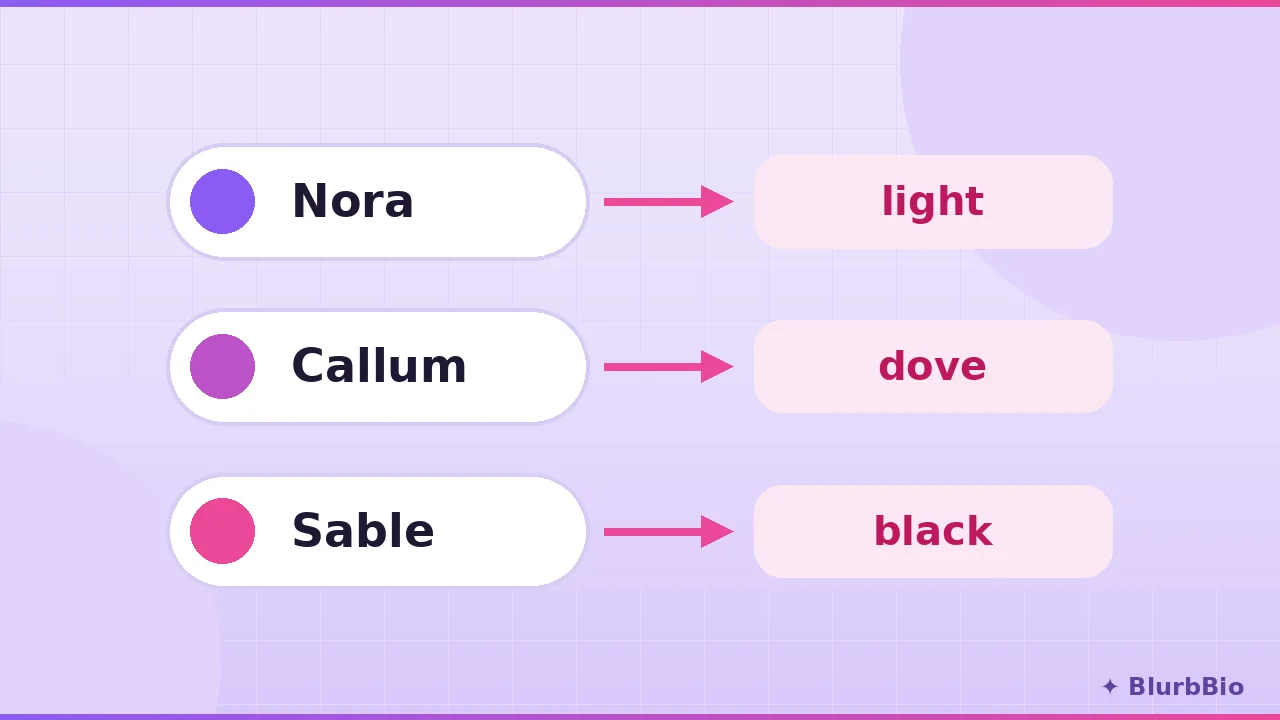
Agreement. Name the leader with a rulership root, the healer with light. Readers who look it up get a mythic click of confirmation; readers who do not still get a name that sounds right, because these roots shaped what "sounds right" means.
Irony. The corpus is full of names making promises; a character can break their name's promise. A failed king named Frederick, peaceful ruler, is carrying his tragedy in his byline.
The parents' voice. Characters do not name themselves. A meaning is a message from the people who chose it, which makes the name a fossil of backstory: who were these parents, that they named their daughter "bright, noble one," and what did she do with that weight?
The warning: do not gloss the meaning on the page. "Her name meant light, and she was the light of the village" is the naming equivalent of explaining a joke. The meaning works precisely because it is submerged.
Method note
Counts are from the BlurbBio name generator dataset as of July 2026: 4,803 curated names, 2,586 with hand-curated etymologies reduced to short glosses from standard references. Invented fantasy and archetype names carry no fabricated etymologies and are excluded from meaning counts. Frequency analysis was run on the gloss text; origin-language counts reflect explicit mentions in glosses and understate true origin distribution.