Open any novel in a bookstore and watch what your eyes do: they drop to the white space, to the quotation marks, to the talk. Readers skim toward dialogue because it is the fastest, most alive text on the page, and that is precisely why it is the most dangerous. Description can be merely adequate and survive. Dialogue that is merely adequate reads as dead air, and readers blame the characters for it.
The good news is that dialogue is a craft system, not a talent lottery. It has mechanics that can be learned, failure modes that can be diagnosed, and revision passes that reliably fix it. This guide covers all three.
The three-job rule
Every dialogue exchange in your manuscript should be doing at least two of three jobs: revealing character, advancing plot, or raising tension. One job is a cut candidate. Zero jobs is filler, and filler dialogue, the hellos, the weather, the recap of what the reader just watched happen, is the single most common note professional editors give on first novels.
This is the deep difference between speech and dialogue. Real speech is transcription; dialogue is performance. Your characters should sound like people, but people with the boring parts removed, the intentions sharpened, and something at stake in every line. When a transcriptionist records a real conversation, most of it is phatic: noises people make to maintain social connection. Fiction has no room for phatic. Every line either earns its place or borrows against the reader's patience.
The test is mechanical enough to run in revision. For each exchange, ask: what does the reader learn about who these people are? What is different in the story after this conversation than before it? What does either speaker want that they are not getting? If you can answer two of the three, the exchange stays. If you can answer none, the scene is using dialogue as set dressing.
Tags, beats, and the invisible machinery
Attribution has three tools, and the craft is in the ratio.
Said and asked are the workhorses. Analyses of published commercial fiction consistently find that well over ninety percent of tags are one of these two, because they are functionally invisible: the reader's eye registers the attribution and moves on without slowing. The thesaurus tags, exclaimed, opined, chortled, growled, do the opposite, yanking attention from the line to the label. Worse, they are usually a confession: if you need the tag to tell the reader the line was angry, the line is not angry enough.
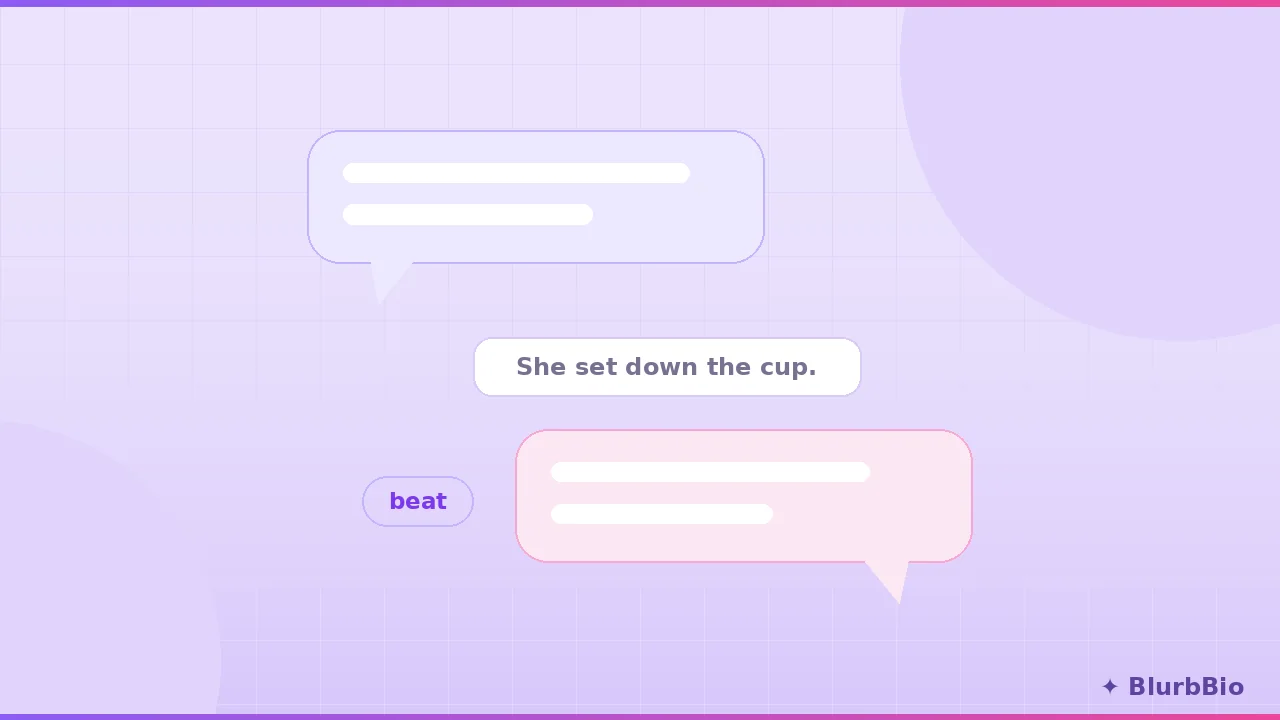
Action beats replace tags with embodiment: She set the cup down. "That is not what I said." Beats do three things at once, attributing the line, pacing the exchange (a beat is a breath), and keeping characters physically present in a scene that would otherwise float in white space. Their failure mode is inflation: when every line carries a nod, a sigh, a glance out the window, the beats stop meaning anything and the scene reads like choreography notes. Ration beats to moments where the action itself communicates.
Nothing at all is the third tool, and the most underused. In a two-person exchange with established rhythm, runs of three to five untagged lines read fast and hit hard. The limit is reader confusion: the moment anyone has to count back up the page to identify a speaker, the scene has failed at its cheapest job.
| Tool | Best for | Failure mode |
|---|---|---|
| said / asked | Default attribution, staying invisible | Almost none; this is the safe house |
| Descriptive tags | Delivery the words cannot carry (whispered) | Thesaurus parade; emotion the line should show |
| Action beats | Pacing, embodiment, meaningful action | Beat inflation; nods and sighs on every line |
| No attribution | Fast two-person runs, arguments | Reader loses track of the speaker |
A fast diagnostic: search your manuscript for tags other than said and asked, and for the words nodded, sighed, shrugged, and glanced. The counts will tell you immediately whether you have a thesaurus problem, a beat inflation problem, or both. BlurbBio's repetition checker makes this a two-minute pass.
Subtext: the question under the question
The most quoted craft advice about dialogue is also the most misapplied: people rarely say what they mean. The misapplication is writing evasive characters who never communicate anything, which reads as coy. The real technique is more precise: characters answer the conversation they are actually having, which is often not the conversation on the surface.
A couple arguing about whose turn it is to load the dishwasher is arguing about the dishwasher zero percent of the time. The surface topic is a proxy war, and the reader, given the context you have built, hears the real argument underneath: about respect, about who sacrifices more, about the thing said at dinner three weeks ago. This is why the strongest arguments in fiction are frequently about trivial objects. The triviality is the point; it proves the fight is about something else.
Three reliable subtext mechanisms:
Deflection. A character responds to the dangerous question with a different topic, and the swerve itself is the answer. Asked "do you still love him?", she says "the train leaves at six." The reader hears yes.
Weaponized politeness. Characters in conflict who cannot afford open conflict, subordinates, in-laws, rivals at a dinner party, fight through compliments with edges. Everything is deniable; everything lands.
The unsaid line. The strongest line in many exchanges is the one a character visibly decides not to say: the drawn breath, the closed mouth, the subject change. This is where dialogue and interiority cooperate; what a POV character does not say, while we hear them not saying it, characterizes harder than a monologue.
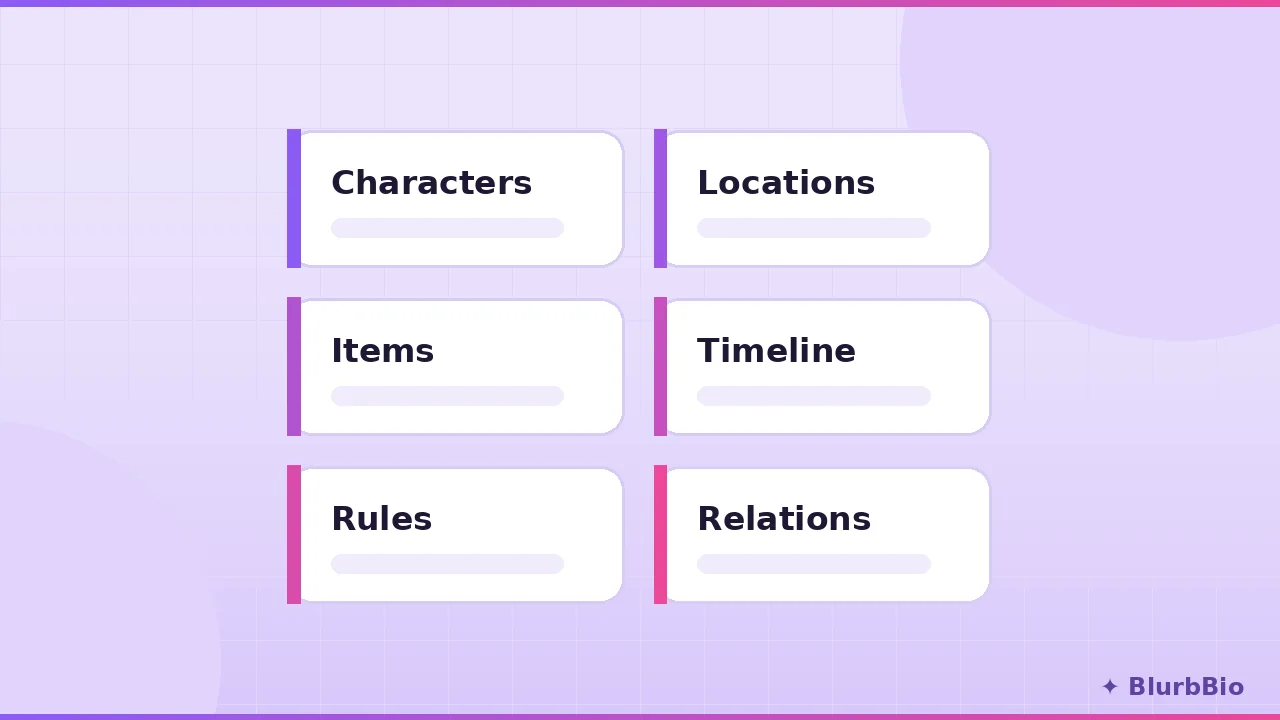
Subtext requires setup. The reader can only hear the conversation under the conversation if earlier scenes built the pressure. This is a continuity discipline as much as a line-level one: the dishwasher fight pays off the dinner three weeks ago only if the dinner is on the page and consistent. Long manuscripts drop these threads constantly, which is why relationship state, who knows what, who resents what, who apologized and who did not, belongs in your story bible alongside eye colors and timelines.
Voice: making characters sound like themselves
If you cover the names in a page of your dialogue, can a beta reader still tell who is speaking? For most first drafts the honest answer is no: every character speaks in the author's default voice, distinguished only by content. Differentiating voices is a deliberate engineering job across five levers.
Vocabulary register. The words a character reaches for: technical or plain, formal or profane, generational slang or none. Sentence length and rhythm. Clipped speakers versus spiralers; a character who talks in fragments argues differently than one who talks in paragraphs. Grammar and idiom. Regionalisms, non-native constructions, professional jargon, verbal habits like hedging (I just think maybe) or absolutes (always, never). What they talk about. Attention is characterization; the character who notices costs and the one who notices feelings describe the same room differently. What they refuse to say. Taboos, deflections, the name they never speak.
The modern standard for dialect and accent is suggestion over transcription. Phonetic spelling exhausts readers and shades into caricature fast; word choice and syntax place a character just as precisely with none of the cost. "I might could fix that" locates a speaker instantly and is perfectly readable at chapter length, which "Ah maht cud fix thet" is not. Establish an accent with a light touch in a character's first scene, then trust the reader to keep hearing it.
The hard part is not creating distinct voices; it is holding them for 90,000 words. Voice drift, where a character's diction slowly converges on the narrator's over months of drafting, is invisible while it happens and glaring in a read-through. Our character voice fingerprinting guide covers how to measure it, and automated voice-consistency analysis exists precisely because this is mechanical checking that humans do badly at novel length.
The five-pass dialogue revision protocol
Dialogue is rewritten, not written. These passes, run in order on a finished draft, fix the large majority of flat talk.
Pass 1: Cut the phatic. Delete greetings, goodbyes, how-are-yous, weather, and any line whose only content is agreement. Enter every conversation as late as possible and leave it before it resolves fully; the reader will bridge.
Pass 2: Run the three-job test. Exchange by exchange: character, plot, tension. Two of three or it goes.
Pass 3: Fix the attribution ratio. Strip thesaurus tags back to said, deflate the beats, and open up untagged runs where the rhythm supports them.
Pass 4: Sharpen the disagreement. For every scene, name what each speaker wants. If they want the same thing, give one of them a competing goal, a secret, or a grievance, or cut the scene to summary. Flat dialogue is almost always dialogue without opposing wants.
Pass 5: Read it aloud. Every dialogue scene, out loud, ideally doing the voices. Your ear catches what your eye forgives: lines no human mouth would produce, rhythms that repeat, characters who sound identical. This pass is non-negotiable and it is the one most writers skip.
Dialogue is where readers decide whether your characters are people. Give the exchanges real jobs, real opposition, and real voices, then revise like a director running table reads, and the talk on your pages stops being text and starts being performance.
Try it: fix the line
Two lines from the wild. Diagnose each, then click to see the rewrite and why it works.
What is wrong here, and how would you fix it?
The original commits all three sins at once: it names the emotion instead of playing it, the adverb duplicates the shout, and no human under pressure speaks in a complete grievance summary. The rewrite moves the anger into a beat and lets two words carry the rest.
The original is maid-and-butler dialogue: two people telling each other what both already know for the reader's benefit. The rewrite delivers the same exposition as stakes inside a live conflict, which is the only way exposition survives dialogue.
For the manuscript-wide version of this exercise: BlurbBio includes dialogue authenticity analysis that reads every conversation in a book for voice consistency and naturalness. It works on imported manuscripts, so a draft written in Word or Scrivener can be analyzed without writing a word inside the platform.
See also: How to Write Compelling Characters · Character Voice Fingerprinting · Show, Don't Tell: The Complete Guide · How to Write a Novel: The Complete Guide