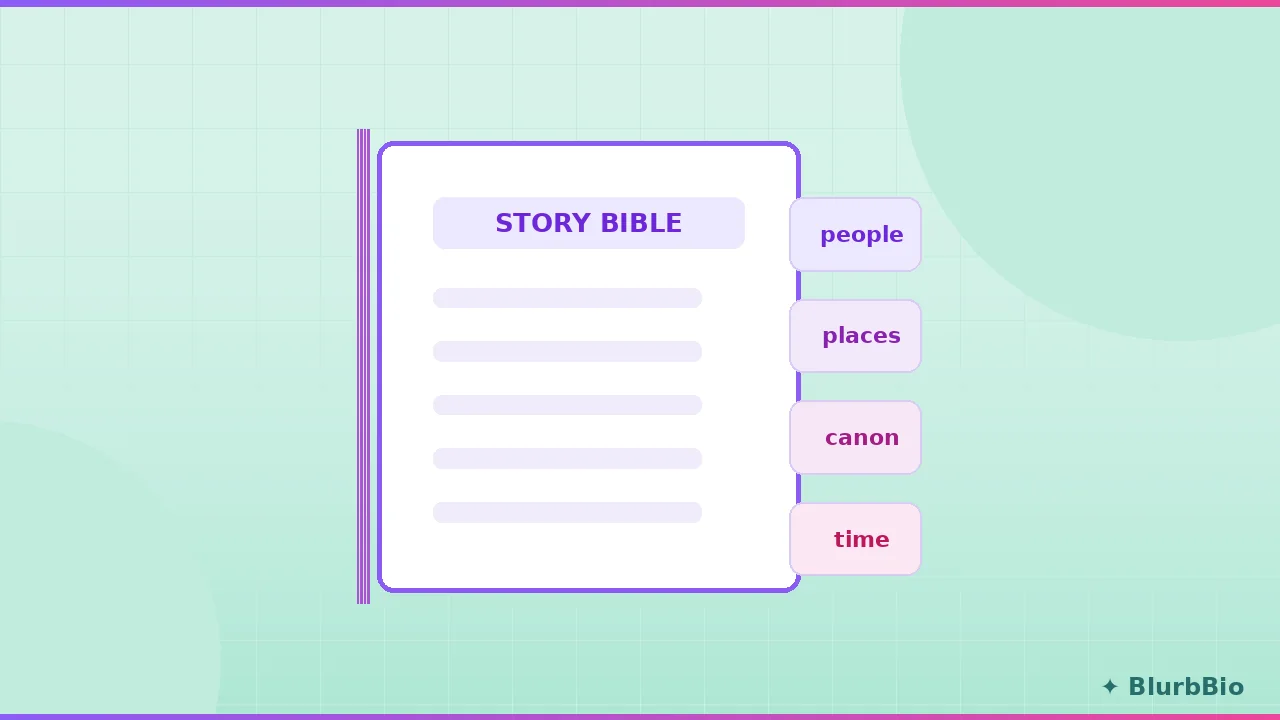
A story bible is the document that prevents your protagonist's eye color from changing between chapter 3 and chapter 47. More precisely, it's the living reference that keeps a 100,000-word fictional world internally consistent, the single source of truth for every character, location, timeline event, and world rule you've committed to on the page.
Professional authors across every genre maintain some version of this document. Brandon Sanderson writes fantasy novels that routinely exceed 300,000 words. His Stormlight Archive series spans four published books with hundreds of named characters, a magic system precise enough that readers have published academic analyses of its internal logic, and a cosmology spanning multiple worlds. He doesn't hold all of that in his head. Nobody could. He holds it in structured reference documents.
The term itself comes from television production. Before a writers' room breaks a season, the showrunner produces a series bible, a comprehensive document covering character backstory, world rules, tone, locations, and mythology that every writer references to ensure consistency across episodes. Novelists adapted the concept for solo work, and it has become standard practice among working fiction authors.
What the Research Actually Shows
The case for a story bible isn't anecdotal. A 2022 survey of 340 fiction authors conducted by the Alliance of Independent Authors found that writers without a dedicated continuity system spent an average of 14.3 hours per manuscript on continuity-related revisions. Writers with a story bible spent 3.1 hours. That's not a marginal efficiency gain, it's a structural difference in how much cognitive overhead the revision process requires.
The same survey found that 78% of self-published authors discovered at least one significant continuity error during revision of their debut novel. The most common: character physical descriptions that shifted between early and late chapters (reported by 62%), timeline inconsistencies where scenes couldn't logically fit the established chronology (51%), and factual contradictions in world rules (38%).
A 2023 BookMachine survey of 512 independent authors found continuity errors cited in 41% of one-star reviews that mentioned a specific craft problem, the single most common craft complaint readers raise publicly. Readers notice. They mention it in the places that affect future sales.
The Eight Sections That Actually Matter
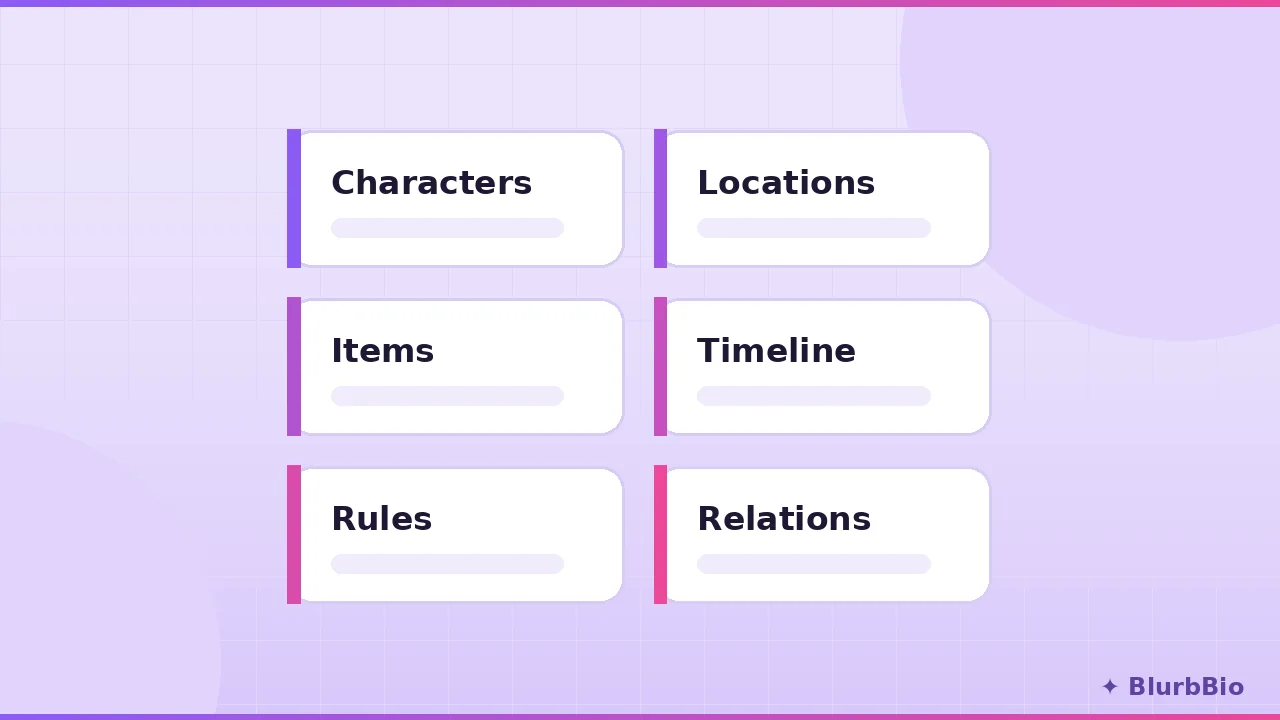
1. Characters
The most critical section, and the one you'll reference most. Each character entry needs enough specificity to be useful, not just "tall" but "six-foot-two, angular jaw, scar along the left ear from a childhood fall." Cover physical description, backstory summary, motivation, arc trajectory, and critically, a voice fingerprint.
The voice fingerprint is what most authors skip and later regret. It's two or three sentences describing how this specific character speaks differently from everyone else: vocabulary range, sentence rhythm, topics they avoid, verbal habits. "Marcus speaks in short declaratives. He never qualifies a statement. He ends conversations when he has what he came for." This entry becomes invaluable at chapter 60 when you need to verify that Marcus doesn't accidentally sound like Elena.
2. Locations
Go further than visual description. The entries that prevent errors are the ones covering sensory specifics, smell, sound, weather by season, and critically: travel times. What's the distance from here to the three places your characters visit most, and how long does it take by each available mode of travel?
Distance inconsistencies are among the most common continuity errors in long fiction. A journey that took two days in chapter 4 cannot shrink to a half-day in chapter 19. A single location entry that reads "three days on horseback from the capital; four days in winter, impassable in deep snow" prevents this entire class of error and costs two minutes to write.
3. Timeline
Your chronological spine. Every significant event, dated or relatively dated: "Day 3 of the siege," "Six weeks after the exile," "Mid-harvest season." Track character ages at key plot points and how much time elapses between chapters.
Many authors maintain this section as a spreadsheet rather than prose notes, specifically because sorting by date is more useful than reading entries sequentially. The test: can you answer "exactly what happened in what order across chapters 8 through 15, and how many days elapsed?" in under two minutes? If not, your timeline section needs work.
4. Canon Facts
The rules of your world, stated plainly and positively. Magic system mechanics. Physical laws that differ from reality. Social hierarchies. Economic systems. Each entry states a rule so you can check against it when writing a scene that touches an established constraint.
The discipline here is writing rules in declarative form: "A practitioner can cast no more than three spells per day before experiencing physical deterioration." Not "I think magic has some kind of cost." Vague notes are useless in revision. Declarative rules are checkable, unambiguous, and enforceable against your own future writing.
5. Relationships
Track not just the baseline relationship between two characters but its current state, which changes across the manuscript. Log the baseline, then record significant shifts with chapter references:
"Allies (ch.1) → Fractured after the Ashford meeting (ch.14) → Reluctant operational truce (ch.22) → Open conflict (ch.31)."
This section prevents the specific error of writing warmth between characters whose relationship has since collapsed, or writing hostility where a reconciliation has already occurred. Review this before writing any scene where more than two characters with complex history are in the room together.
6. Items and Objects
Named objects that appear more than once deserve their own entries: physical description, material, history, current location, who knows what about it. This section sounds unnecessary until you discover that the ancestral sword you described as having a black blade in chapter 1 has acquired a silver blade by chapter 19.
The errors readers notice most sharply involve physical objects, because objects feel verifiable in a way that emotions don't. A character's arc is interpretive. The color of a specific sword is a fact.
7. Factions and Organizations
Institutions, guilds, governments, secret societies, their structure, goals, the gap between their public face and private reality, key members, and their relationships with other factions. The test for a faction entry: can you answer "what would this organization do if threatened by X?" quickly enough to write a consistent scene without interrupting your draft?
8. Lore and Deep History
The iceberg section. Most of it never appears directly in the manuscript, it shapes decisions, informs dialogue, and creates the texture of a world that clearly existed before page one. Readers feel the depth without seeing it explicitly.
Lore entries don't need to be exhaustive. A paragraph establishing the founding myth, the last major war, and the three events that created the current political order is enough to ensure your characters reference their history consistently.
The Five-Minute Rule
A story bible is only useful if it's current. The most common failure mode isn't failing to start one, it's starting one and letting it go stale after chapter 6.
The system that works: after every writing session, before you close your files, spend five minutes updating your bible with anything new. A character introduced. A location described for the first time. A relationship that shifted. A rule you invented.
Five minutes feels trivial in isolation. Over a 90,000-word draft, typically 60 to 100 writing sessions, it compounds into a complete, current record of your entire world. Authors who skip this and plan to batch-update later almost universally stop maintaining their bible by the midpoint. The catchup task feels overwhelming and gets deferred indefinitely.
The five-minute rule is especially important for pantsers. Because you're discovering your story as you write rather than pre-planning it, your bible is the only record of what you've actually established. Plotters can reference their outline. Pantsers invented their world rules as they wrote, and only their bible holds them.
Series Bibles: The Stakes Double
For a standalone novel, a story bible is a significant efficiency tool. For a series, it is non-negotiable.
The challenge is that your published canon from book one becomes an absolute constraint on book two. A character's eye color, the distance between cities, a throwaway detail about a character's dead sister, all of it is now in print, held in readers' memories, referenced in fan wikis. You cannot un-establish it.
Working series authors typically maintain two documents: the working bible (updated freely during drafting, can contain speculative and tentative notes) and the published canon bible (updated only after a book is finalized and in print, the authoritative record of what readers can hold you to).
N.K. Jemisin, who won three consecutive Hugo Awards for the Broken Earth trilogy, has discussed maintaining extensive timeline and character tracking documents specifically to ensure that the revelations in the third book were consistent with details planted in the first. The payoff for readers, the sense that every detail had been planned from the beginning, came directly from the discipline of the documentation.
Where to Build It
The format matters less than the habit, but some tools serve better than others.
Scrivener's research section keeps your bible alongside your manuscript in the same application. Search works across both simultaneously, the most common use case.
Notion works well for relational structures. You can link character entries to location entries and view everything connected to a specific character from a single page.
Obsidian suits writers who want local-first storage, backlinks between entries, and graph views. Steeper learning curve, powerful for complex worlds.
Google Docs is entirely functional if you use named headings and maintain discipline with structure. Full-text search is what matters.
The wrong tool: your manuscript file itself. Notes buried in comments, cut scenes, or end-of-document appendices are neither reliably searchable nor maintainable. Keep the bible separate.
Starting Right Now
You don't need a perfect system. You need a document and a habit.
Open a new file. Create eight headings. Add every character you've introduced. Add every location you've described. Write down the three most important rules of your world.
That's a story bible. It isn't complete, it never will be, because your story isn't finished. But it's started, and starting is the only threshold that matters.
BlurbBio builds your story bible automatically as you write, detecting characters, locations, items, and relationships directly from your manuscript. Every chapter you add populates your bible in real time. When a new scene contradicts established canon, you get an alert before it becomes a published error. See how this compares to maintaining one by hand in our story bible software guide.
See also: The 7 Types of Plot Holes (And How to Fix Every One) · Character Voice Fingerprinting: Make Every Character Sound Unmistakably Themselves · How to Write a Novel: The Complete Guide