No pages in your novel work harder or face harsher judges than the first ones. An agent decides in a page whether to keep reading a submission. A browser in a bookstore reads the opening paragraph standing up. A Kindle shopper downloads the sample, and the retailer quietly measures whether they finish it. Whatever gatekeeper you face, human or algorithmic, the venue is the same: chapter one, and often page one.
That pressure produces two opposite failures: the throat-clearing opening that starts before the story does, and the flash-bang opening that starts before the reader can care. The way out of both is to treat the first chapter as a checklist of jobs rather than a mood.
The seven jobs
A working first chapter accomplishes all seven of these, most of them in the first few pages:
1. Establish the voice. The reader's first and fastest judgment is not about plot; it is do I want this voice in my head for ten hours? Voice is the one job that must be done in the first paragraph, because it is being evaluated in the first paragraph.
2. Anchor a character. A name, a body, a want, within the opening page. Readers attach to people, not situations; unanchored description and unattributed action delay the only attachment that matters.
3. Anchor the world. Where and when, concretely, plus, for speculative fiction, the reality rules in force. Not the whole system: enough that the reader stands somewhere instead of floating.
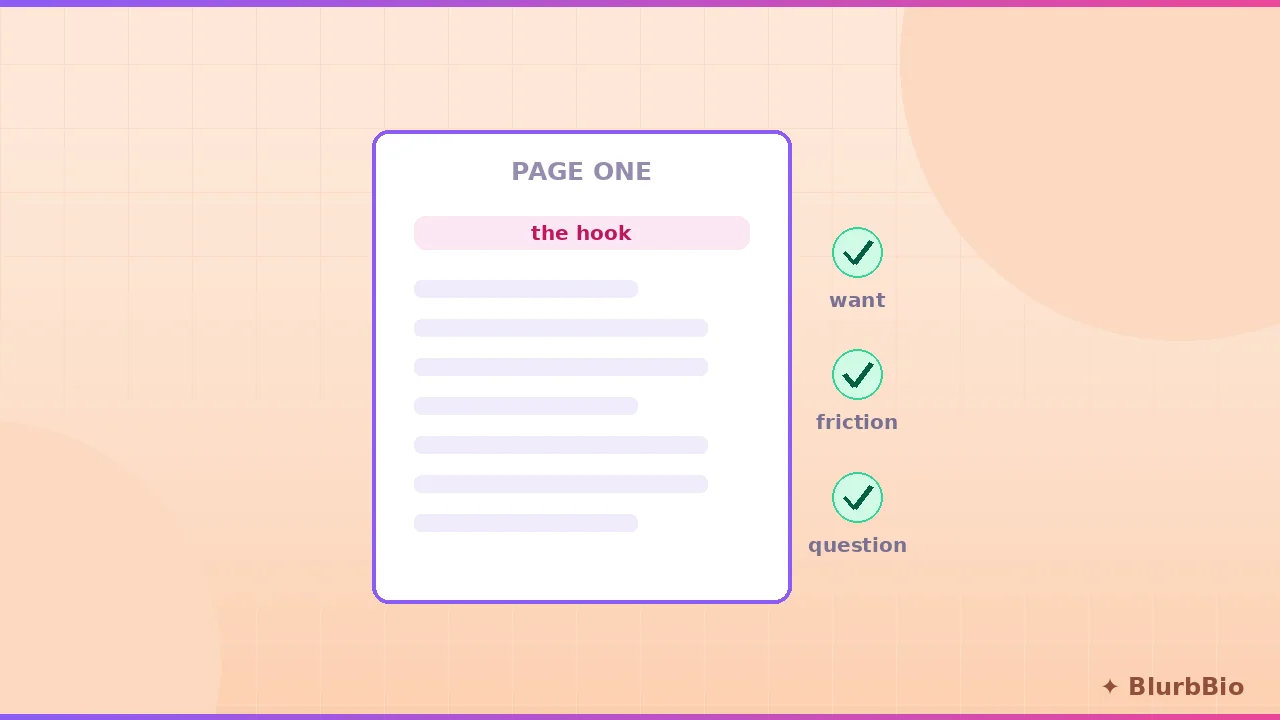
4. Start motion. Something is happening and something is at stake in the scene itself, however small. A scene-level want with friction (she needs the shift covered; the manager owes her and is dodging) generates more page-turn than an off-page war the reader has not been given a reason to care about.
5. Show the crack. The status quo should be visibly unstable: the tension, absence, or wrongness that the inciting incident will split open. The explosion can wait; the fuse cannot.
6. Make the promise. Genre, tone, heat, darkness, pace: chapter one is a contract about what kind of book this is. Promise management failures surface months later as reviews that say "not what I expected."
7. End on ignition. The last lines of chapter one exist to make stopping feel unnatural: a question opened, a decision made, a door knocked on.
The five openings that fail on sight
Certain openings are so overrepresented in slush that they function as rejection triggers regardless of execution. Every one of them is a symptom of starting in the wrong place.
| Opening | Why it fails | The underlying error |
|---|---|---|
| Weather report | No character, no stakes, pure delay | Scene-setting mistaken for story-starting |
| Waking up | The literal beginning of a day, not a story | Starting at chronological zero instead of dramatic zero |
| Mirror description | Transparent device for physical description | Prioritizing reader's visual file over momentum |
| It was all a dream | Invests the reader, then refunds them | Fear that the real opening is not dramatic enough |
| Unanchored action | Explosions before attachment; stakes without a person | Confusing motion with momentum |
The fifth deserves emphasis because it is the failure of writers who have absorbed "hook them fast" too literally. An opening firefight involving people the reader met four seconds ago produces adrenaline without investment, and adrenaline without investment is noise. The hook is not the loudest available event; it is the earliest moment a specific person's situation generates a question the reader wants answered.
Where to actually start
The practical formula that survives across genres: start as late as possible in the pre-story world, inside a scene that would be worth reading even if the plot never arrived. Late, because everything before the crack is deletable. Inside a scene, because summary cannot do jobs one through four. Worth reading anyway, because the scene-level engine (want, friction, change, the same fuel described in our pacing guide) is what carries the reader to the ignition point.
For placement of the inciting incident itself, the working norm in commercial fiction is within the first ten to fifteen percent of the manuscript, which for most novels means chapters one to three; our chapter length guide covers the word-count math. Chapter one does not need the incident. It needs the incident to be imminent, and felt.
A brutal and effective drafting test: delete your current chapter one entirely and read chapter two as the opening. A surprising fraction of manuscripts improve immediately, because the real story was starting there all along, and everything in the deleted chapter that mattered can be fed back in as context inside moving scenes.
Promise management
Chapter one is where reader expectation is set, and mismatched expectation is deadlier than mediocre craft: it produces the reviews that say slow, too dark, not really a romance, verdicts about the contract, not the book. Audit the opening chapter for what it promises on four axes: genre furniture (a body on page three promises a mystery whether you meant it or not), tone (comic voice promises comedy; lyrical dread promises dread), pace (a breakneck opening promises a breakneck book, and readers feel the betrayal when chapter four downshifts), and content register (heat level, violence level, darkness, all calibrated to what the book actually sustains). This is the same contract logic that governs genre expectations broadly, and it is enforced hardest in trope-forward markets; our romantasy guide shows how explicitly modern readers shop on these signals.
The consequence for process: the final first chapter is written last. You cannot promise precisely until you know exactly what you are promising. Draft an opening to get moving, then, once the ending exists, rebuild page one as the door to the book you actually wrote.
The rebuild protocol
When a first chapter is not working, feedback says slow, confusing, or "I wasn't grabbed", run this sequence rather than polishing sentences:
1. Find the true start. Locate the first moment a named character wants something and is resisted. Everything before it is candidate for deletion or diffusion into later scenes. 2. Convert backstory to debt. Every paragraph of history in chapter one becomes a question the reader carries instead: cut the explanation, keep the visible consequence, pay off the explanation later when the reader is hungry for it. 3. Re-run the seven jobs as a literal checklist against the new opening pages. 4. Check the promises against the finished book's actual genre, tone, pace, and heat. 5. Read page one aloud, alone, listening only for voice, because voice is the job that cannot be checklisted and the judgment every gatekeeper makes first.
First chapters are expensive because they are compressed: seven jobs, a few thousand words, and an audience with its hand on the door. Treat those pages as engineered rather than inspired, rebuild them without sentimentality once the book exists, and the door starts opening.
Audit your opening
Open your chapter one beside this list and check off only what is actually on the page.
See also: How to Write a Novel: The Complete Guide · How to Fix Pacing in a Novel · How Long Should a Chapter Be? · How to Outline a Novel