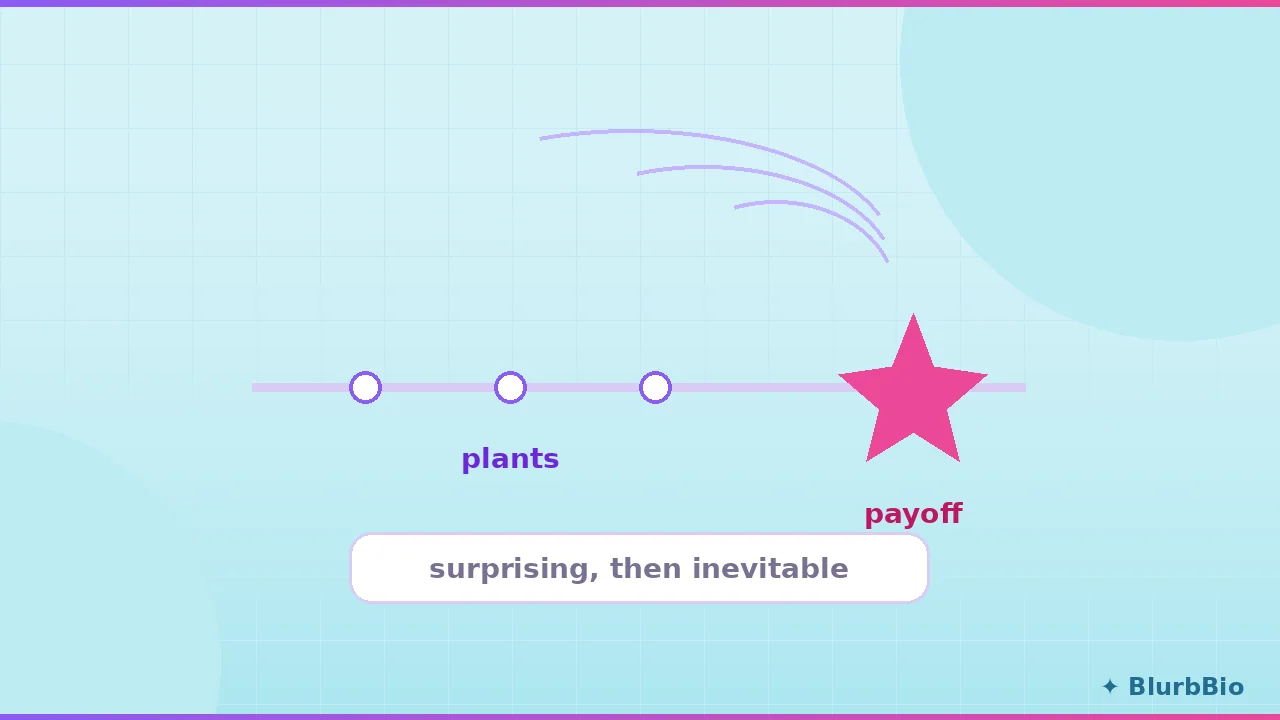
Think of the last twist that genuinely got you, the reveal that made you put the book down, say something out loud, and flip back thirty chapters to check. What you were checking for was the trail: and it was there, wasn't it? The offhand remark, the object described a beat too carefully, the alibi that was technically worded. The twist surprised you and then, instantly, felt like the only thing that could have happened.
That double sensation, unforeseeable, then inevitable, is not a property of the twist. It is a property of the foreshadowing, and it is engineered with mechanics specific enough to learn.
Every plant is a promise
Chekhov's famous gun, show a rifle in act one and it must fire by act three, is usually quoted as advice about props. It is actually a law about attention: narrative emphasis creates expectation. Whatever you linger on, the reader files as significant, because readers correctly assume that a professional storyteller does not spend words on nothing. This cuts both ways and produces the two fundamental foreshadowing errors:
The unfired gun: emphasis without payoff. The mysterious locked room that is never opened, the sister mentioned twice and never seen, the poison lecture that poisons no one. Each one is a promise made and broken, and readers, who keep better books than writers do, experience the break as sloppiness even when they cannot name it.
The unshown gun: payoff without emphasis. The climax solved by a skill, object, or rule the reader never saw planted. This is the deus ex machina family, and it converts your biggest moment into your biggest eye-roll, because a payoff with no plant is not a twist, it is an author reaching into the story from outside.
Foreshadowing, then, is double-entry bookkeeping: plants and payoffs must balance. Which is why the craft has two halves, placing plants well, and keeping the ledger.
The four types of plant
Object plants. Physical items whose later function is hidden in an earlier innocent appearance: the letter opener, the grandmother's ring, the vial. Camouflage comes from giving the object a real job in its planting scene, sentiment, clutter, a minor argument about it, so it earns its words twice.
Information plants. Facts, rules, and history whose significance detonates later: the terms of the will, the way the tide runs, the one condition of the spell. In speculative fiction these are load-bearing, a magic system's costs and limits are one long information plant for the climax, which is why rule-consistency (covered in our worldbuilding guide) and foreshadowing are the same discipline wearing different hats.
Capability plants. Skills and traits the resolution will require: she must be shown climbing before the climb matters, shown lying well before the lie saves her life. Capability plants prevent the competence-from-nowhere problem, and they double as characterization, which is their natural camouflage.
Tonal plants. Atmosphere and image preparing an emotional register rather than a fact: the recurring cold, the dead orchard, the lullaby in a minor key. Tonal foreshadowing is how endings feel fated rather than merely caused, and it is the type most invisible on first read and most visible on second.
Camouflage and fair misdirection
A plant the reader consciously clocks is called a spoiler. Hiding plants in plain sight comes down to three techniques.
Dual function. Every plant does a visible job in its own scene, gets a laugh, sharpens a character, feeds an argument, so the reader's attention is satisfied by the surface purpose and slides past the buried one. The best plants are sentences no one would cut even if they never paid off.
Position control. Readers over-weight the ends of sentences, paragraphs, and chapters, and under-weight middles. Plant in the middles: the crucial detail third in a list of five, the key fact inside a scene about something else. Save the emphasized positions for your misdirection.
Distributed setup. Split one large setup into several small plants, chapters apart, none sufficient alone. Convergent plants are individually invisible and collectively airtight, and they are what makes the flip-back reread so satisfying.
Then aim the reader somewhere else, fairly. Misdirection gives suspicion a louder home: an alternative explanation, a more obvious suspect, a red herring with a real (innocent) resolution of its own. The line that must never be crossed is cheating: hiding what the POV character knows, or asserting facts the reveal will contradict. The reread test is the arbiter, misdirected readers reread and admire the machinery; cheated readers reread and file a complaint. Fair play matters most in mystery and thriller, but every genre's twists live under the same law.
Steal the mystery writer's habit whatever your genre: when you write the payoff, immediately list what a skeptical rereader would demand to have seen earlier, then go plant it, in middles, with dual functions. Retro-planting during revision is not a failure of process; it is the process. Most inevitability is installed backward.
Scale: chapter, book, series
Foreshadowing distance should be proportional to payoff size. Scene-level turns can be set up pages ahead; a climactic reveal wants first-act planting, usually reinforced once mid-book so the click is instant rather than requiring archaeology. At series scale the discipline merges with series planning: fixed landmarks seeded books in advance, flexible corridors planted with multiple legal payoffs, exactly the three-tier system in our series planning guide, and the plants themselves become long-lived continuity objects. The vial planted in book one must still exist, unchanged and unnoticed, when book four opens it, which is why the plant ledger belongs inside your story bible rather than in marginalia you will lose.
The plant-and-payoff audit
In revision, run the ledger both directions. Forward pass (find unfired guns): list everything the draft emphasizes, objects described at length, skills established, questions raised, rules explained, rooms locked, and mark each as paid off, deliberately demoted to texture, or orphaned. Orphans get a payoff or a cut. Backward pass (find unshown guns): for every reveal, rescue, and reversal, list what it depends on, information, items, capabilities, and verify each is planted earlier, more than once if the payoff is major, and camouflaged rather than spotlit. Consistency pass: confirm every surviving plant's details match its payoff, the drawer it was in, who saw it, what exactly was said, because a payoff that contradicts its own plant is a plot hole with extra ceremony, and it will be caught; our plot holes guide taxonomizes what happens when it is not.
Foreshadowing is the craft that pays twice: once when the payoff lands, and again when the reader flips back and finds you were playing fair all along. Keep the ledger, hide the plants, and let inevitability do your ending's heavy lifting.
Find the plant
A paragraph from a working manuscript. One sentence is a plant for a reveal six chapters later. Find it, then check yourself.
Plants are continuity objects: the key must stay pocketed, the glass must stay empty, across every revision. BlurbBio has a dedicated foreshadowing tracker plus continuity validation that follow details across an entire manuscript, including imported drafts.
See also: The 7 Types of Plot Holes · How to Plan a Book Series · Worldbuilding Guide for Fiction Authors · How to Outline a Novel