Ask a hundred writers how they plot and the answers cluster into two camps: the ones who fill in a structure template before drafting, and the ones who refuse to outline at all because templates kill the life in their ideas. Both camps produce brilliant books. Both camps also produce a very specific kind of failed draft: the plotted book where events march competently through their beats while the protagonist feels interchangeable, and the discovered book that opens electric and dies somewhere in the swamp of the middle.
Lisa Cron's Story Genius diagnosed why, and the diagnosis holds up: both failures come from treating plot as the story. Plot is not the story. The story is the internal change one specific person is forced through, and plot is the machine you build to force it. Which means the machine cannot be designed before you know, precisely, what it exists to do.
That inversion is the whole method. Here is how it works in practice.
Start before the beginning
The method's first, most counterintuitive move: the story's engine is built entirely before page one, in territory that never appears in the book.
It starts with specificity about desire. Not "she wants love" or "he wants justice," which fit a hundred thousand protagonists, but the concrete, circumstantial version: what does this person want, in this situation, right now, even if they believe they cannot have it? And underneath that, the internal version: what do they believe getting it will finally prove about them?
Then the harder question: what is stopping them? Not the external obstacle. The internal one. Somewhere in this character's past, they concluded something about how the world works that is simply not true. It made sense when they concluded it. It may even have protected them once. Now it is the wall between them and everything they want. Cron calls it the misbelief; other craft traditions call it the lie the character believes. Whatever the label, it is the single most load-bearing sentence in the entire plan, because every scene you build will exist to strike it.
Write the wound, privately
Here the method demands something most outlining systems never would: actual writing, before the outline exists. You write the origin scene, the specific moment the misbelief took root. Not a summary. A scene, with a place and people and a before and after: what the character believed walking in, what they expected to happen, and the exact moment reality split from the expectation and taught them the wrong lesson.
Then you sketch the turning points: a few moments between that origin and page one where life kept confirming the misbelief, each raising its stakes. These pages are for you alone. Their job is to make the character's psychology so concrete in your mind that when the plot begins hitting it, every reaction on the page feels inevitable.
Writers resist this step more than any other, because it feels like writing pages you will throw away. The reframe that helps: you are not throwing them away. You are building the instrument the whole novel plays.
The three-question test
Only now does plot enter, and it enters through a gate. Every idea for something that could happen in the book, every scene, every twist, every clever set piece, must answer three questions before it earns a place:
- Can this problem force the inner change this novel is actually about?
- Does it force the character to struggle with the misbelief, testing it, defending it, or cracking it?
- Will the approaching consequence cost them something big emotionally, even if they achieve their external goal?
Ideas that fail the test are not necessarily bad ideas. They are ideas for a different book, or raw material that needs another turn of the screw before it belongs in this one. The discipline of the gate is what prevents the classic middle-of-the-book failure mode: chapters of events that are individually interesting and collectively inert, because nothing in them touches the one conflict the reader actually signed up for.
Scene cards with two tracks
The method's unit of planning is the scene card, and its defining feature is that every card carries two tracks at once. The external track: what happens, and what changes in the world because of it. The internal track: why this event matters to this character given everything you now know about them, and what shifts inside them because of it.
A card with only the top track filled is a to-do item, not a scene. The internal track is where the actual story lives, and forcing yourself to fill it for every card is the most reliable diagnostic in the whole system: when you cannot say why an event matters to your protagonist, you have found the exact place your book would have gone slack.
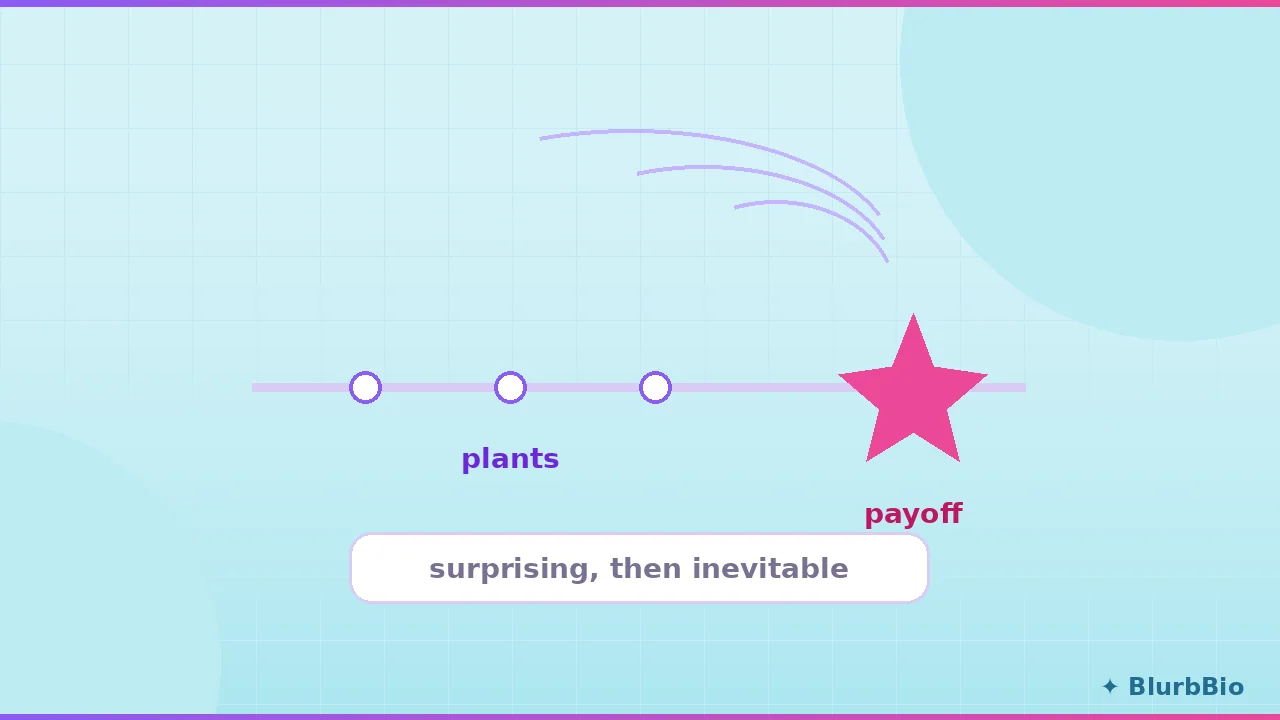
Each card ends with a causal handoff, the "and so": the concrete action this scene forces next. Cards chain into each other, cause into effect, which is what separates a plot from a list. A useful test of any outline is whether you can read only the handoffs and watch the story fall forward like dominoes. If a card's consequence connects to nothing later, you have setup without payoff. If a scene happens for no reason established earlier, you have coincidence wearing plot's clothing.
Where it goes wrong, and how to catch it
Three failure patterns account for most character-first plans that stall.
The generic misbelief. "She believes she is not good enough" powers no scenes, because it is a mood, not a belief with consequences. A working misbelief implies behavior: silence, control, flight, performance. If you cannot predict what your character will do in a crisis from the misbelief alone, it is not yet specific enough.
The flat middle. Internal stakes are supposed to escalate. If you rated each scene's internal intensity from one to five, the line should climb, dip, and climb higher. Three or more scenes in a row at the same intensity is where middles sag, and it is visible in a plan long before it costs you a drafted chapter.
The untouched rail. Under deadline pressure, external plot multiplies and internal tracks empty out. The fix is a periodic audit: walk the cards and mark every scene where nothing touches the misbelief. A few breather scenes are rhythm; a run of them is a book quietly abandoning its own premise.
Character-first plotting is slower to start than grabbing a template, because it front-loads the hardest thinking. What it buys you is a middle that cannot sag in the usual way, an ending that was earned from page one, and a protagonist no reader could mistake for anyone else's.