Ask an online writing community which AI tool to try and these two names come back within minutes. They get grouped together constantly, which is unfortunate, because they are opposite answers to the same question. Sudowrite asks: what if the AI were a fiction-trained collaborator that drafts alongside you? Novelcrafter asks: what if you had a workshop where you bring your own AI and direct it precisely?
This comparison is written by the team behind BlurbBio, a tool that deliberately does neither, so read it knowing where we sit. We think that position makes us a useful referee here: we have no stake in which of these two wins, and both are genuinely good at what they set out to do.
The core design difference
Sudowrite is a complete, opinionated environment. Its features, Write, Describe, Rewrite, Brainstorm, and the Story Engine pipeline for longer-form generation, run on its own model stack, including Muse, its fiction-trained model. You do not configure anything; you buy a credit plan and start. The craft opinions are baked in, and for many authors that is exactly the appeal: the tool understands genre conventions, scene beats, and show-don't-tell without being told.
Novelcrafter is infrastructure. You connect your own model through API keys (OpenAI, Anthropic, OpenRouter, local models), maintain a Codex of characters, places, and lore, and work through a chat workshop and scene-beat drafting flow where the Codex feeds context to whatever model you chose. It has few opinions and enormous flexibility, and its community is famously full of writers who enjoy tuning prompts as much as writing.
The temperament test is simple: if configuring a tool sounds like procrastination, you are a Sudowrite person. If a tool that cannot be configured sounds like a cage, you are a Novelcrafter person.
Pricing models, and the bill nobody predicts
The pricing structures differ more than the sticker prices, and the structure is what bites.
Here are the actual numbers, verified against both pricing pages and current reviews in July 2026.
| Plan | Sudowrite | Novelcrafter |
|---|---|---|
| Entry | Hobby and Student: $19/mo ($10/mo annual), 225,000 credits | Scribe: $4/mo, no AI features |
| Middle | Professional: $29/mo ($22/mo annual), 1M credits | Hobbyist: $8/mo, BYO-key AI unlocked; Artisan: $14/mo adds chat workshop |
| Top | Max: $59/mo ($44/mo annual), 2M credits, 12-month rollover | Specialist: $20/mo, adds collaboration |
| AI usage | Included in credits; premium models like Muse burn credits 3 to 5x faster | Not included; users report $5 to $50/mo in API costs on top |
| Free option | Trial of about 10,000 credits, no permanent free plan | 21-day full trial, no credit card, no permanent free plan |
| Annual deal | Up to about 50% off entry tier | Two months free (about 17% off) |
The structural point the table hides: Sudowrite's credits expire monthly on the two lower tiers, and its own users report the entry tier's 225,000 credits vanishing in days of heavy drafting with premium models, while Novelcrafter's real monthly cost is unknowable in advance because it tracks your API meter. A moderate Novelcrafter user often lands at $13 to $18 total per month, competitive with Sudowrite's annual Hobby rate; a heavy user against a frontier model can pass Sudowrite's Professional price without noticing. Neither is wrong; they are different bets on your usage curve, and both change tiers often enough that the official pricing pages get the final word.
Story bibles: Codex vs Story Bible, and what neither does
Both tools understand that long fiction needs a canonical reference. Novelcrafter's Codex is the more developed version: structured entries for characters, locations, and lore that get injected into the AI's context so generated text respects your world. Sudowrite's Story Bible plays a similar role for its Story Engine, holding synopsis, characters, and outline that shape what gets generated.
Here is the limitation they share, and it matters more the longer your book gets: both are references the AI reads, not systems that read your manuscript. You maintain them by hand, they go stale the way all manual documents do, and neither will ever tell you that chapter 31 contradicts chapter 4. They exist to make generation coherent, not to audit what you wrote. Authors who want the bible built from the manuscript itself, and actively enforced against it, are shopping in a different category, which we cover in the story bible software guide.
The disclosure question
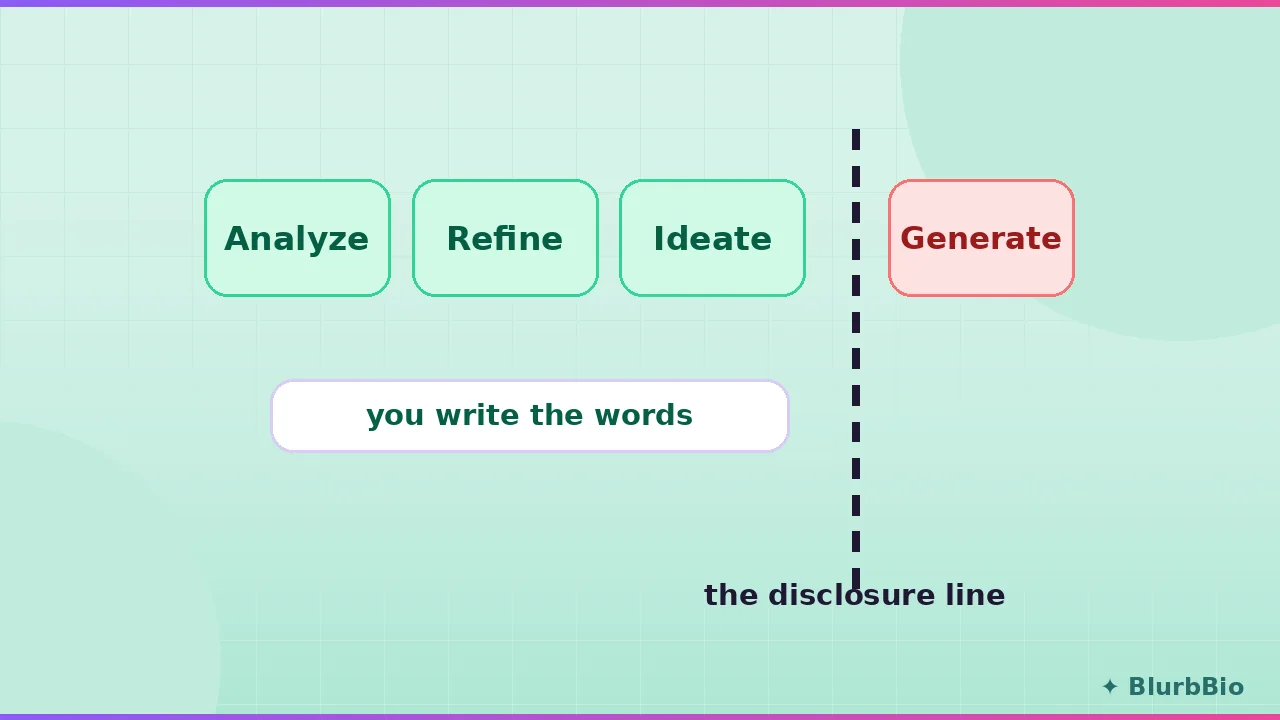
Because both tools generate prose in their core workflows, books drafted with them fall under Amazon KDP's AI-generated content disclosure, which applies even to heavily edited AI text. The disclosure is private and Amazon states it does not affect ranking, but it is a classification some authors want and some want to avoid entirely. Our full KDP disclosure guide maps every workflow; the short version is that the tool you draft with decides the bucket, not the amount of editing you do afterward.
Where each one clearly wins
Choose Sudowrite if you want fiction-quality generation with zero setup, you draft in bursts and value momentum tools, and you are comfortable with credits and with the AI-generated classification. It is the strongest purpose-built prose engine in the category, and its fiction tuning shows.
Choose Novelcrafter if you want to choose your model, write your own prompts, and pay raw API rates, you enjoy structured worldbuilding in a Codex, and you want one tool to flex from light assistance to heavy generation. It rewards tinkerers like nothing else in the space.
Choose neither if your answer to "how much should the AI write?" is "nothing." A significant share of authors comparing these two are actually looking for deep AI help that stops short of drafting: continuity checking, plot hole detection, pacing analysis, a story bible that maintains itself. That is a third category, it keeps your book cleanly in KDP's AI-assisted bucket, and it is the one we build in. The comparison hub lays out all three positions side by side.
Whichever way you go, the portability story is decent: all of these tools, ours included, exchange manuscripts through DOCX, so a wrong first choice costs you an afternoon, not your book.
See also: Best Writing Software for Novelists in 2026 · Amazon KDP AI Disclosure Rules · Scrivener vs Plottr