Every scene you will ever write has a camera, whether you placed it deliberately or not. Point of view is where that camera sits, whose skull it sits inside, and how far into that skull the reader is allowed. It is the craft decision that silently controls all the others: what the reader can know, when they can know it, how much they feel it, and whose voice the prose wears.
Most POV problems in manuscripts are not exotic. They come from choosing a mode by default, then breaking its contract by accident. Both are fixable, and both start with knowing exactly what each mode buys and costs.
The one law of POV
Under every mode sits a single governing law: the reader may only receive what the current narrating consciousness can plausibly know. A first-person narrator cannot report the expression on her own face unless she is looking in a mirror or guessing. A third-limited viewpoint cannot tell us what the man across the table is thinking, only what he does and what the viewpoint character infers. An omniscient narrator can know everything, but must know it as the narrator, from a consistent altitude, not by teleporting into skulls mid-paragraph.
Every POV error, head-hopping, information leaks, impossible perceptions, is a violation of this one law. Which makes revision simpler than the topic's reputation suggests: for any suspect sentence, ask who knows this, and is that who is narrating right now?
The modes, honestly compared
| Mode | Intimacy | Scope | Suspense tool | Main cost |
|---|---|---|---|---|
| First person | Maximum | One skull per strand | Unreliability, withheld self-knowledge | Voice must carry everything; scope limits |
| Third limited (deep) | Near-maximum | One skull per scene, multiple per book | Dramatic irony across POVs | Discipline: breaks are glaring |
| Third limited (distant) | Moderate | Same as deep, more narrator room | Narrator withholding | Can read as cool or dated if unintentional |
| Omniscient | Variable | Everything | Godlike foreshadowing | Hardest to control; unfashionable in most genres |
| Second person | Strange, intense | One "you" | Implication of the reader | Novelty fatigue at length |
First person is voice-forward and currently dominant in romance, romantasy, YA, and much thriller writing; the present-tense first person wave in romantasy made it the genre's house style. Its superpowers are voice and unreliability; its constraint is informational, everything must route through one perceiver, which multi-strand books solve with alternating first-person narrators (label the chapters) or a mixed first-and-third architecture.
Third person limited is the workhorse of commercial fiction. One consciousness per scene, full access to that consciousness, none to any other. Written at close distance (deep POV, below) it delivers nearly first-person intimacy while letting the book rotate among viewpoint characters between scenes. This flexibility is why it owns epic fantasy and most multi-thread thrillers.
Omniscient is a narrator who knows everything and says so, moving between minds from a consistent narratorial altitude. It is the mode of most nineteenth-century fiction and a minority of current literary work. The critical distinction: omniscient is not "third limited with permission to head-hop." It is a voice, a personality above the story, and if that personality is not established and maintained, mind-to-mind movement reads as error, not technique.
Second person exists, works in short forms and rare novels, and should be chosen the way you choose to juggle knives: deliberately, with a reason the audience can see.
Psychic distance: the zoom control
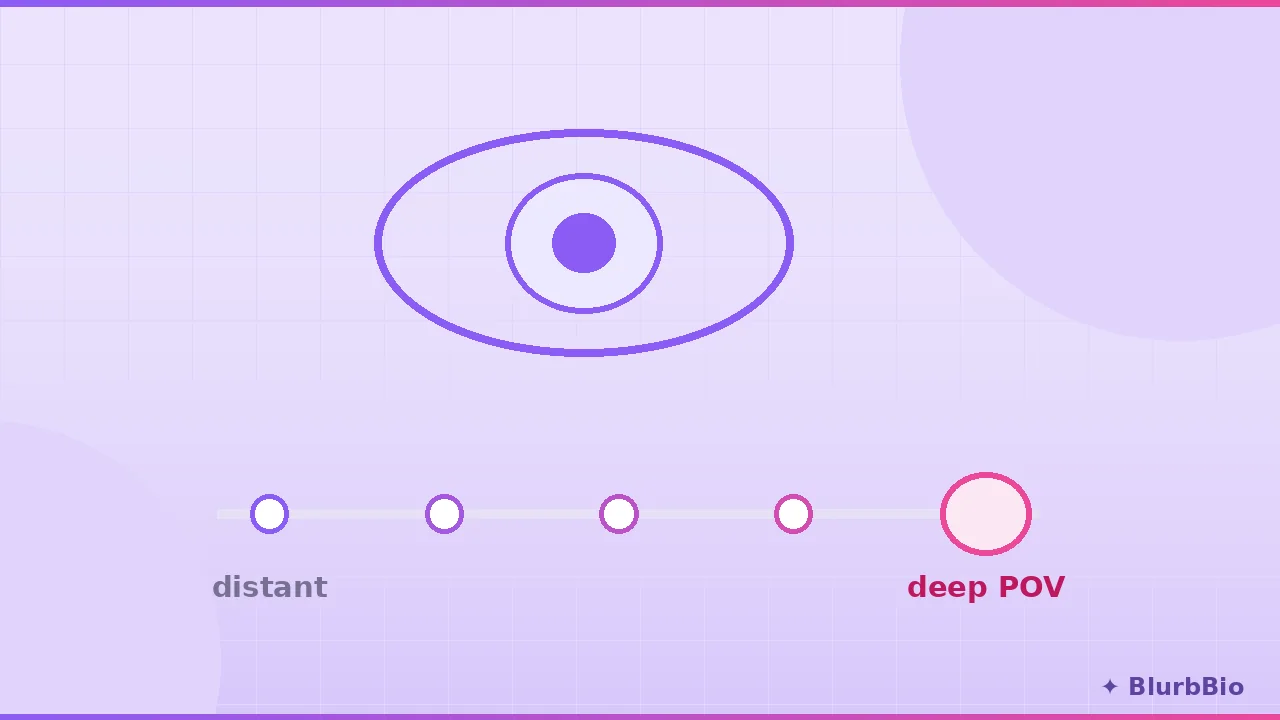
Within any third-person mode, the camera has a zoom, classically described as five steps of psychic distance:
Two practical consequences. First, deep POV is simply levels four and five held as a default: filter words cut, narrator commentary gone, thought rendered without tags or italics scaffolding. It is the reigning style of current commercial fiction because it produces the immersion readers describe as "I was inside her head." The mechanical move that gets you most of it: hunt the filter words, saw, heard, felt, noticed, watched, realized, wondered, and render the perception directly. This is the POV-level expression of the principle in our show, don't tell guide.
Second, distance moves are pacing tools. Zooming out to level one or two lets you compress time and travel; zooming to five detonates a moment. The error is unmotivated jitter, level five grief in one paragraph, level one report in the next, with no scene logic driving the zoom. Choose a home distance per scene and depart from it on purpose.
Fast deep-POV pass: search a chapter for felt, saw, realized, noticed, and wondered. Rewrite each hit to render the perception directly, keeping only the filters doing deliberate distance work. The chapter will read measurably closer without a single other change.
Multi-POV architecture
Multiple viewpoints buy two things single POV cannot: scope (scenes the protagonist cannot witness) and dramatic irony (the reader knows the assassin is in the house; the heroine does not). They cost attachment, every rotation asks the reader to re-invest, and they multiply your continuity surface, since each viewpoint carries its own knowledge state that must stay consistent: who has learned what, as of which chapter, in whose head.
Working rules that survive contact with real manuscripts: one viewpoint per scene, switch only at scene or chapter breaks, and mark the switch immediately, name in the first line, or a chapter header, so no reader spends a page in the wrong skull. Give each viewpoint a distinct voice at the prose level (our character voice fingerprinting guide covers how to verify this), and audit each POV for load-bearing purpose: a viewpoint that exists only to show the reader one hidden scene is usually a structure problem wearing a POV costume.
Knowledge-state tracking is the unglamorous half of multi-POV craft. In a dual-POV romantasy, the exact chapter where he learns her secret changes the legal content of every one of his subsequent scenes. This is precisely the class of error that survives rereading and gets caught by binge readers after publication, and it is why per-character knowledge belongs in your story bible rather than your memory.
Diagnosing and fixing breaks
Head-hopping shows up as private interiority from a non-viewpoint character inside a limited scene: Mara forced a smile. John wondered why she was lying. If the scene is Mara's, John's wondering is illegal; render it as what Mara can perceive, John's eyes narrowed, or move the reveal to John's own scene. The fix is rarely deletion; it is conversion of interiority into observable behavior.
Information leaks are subtler: the narration knows things the viewpoint does not. She walked past the man who would kill her is legal only for omniscient or retrospective narrators. Impossible perception is the self-observation class: viewpoint characters describing their own faces, or perceiving events behind closed doors.
A systematic pass, one scene at a time, asking whose scene is this, and does every sentence stay inside what they can know, catches nearly all of it. At full manuscript length that pass is long, mechanical, and exactly the kind of consistency work that automated analysis performs tirelessly and human attention performs in decaying quality after chapter ten, which is why POV mapping sits alongside continuity checking in modern manuscript tooling.
The camera decision is yours, and any of the modes can carry a great book. What separates professional pages is not which POV was chosen but how completely its contract is kept, scene after scene, for four hundred pages. Choose deliberately, zoom on purpose, and keep the one law.
Spot the violation
Three passages, three possible sins. Answer all three for your score.
BlurbBio includes POV analysis that reviews perspective handling across a full manuscript. Import an existing draft and it reads the whole book.
See also: Show, Don't Tell: The Complete Guide · How to Write Dialogue · Character Voice Fingerprinting · How to Write a Novel: The Complete Guide