Ask readers on any platform where romance is discussed to name the trope they will one-click on sight, and one answer dominates: enemies to lovers. It headlines BookTok recommendation lists, anchors retailer trope categories, and appears in the marketing copy of an enormous share of the last decade's breakout romances and romantasies. Readers do not merely like it; they search for it by name, which in the current trope-driven discovery economy makes it as much a commercial category as a craft choice.
It is also the trope with the highest failure rate in the slush, for a structural reason worth stating plainly: enemies to lovers makes two promises that pull in opposite directions, a war the reader believes and a love the reader believes, and every craft decision in the book is about honoring both. Here is the system.
The conservation law
Everything in this trope follows from one principle: the payoff can never exceed the setup. The intensity readers come for, the delicious hostility, the charged banter, the devastating turn, is generated entirely by the credibility of the initial opposition. Cheat the enmity and everything downstream deflates: the banter has no edge, the thaw has no resistance to melt, and the love confession lands like a handshake.
The most common cheat is the misunderstanding foundation: the characters hate each other because of a misheard remark or a false assumption, dissolvable by one honest conversation. Readers register this instantly as fake war, because the obstacle is information, not reality. Real enmity is built from position: the characters stand on opposite sides of something that matters, and both are right from where they stand.
Reliable foundations, roughly in ascending intensity: professional rivalry (shared goal, one prize), ideological opposition (incompatible values sincerely held), loyalty conflict (their people versus your people, the romantasy staple of opposing courts and crowns), historical grievance (a real harm between families, nations, or the two of them), and structural opposition (the assassin and the target, the inquisitor and the witch). The stronger the foundation, the more machinery the reconciliation needs, and the bigger the payoff when it comes.
The canonical beat sequence
Across contemporary rom-coms, fantasy courts, and dark variants, the working sequence is remarkably stable. Books vary the proportions, not the order.
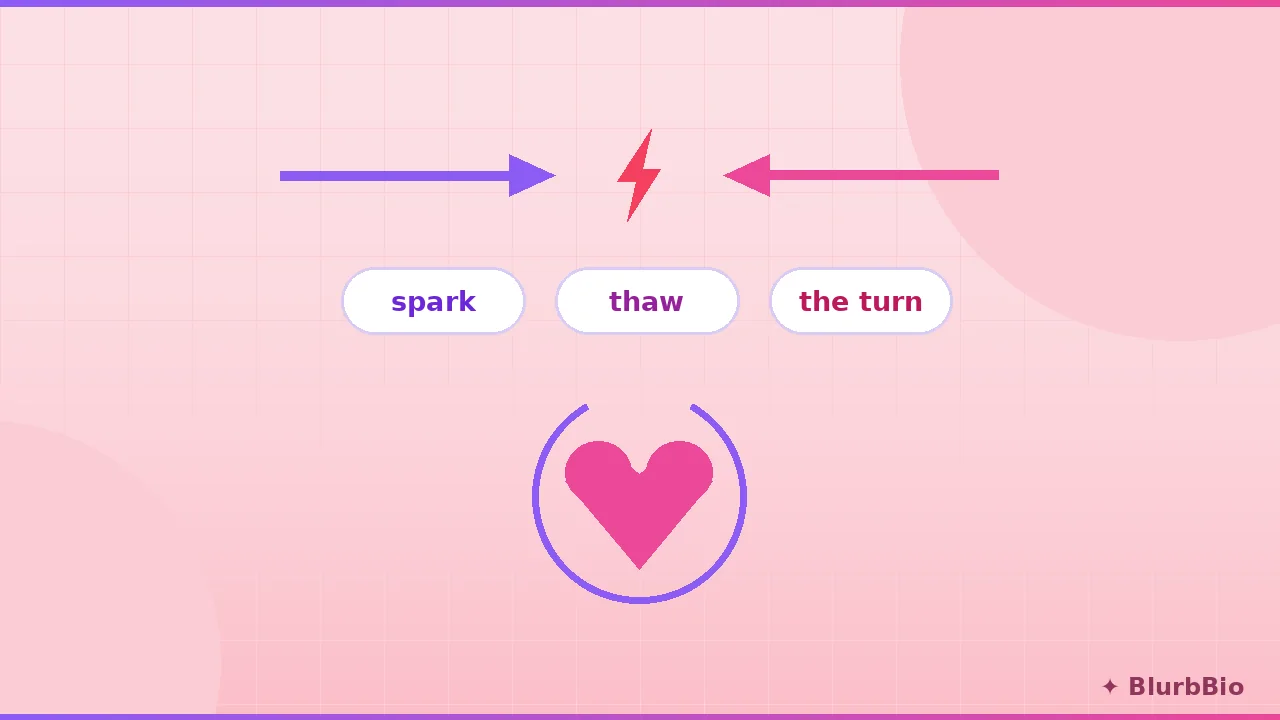
1. Collision. The first meeting establishes the opposition in action, not in summary; the reader watches the incompatibility, ideally in a scene where both behave defensibly. 2. Open war. Sustained hostility with real exchanges of fire, sabotage, verbal bloodsport, genuine losses, during which the book quietly proves each is the other's only equal. 3. Forced proximity. The engine of transition: the mission, the marriage of state, the shared workplace, the one bed. Circumstance, not choice, holds them in range while everything changes. 4. Grudging respect. The pivot readers can feel: competence witnessed, an unexpected kindness, the discovery that the enemy's position has reasons. Respect must precede attraction on the page, or the attraction reads as purely physical and the trope's promise, being seen by the person who fought you hardest, goes undelivered. 5. The crack. A vulnerability breach: one of them is seen undefended, injured, grieving, laughing, and the war logic fails to survive it. This is usually the book's most quoted scene. 6. The relapse. The old conflict resurfaces, often via the original loyalty structure, and it lands harder now because it is betrayal rather than combat. The relapse is what makes the ending chosen rather than drifted into. 7. The choice. Love declared with the cost visible: sides changed, prices paid, the ledger of the war settled with accountability proportional to the harm done.
Track the ledger. Enemies-to-lovers readers keep unconscious books: every insult, sabotage, and secret learned during the war phase is an entry that the thaw and ending must service. A cutting remark from chapter four that is never answered, a betrayal that costs nothing, these are the continuity errors of this trope, and binge readers catch them all. Log the exchanges in your story bible like the plot events they are.
Banter: the trope's native language
The war phase lives in dialogue, and enemies-to-lovers banter has a specific chemistry the general craft in our dialogue guide can be tuned toward. The exchanges must be matched, two fencers of equal skill, because a one-sided beatdown characterizes cruelty, not chemistry. They must be revealing: each barb, to land, requires knowing the target, so the insults themselves prove escalating attention, the fights are how these two study each other. And they should be enjoyed, at least secretly; the moment the reader detects that each is their opponent's most interesting problem, the subtext is doing the trope's real work. Subtext is the whole game: the argument about the mission is never about the mission.
Variations and their dials
| Variant | Opposition scale | Thaw length | Extra requirement |
|---|---|---|---|
| Rivals to lovers | Competition within rules | Short | Keep the contest alive after the kiss |
| Workplace enemies | Positional, professional | Short to mid | Stakes beyond the office |
| Opposing loyalties | Structural (courts, houses, nations) | Long | The loyalty question must be resolved, not dropped |
| Historical grievance | A real harm to reckon with | Long | Accountability beat proportional to the harm |
| Villain romance | One lead is genuinely dark | Longest | Dark romance trust contract in full effect |
The right end of that table crosses into territory with its own rules: when the "enemy" has done genuinely dark things, the book is operating under the reader trust contract of dark romance, signaling, interiority, and a rebalanced ending, and the market's current appetite runs strongly in that direction, with villain romances and morally grey pairings among the defining demands of the 2026 dark-shift. In romantasy, where the trope is practically constitutional, opposing-court enmity also has to obey the dual-plot rule from our romantasy guide: the war between their peoples must be a real fantasy plot that would stand without the romance.
The failure audit
Before calling the manuscript done, test the five points where this trope breaks: Is the enmity positional or informational? (One honest conversation should not be able to end the war.) Does respect precede attraction on the page? Can you point to the crack scene? (If the thaw has no identifiable breach moment, it happened in summary, and the reader was owed the scene.) Does the relapse use the original opposition? (A third-act breakup imported from outside the enmity wastes the trope's built-in one.) Is the ledger settled? Harm acknowledged, sides reckoned with, the choice made expensive and made anyway.
The trope's promise is among the most powerful in fiction: the person who knows your every weakness, because they spent half a book attacking them, choosing to guard them instead. Build a war worth ending, and readers will follow you through every beat of the peace.
Diagnose the turn
Two failing turns from workshop manuscripts. Diagnose, then check the fix.
The manuscript-wide version of this diagnosis: BlurbBio's Story Bible tracks relationships, their evolution, and their key moments across chapters, built from the manuscript itself, and imported drafts work the same as ones written in the platform.
See also: How to Write Romantasy · How to Write Dark Romance · How to Write Dialogue · How to Write a Character Arc