Ask a room of working novelists whether they use AI and the honest answer is now unanimous, because the question has stopped meaning anything. The spellchecker is a language model. The search engine summarizes. The editing suite suggests rewrites. The formatting tool lays out the print interior. AI is in the plumbing of every author workflow in 2026, which is precisely why the industry's entire policy apparatus has converged on a narrower and much more useful question: not did AI touch this book, but who created the text?
That question, assisted versus generated, now decides your KDP disclosure answer, shapes your copyright position, and increasingly frames your relationship with readers. It deserves a precise treatment, so here is one.
The taxonomy that actually works
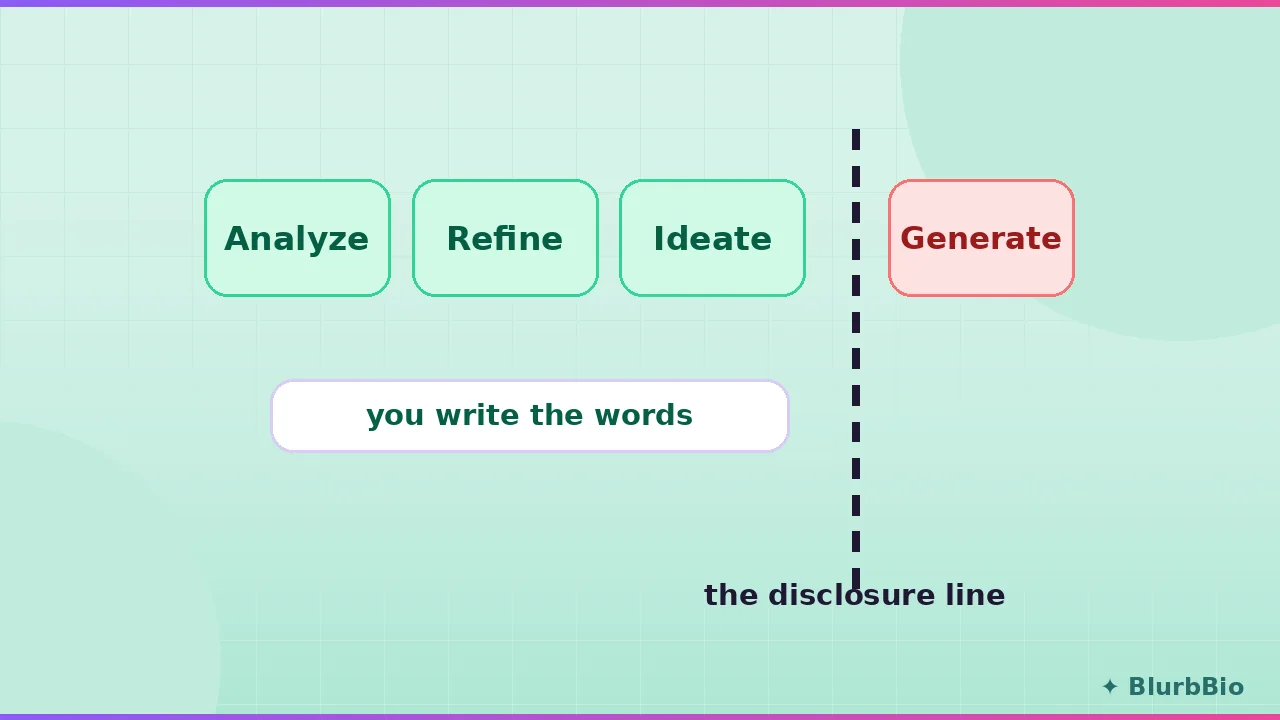
Policies differ at the edges, but the workable map of AI use in fiction sorts into four zones by one variable: where the words come from.
| Zone | What happens | Who created the text | Standard classification |
|---|---|---|---|
| Analysis | Continuity checks, plot hole detection, pacing and POV analysis, repetition finding | You; the AI reads, never writes | Assisted |
| Refinement | Grammar, spelling, style suggestions on your prose; you accept or reject line edits | You; the AI proposes changes to your text | Assisted |
| Ideation | Brainstorming, research, outlining discussion, what-if exploration in conversation | You; ideas are not authorship of text | Assisted |
| Generation | The tool drafts prose, scenes, or translations that enter the manuscript | The AI; your role is prompting and editing | Generated |
Two boundary notes that resolve most real confusion. First, editing generated text does not move it back across the line: under Amazon KDP's definitions, text the AI created remains AI-generated even after substantial human revision; the creation event is what is classified. Second, volume matters inside refinement: accepting a suggested comma is assistance; accepting wholesale AI rewrites of passage after passage drifts toward generation, and honest authors treat heavy rewrite acceptance as the gray zone it is.
How each gatekeeper draws it
Amazon KDP wrote the framework the rest of the industry now orbits: the publishing flow asks whether your book contains AI-generated text, images, or translations, generated content must be disclosed, assisted content need not be, and the disclosure is internal rather than a badge on the product page. Disclosed generated books remain eligible for normal royalties and Kindle Unlimited; the punishable offense is non-disclosure, with removal and account action on the table. The Authors Guild, which pushed for the policy, endorsed it as a first step toward transparency and accountability. Our KDP AI disclosure guide walks the form itself question by question.
Other platforms and organizations draw recognizably similar lines with different accents: writing organizations and awards increasingly require human-authorship attestations; some contests bar generated text entirely; wide retailers and aggregators have largely followed the disclosure model. The trend line across all of them is the same convergence, tools fine, undisclosed generation not.
Copyright law draws the starkest version. Under current US Copyright Office guidance, purely AI-generated text is not protectable; protection attaches to human-authored contributions, selections, and arrangements. For a career built on owning and licensing stories, a manuscript whose prose is substantially generated carries structurally thinner rights, a business exposure that exists regardless of what any platform permits.
Readers are the gatekeeper without a form, and 2026's trust economy has made their line commercially loud: sentiment runs hard against undisclosed generated prose, is broadly comfortable with assistive tooling, and rewards authors who describe their process plainly. Human authorship has become a positioning asset, trust and authenticity sit at the center of current author-brand thinking, and the authors handling this best treat their workflow as something to state once, clearly, and never dance around.
What 2026 changed: the enforcement wave
The disclosure regime began as an honor system. It is not one anymore. Across 2025 and 2026, Amazon layered on identity verification for publishers, tightened limits on new-title volume, and ramped enforcement that pairs automated pattern detection with human review to catch undisclosed generated content, a response to the flood of low-effort generated titles pressuring catalog quality and, for exclusive authors, diluting the shared Kindle Unlimited payout pool that our KU versus wide guide covers as a strategic factor.
Two practical consequences follow for honest authors. First, the cost calculus of fudging is gone: disclosure of generated content costs nothing visible, while detection of undisclosed generation risks the catalog and the account. Second, false positives are now a real hazard: automated detection sweeps have caught legitimate human authors, and the practical defense is provenance, contemporaneous drafts and version history showing a manuscript accumulating through human writing sessions. Process documentation has quietly become part of professional hygiene.
The strongest provenance evidence you can own is boring: dated drafts. Write in a system that keeps version history, export snapshots at milestones, and keep your planning notes. If a detection sweep ever flags you, a visible trail of the book growing sentence by sentence across months is worth more than any argument.
Building a workflow you can disclose without flinching
The durable strategy is not avoiding AI; it is choosing your side of the line on purpose and being able to say so in one sentence. A defensible assisted workflow in 2026 looks like this: you draft every sentence; AI tools analyze the manuscript (continuity, plot holes, pacing, POV, repetition, the mechanical checking that machines do tirelessly and humans do badly at 100,000 words); editing tools propose line-level refinements you individually accept or reject; brainstorming happens in conversation, with the resulting ideas written up by you; and formatting, metadata, and marketing tooling do their jobs outside the manuscript's prose entirely. Every item on that list is assisted-side under every major policy, your KDP answer stays simple, your copyright position stays whole, and your reader-facing sentence is easy: the AI checks my work; I write my books.
If you do choose generation, for translations, for experimental projects, for any reason, the professional version is the same posture with a different answer: disclose accurately, understand the rights limits, and signal honestly to readers. What no longer exists in 2026 is the middle path of quiet ambiguity; the platforms, the detection systems, and the readers have all closed it.
The line, in the end, is the oldest one in the craft wearing new terminology. Tools have always been welcome, the typewriter, the spellchecker, the editor's pencil, and authorship has always meant the words are yours. Pick your side deliberately, document it boringly, and get back to the part no tool can do.
Assisted or generated?
Four real workflows. Classify each under the KDP framework, then get your score.
BlurbBio is built entirely on the assisted side of this line: its AI analyzes, checks, and brainstorms, and never writes prose, so every sentence in your manuscript stays yours.
See also: Amazon KDP AI Disclosure Guide · Kindle Unlimited vs Going Wide · Best Writing Software for Novelists · How to Write a Novel: The Complete Guide